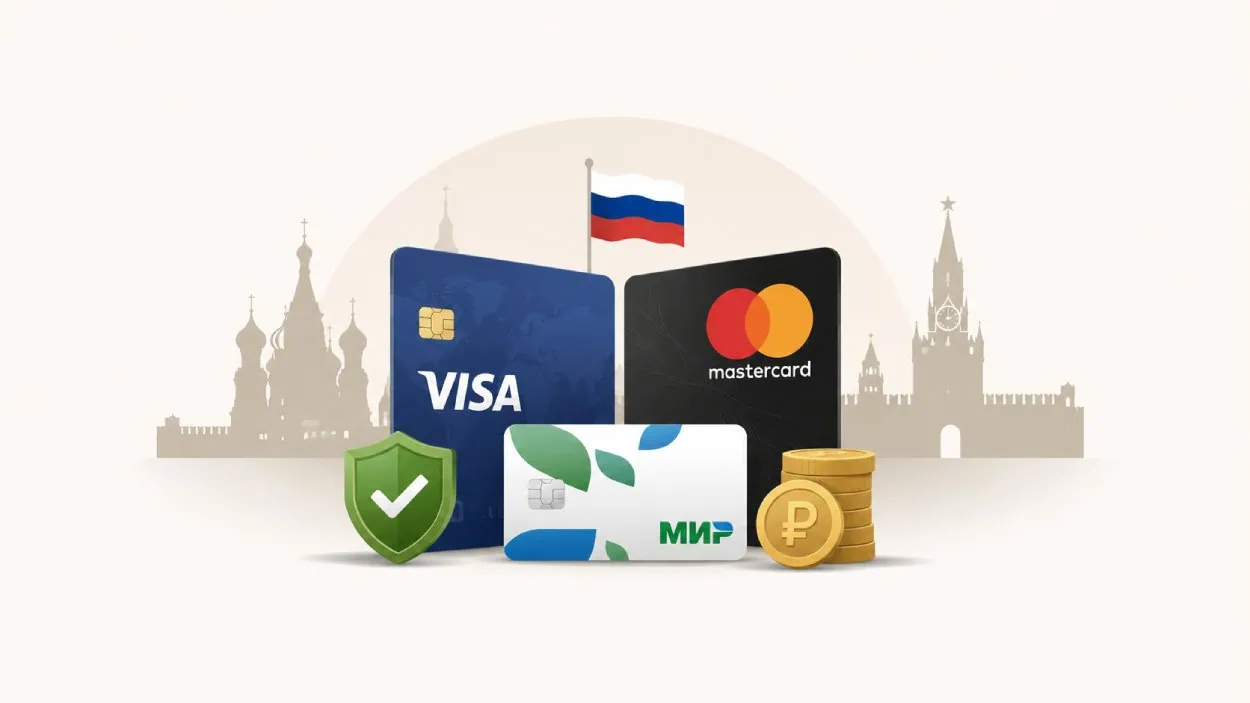






Russia is moving closer to removing Visa and Mastercard from its financial system as officials push for a complete transition toward domestic payment alternatives.
Key Takeaways
- Russia’s central bank wants Visa and Mastercard to fully leave the domestic market.
- The market share of both payment giants has fallen below 17% in Russia.
- Mir cards and the National Payment Card System now dominate local transactions.
- Officials say the transition will happen gradually without disrupting payments.
What Happened?
Russian officials have signaled a stronger push to phase out Visa and Mastercard from the country’s payment ecosystem. The comments came from Alla Bakina, head of the National Payment System Department at the Bank of Russia, during a recent press conference.
Bakina said the two payment companies no longer provide the functionality they once offered, while Russia’s National Payment Card System continues to carry the costs of supporting their operations inside the country.
Russia’s central bank wants @Visa and @Mastercard out of the domestic market completely.
— CoinLaw (@coinlaw_io) May 26, 2026
Officials say Mir cards and local payment systems are now strong enough to replace Western networks, with cashless payments reaching 88% nationwide. pic.twitter.com/o9njT8C8Ag
Russia Pushes for Domestic Payment Independence
Visa and Mastercard suspended operations in Russia in 2022 following Moscow’s full scale invasion of Ukraine. Despite their withdrawal, cards issued by Russian banks under both networks continued to function domestically because transactions were processed through Russia’s National Payment Card System, also known as NSPK.
However, the situation changed significantly for international transactions. Russian issued Visa and Mastercard cards can no longer be used abroad, while foreign issued cards also stopped functioning inside Russia.
According to Bakina, the share of Visa and Mastercard cards in Russia’s payments market has now dropped below 17%. She noted that Russian banks have gradually replaced these payment methods with domestic alternatives, particularly Mir cards.
Bakina said:
The Mir payment system has rapidly expanded since Western sanctions hit Russia’s financial sector. Reports indicate that more than 476.5 million Mir cards had been issued by January 2026, showing the country’s aggressive shift toward local financial infrastructure.
Economic Measures and State Oversight
Russian authorities are also introducing what Bakina described as “economic incentives” to encourage the exit of Visa and Mastercard. These measures reportedly include new tariffs connected to VAT and other financial adjustments aimed at reducing dependence on Western payment systems.
At the same time, the government is increasing oversight of financial transactions. Starting in September, Rosfinmonitoring is expected to gain access to transaction data from the Faster Payments System and the Mir network.
Russian officials and local experts argue that domestic systems provide stronger protection against fraud and offer greater resilience during periods of geopolitical tension.
Meri Valishvili of the Plekhanov Russian University of Economics stated that Western payment methods no longer provide the same level of security and reliability for Russian consumers. She encouraged users to switch to local payment alternatives instead.

Broader Strategy Against Western Influence
The move against Visa and Mastercard appears to be part of a wider strategy by Moscow to reduce Western technological influence across the country’s economy and communications infrastructure.
Since 2022, Russian authorities have increasingly promoted domestic alternatives in banking, internet services, and telecommunications. Officials believe these changes are necessary to strengthen national control and reduce exposure to foreign sanctions.
A recent example was Russia’s ban on the import of foreign satellite communication equipment, including Starlink devices, introduced on April 30. Under the new rules, state permission is now required for communication frequencies coming from space.
Despite the strong rhetoric from officials, analysts do not expect sudden disruption for Russian consumers. Ilya Grashchenkov, head of the Center for Regional Policy Development, said the transition would likely happen smoothly.
Grashchenkov explained:
Russia’s central bank also highlighted that cashless payments now account for around 88% of transactions in the country, reflecting what officials described as the resilience and adaptability of the domestic payment market.
CoinLaw’s Takeaway
I think Russia’s decision shows how quickly global financial systems can split during geopolitical conflicts. In my experience, payment infrastructure is one of the hardest sectors to replace because consumers depend on stability and trust. What stands out here is how aggressively Russia has built its own alternatives while reducing reliance on Western companies.
I also found it notable that the transition appears more organized than many expected in 2022. The rise of Mir cards suggests Russia is determined to create a self sufficient financial ecosystem, even if it means sacrificing international compatibility for tighter domestic control.