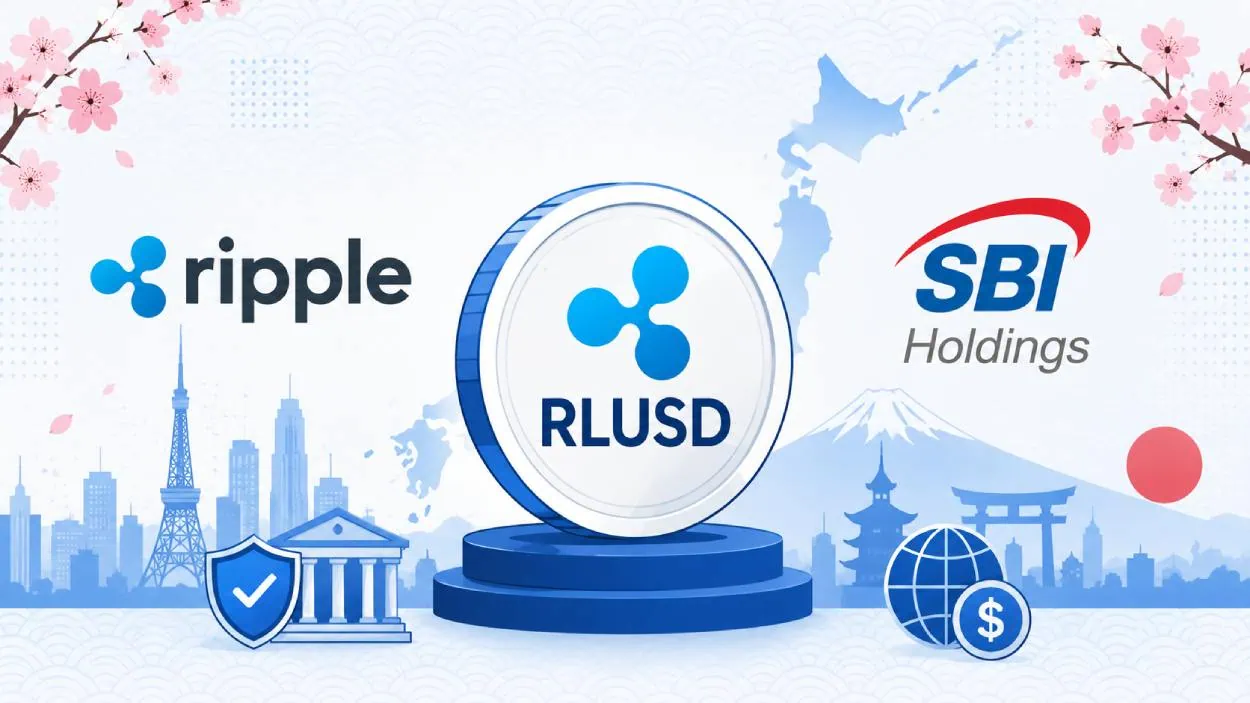






Ripple has officially launched its RLUSD stablecoin in Japan after securing approval from the country’s Financial Services Agency, marking a major step in the company’s expansion into one of Asia’s most tightly regulated digital asset markets.
Key Takeaways
- Ripple’s RLUSD stablecoin is now available in Japan after receiving approval from the Financial Services Agency.
- SBI VC Trade will distribute RLUSD to both institutional and retail customers through its VCTRADE platform.
- Japan’s updated Payment Services Act allows qualified foreign stablecoins to operate as regulated electronic payment instruments.
- Ripple aims to expand the use of RLUSD for payments, tokenization, and collateral management, although it still trails market leaders USDT and USDC by a wide margin.
What Happened?
Ripple has expanded the reach of its dollar backed stablecoin, RLUSD, by launching it in Japan after obtaining approval from the country’s Financial Services Agency. The approval allows RLUSD to operate as a regulated electronic payment instrument under Japan’s revised Payment Services Act, giving the token access to one of the world’s most closely regulated digital asset markets.
The stablecoin is being distributed through SBI VC Trade, the cryptocurrency arm of SBI Holdings, making RLUSD available to both institutional and retail users across Japan.
We’re proud to announce that Ripple USD ($RLUSD) is now officially available in Japan, following approval from the Japan Financial Services Agency (JFSA): https://t.co/5rJZBrFaIM
— Ripple (@Ripple) June 25, 2026
Through our partnership with SBI Group and @sbivc_official, $RLUSD will be accessible to both…
Japan Opens the Door for RLUSD
Japan recently introduced an updated regulatory framework for foreign-issued stablecoins. The revised rules, which took effect on June 1, 2026, recognize eligible foreign stablecoins as electronic payment instruments, allowing them to be used legally within the country once they meet strict reserve and compliance requirements.
RLUSD has been approved under this framework, becoming one of the first foreign dollar backed stablecoins to receive permission to operate in Japan’s regulated market.
The public launch follows months of regulatory preparation. Ripple and SBI signed a memorandum of understanding on August 22, 2025, while the initial distribution of RLUSD through SBI VC Trade began on March 31, 2026, ahead of the official announcement.
Ripple Builds on a Long Standing Partnership
The launch further strengthens Ripple’s relationship with SBI Holdings, one of its longest standing partners in Asia. The two companies have worked together since 2016 on cross border payments and blockchain infrastructure.
SBI VC Trade already had experience handling regulated dollar denominated stablecoins after becoming a distributor of USDC, providing the infrastructure needed to support RLUSD’s rollout.
Ripple also continues to expand its presence in Japan beyond stablecoins. Earlier this year, XRP secured a spot listing on Rakuten Wallet, further increasing the company’s visibility in the country’s digital asset ecosystem.

Ripple Sees RLUSD as an Enterprise Stablecoin
Ripple positions RLUSD as more than a payment token. The company says the stablecoin is designed to support enterprise use cases including settlements, tokenization, and collateral management.
Ripple Senior Vice President of Stablecoins, Jack McDonald, said:
McDonald also said RLUSD will serve as a bridge for payments, tokenization, and collateral management, helping connect Japanese businesses with global dollar liquidity.
RLUSD is issued through a trust company regulated by the New York State Department of Financial Services. Each token is backed on a one to one basis by reserves that include cash and United States Treasuries, providing an additional layer of regulatory oversight.
Competition Remains Intense
While the Japan approval represents a significant milestone, RLUSD still has considerable ground to cover before challenging the industry’s largest stablecoins.
Ripple said RLUSD has reached a market value of approximately $1.7 billion since its launch in late 2024. DeFiLlama data also shows the token previously reached an all time high market capitalization of $1.8 billion before easing to around $1.59 billion. Even so, its market value has grown by roughly 271 percent over the past year.
Despite this progress, RLUSD remains much smaller than Tether’s USDT, with roughly $186 billion in market value, and Circle’s USDC, which holds about $74 billion.
Japan’s decision to welcome regulated foreign stablecoins increases competition among dollar backed digital assets. Ripple will now look to convert its regulatory approval into stronger adoption, higher trading activity, and greater liquidity in one of the world’s most important digital asset markets.
CoinLaw’s Takeaway
In my experience, regulatory approval often matters more than rapid expansion when financial institutions evaluate new digital assets. I found Ripple’s Japan launch particularly significant because it shows the company is focusing on markets where compliance comes first. While RLUSD still has a long way to go before it can compete with USDT and USDC, gaining access to Japan’s tightly regulated market could become an important foundation for its long term growth if institutional adoption follows.