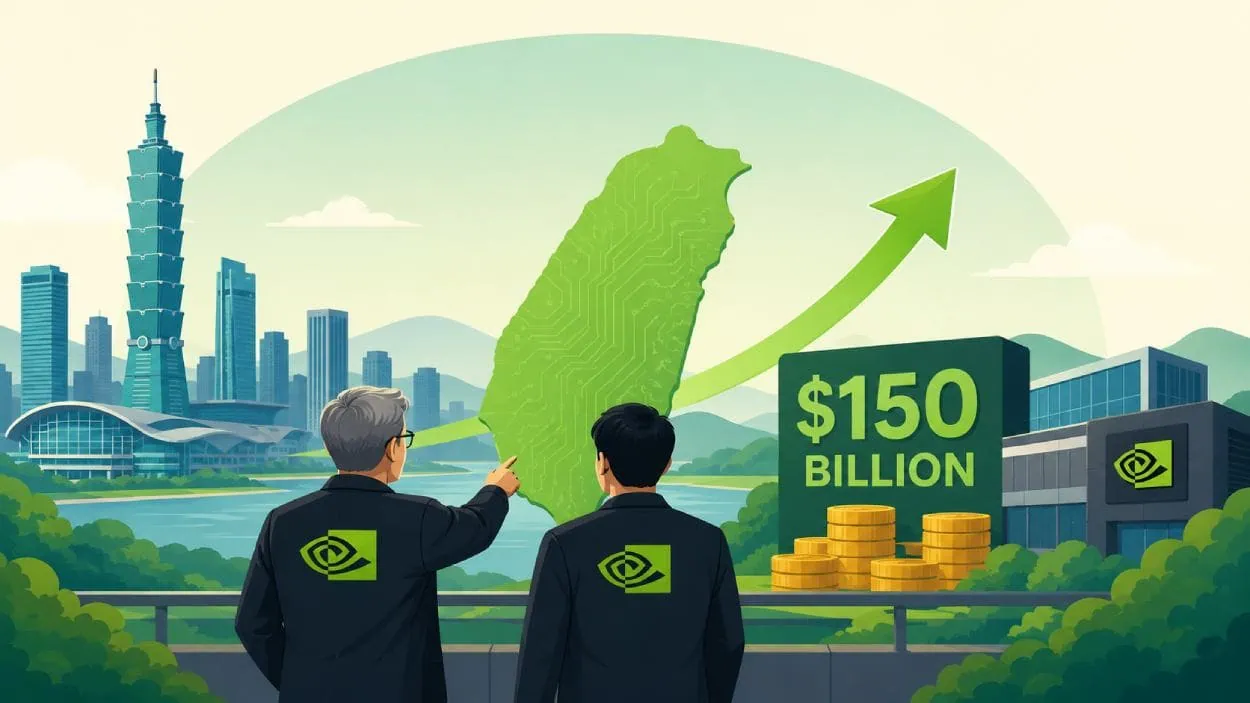






Nvidia plans to increase its annual investment in Taiwan to $150 billion as the company strengthens its position at the center of the global artificial intelligence boom.
Key Takeaways
- Nvidia plans to raise its annual spending in Taiwan from $100 billion to $150 billion.
- CEO Jensen Huang called Taiwan the “epicentre of the AI revolution”.
- Nvidia is building a new Taiwan headquarters expected to employ 4,000 workers.
- Taiwan continues to play a critical role in the global AI supply chain through companies like TSMC and Foxconn.
What Happened?
Nvidia CEO Jensen Huang announced in Taipei that the company plans to significantly increase its investment in Taiwan as global demand for artificial intelligence infrastructure continues to grow. The announcement came ahead of Taiwan’s major technology event, Computex, where AI remains the dominant focus for the semiconductor industry.
Huang said Nvidia’s annual spending in Taiwan has rapidly increased over the last few years and is expected to reach $150 billion annually as the company expands partnerships and operations across the island.
BREAKING: Nvidia spending up to $150bn a year on Taiwan AI suppliers: Jensen Huanghttps://t.co/ScBkzhuNHA pic.twitter.com/VGa2Gizvka
— Nikkei Asia (@NikkeiAsia) May 27, 2026
Nvidia Expands Its Presence in Taiwan
Speaking during a launch celebration for Nvidia’s planned Taiwan headquarters, Huang highlighted the importance of Taiwan in the company’s long term AI strategy. The new headquarters is expected to break ground this year and become operational by 2030.
Huang said during the event:
The planned facility is expected to house around 4,000 employees, bringing Nvidia closer to several of its key manufacturing and supply chain partners.
Huang also said, “Taiwan is booming,” while describing the island as the center of the global AI ecosystem.
Taiwan Remains Critical to the AI Supply Chain
Taiwan has become one of the most important regions in the world for artificial intelligence hardware production. The island is home to TSMC, the world’s largest contract chipmaker, which manufactures Nvidia’s advanced AI semiconductors.
Other major Taiwanese companies including Foxconn, Wistron, and Quanta Computer also play key roles in assembling AI servers and infrastructure used by global technology firms.
Huang said:
The comments reflect how heavily global AI development now depends on Taiwan’s semiconductor industry. Governments and technology companies worldwide continue pouring billions of dollars into AI infrastructure, creating soaring demand for chips and data center equipment.

Nvidia Continues Record Breaking Growth
The announcement follows another major quarter for Nvidia. The company recently reported quarterly revenue of $81.6 billion, beating Wall Street expectations as AI demand continued accelerating across industries.
Revenue increased 85 percent year over year, while net profit surged to $58.3 billion, more than triple the figure from the previous year.
Nvidia has emerged as one of the biggest beneficiaries of the worldwide AI race, with its chips powering everything from generative AI models to cloud computing platforms and AI supercomputers.
The company also became the first publicly traded company to reach a $5 trillion market valuation, cementing its dominance in the AI sector.
Taiwan’s Economy Benefits From AI Boom
Taiwan’s export driven economy has experienced strong growth due to increasing shipments of AI related hardware. Demand for semiconductors, advanced packaging, and AI servers has significantly boosted the country’s technology sector over the past year.
Advanced Micro Devices recently announced plans to invest more than $10 billion in Taiwan’s AI sector as competition among chipmakers intensifies.
Huang predicted Taiwan would remain a global manufacturing hub for technology and electronics for many years. He said:
CoinLaw’s Takeaway
In my experience, Nvidia’s growing investment in Taiwan shows just how important semiconductor manufacturing has become in the AI race. While many countries are trying to build domestic chip industries, Taiwan still holds a unique position that is difficult to replace quickly.
I found Huang’s comments especially important because they confirm that the future of AI infrastructure still heavily depends on Taiwan’s ecosystem and engineering expertise. This move also sends a strong signal that Nvidia expects AI demand to remain massive for years ahead.