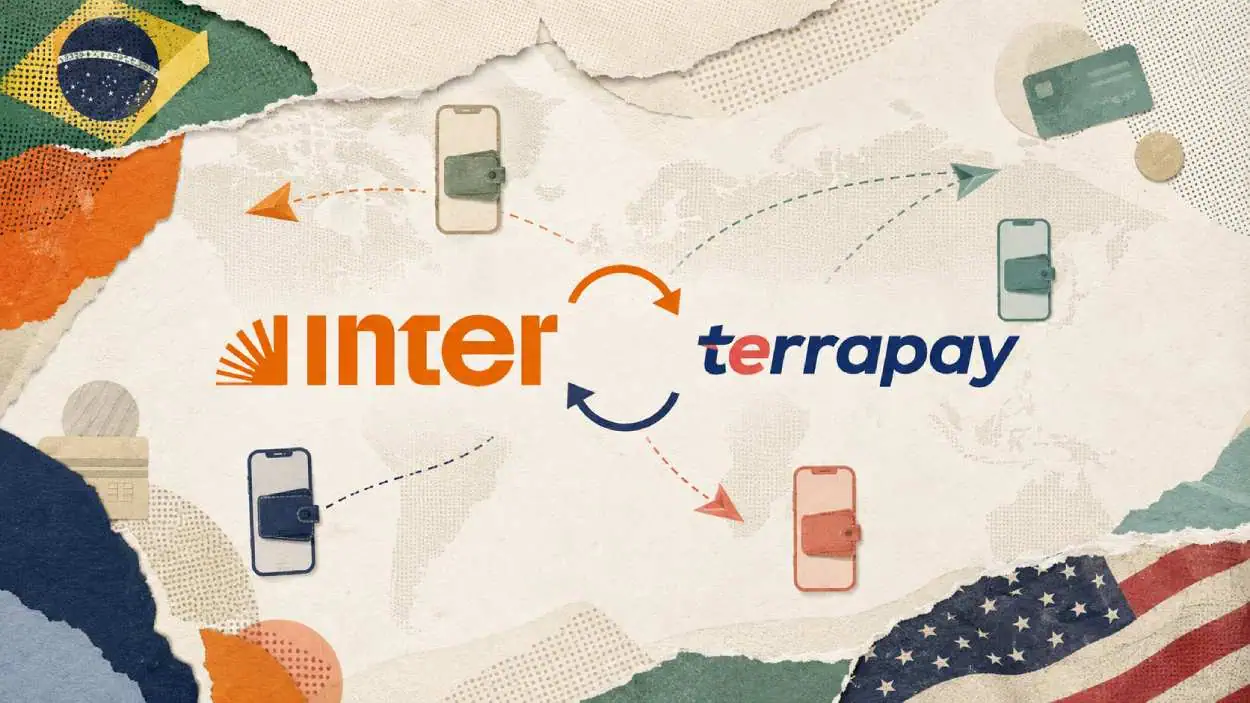






Inter (Nasdaq: INTR) said on August 18, 2026 that its cross-border payment infrastructure now reaches 3.7 billion digital wallets through TerraPay’s Xend network. Inter settles those transfers itself, in Brazilian real and US dollars.
The Big Picture
- Inter connected its Brazilian and US payment rails to Xend, TerraPay’s wallet interoperability network, reaching 3.7 billion wallets.
- Inter acts as the licensed settling institution for the transactions, clearing in both BRL and USD.
- TerraPay’s network covers 3.7 billion mobile wallets and 7.5 billion bank accounts across more than 156 countries.
- Digital wallet transaction value is projected to reach $23.4 trillion by 2031, up from $9.85 trillion this year.
- Most transactions on the combined setup complete in under one minute, the two companies said.
Inter routes bank payments straight into wallets
Inter, which serves more than 45 million customers, announced the integration from Miami and tied its regulated operations in Brazil and the United States directly to Xend, the interoperability network TerraPay recently launched for last-mile localized payouts, cross-border wallet payments and merchant payments. The connection runs over rails Inter already operates, so no new connectivity layer sits between the bank and the wallet endpoint.
Inter contributes PIX (Brazil’s instant payment system), InterPAY, Same Day ACH and Real-Time Payments. TerraPay contributes the wallet reach. Both companies put most transaction times under one minute.
Ralph Boragina, Head of Cross-Border Payments at Inter, in the announcement said:
The settling license is the load-bearing part
Inter is the licensed settling institution for these transactions in both BRL and USD, which is the detail that separates this from a distribution deal. A bank that settles in the sending and receiving currency keeps the payment inside one regulated environment instead of handing it to a correspondent chain, and that is what compresses the timeline to a minute rather than a day or two.
Inter’s regulatory footprint supports the claim. The company is one of Brazil’s largest PIX payers, a leading FX operator by contracts registered with Brazil’s Central Bank, and the holder of a federally authorized banking branch in the US. Ralph Koker, TerraPay’s Senior Vice President and Head of Europe and Americas, described interoperability between banks and digital wallets as the defining feature of the next phase of cross-border payments.
The evidence here shows capability, not volume. Neither company disclosed how much money is moving through the integration, or how much it expects to.
The wallet economy Inter bought reach into
The total value of digital wallet transactions is projected to grow from $9.85 trillion in 2026 to $23.4 trillion by 2031, close to a 140% increase over five years. That growth is concentrated in markets where a wallet balance, and not a checking account, is the primary store of consumer money, which is exactly where correspondent banking performs worst.
For banks, the awkward part is that the wallet has been eating the account relationship for a decade, and the comparison between digital wallets and bank accounts has moved steadily in the wallet’s direction. Inter’s answer is to treat the wallet as a payout destination rather than a competitor, a posture that fits its history as Brazil’s first digital bank and matches how the wider neobank industry has expanded into payment infrastructure.

What the announcement leaves unanswered?
The release describes reach and settlement, and stops short of the operating detail an enterprise payout team would need. Open items include:
- Which corridors and wallet operators are live now, and which are staged for later?
- What Inter charges for a bank-to-wallet transfer, and how the FX spread is set?
- Whether the sub-minute timing holds across every one of the 156-plus countries in TerraPay’s network?
- What happens to a payout that fails at the wallet end, and who holds the funds while it resolves?
Enterprises already routing disbursements through Inter can ask their account team which corridors are enabled today and confirm how BRL and USD settlement is applied before rerouting live volume. Nothing in the announcement changes existing PIX or ACH flows on its own.
The Bottom Line
The integration solves a specific problem: a regulated bank with real settlement licenses in Brazil and the US had no direct way to pay a wallet user in Nairobi or Manila without renting someone else’s connectivity. Xend removes that step, and Inter’s dual-currency settlement keeps the transaction inside a single supervised perimeter. The beneficiaries are platforms and enterprises running high-volume payouts, where the cost of a two-day settlement is measured in working capital rather than customer annoyance.
Read against the projected growth in wallet transaction value, the timing is defensive as much as opportunistic. Banks that cannot terminate a payment at a wallet get pushed toward the correspondent leg of the trade, which is the lowest-margin position in cross-border payments. Inter is arguing that a bank can hold the licensed settlement layer and the last-mile reach at once, and the next few quarters of disclosed volume will show whether enterprise clients agree.