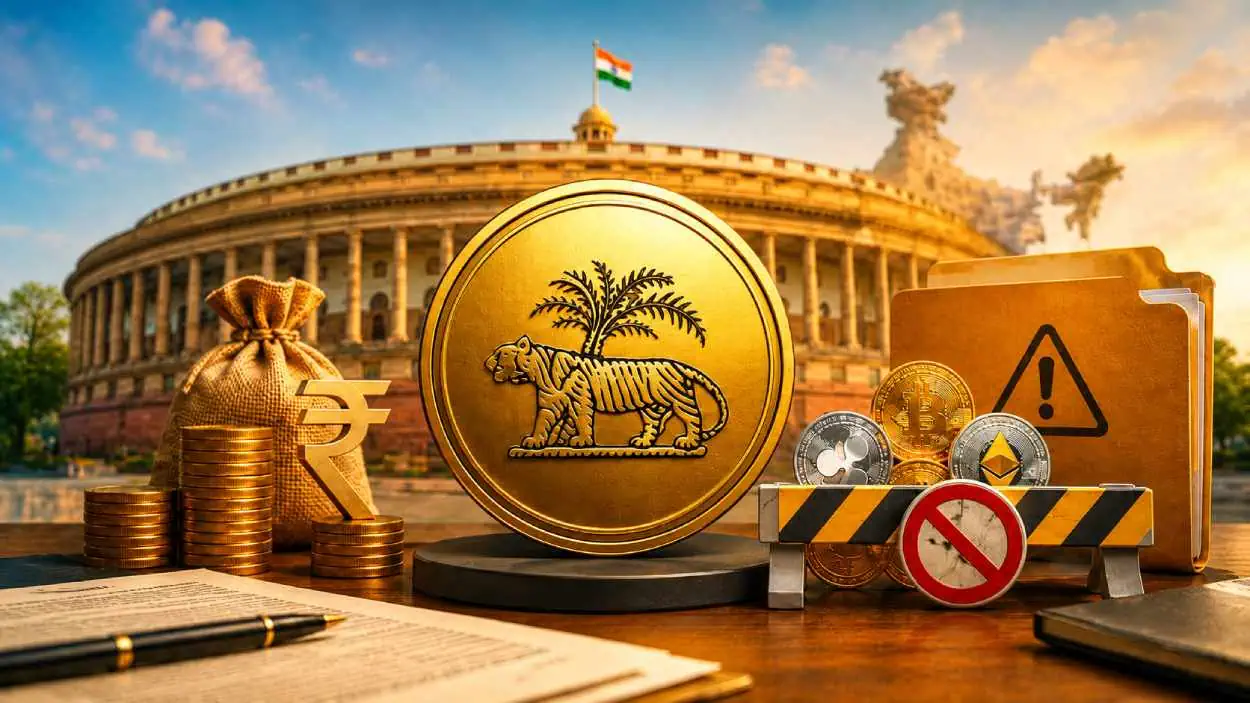






On July 8, 2026, the Reserve Bank of India (RBI) backed banning private cryptocurrencies in its latest submission to the Union government, according to Reuters. India’s Central Board of Direct Taxes (CBDT) separately warned that Virtual Digital Assets create structural tax evasion risks.
Key Takeaways
- The Reserve Bank of India (RBI) submitted views to the Union government backing a ban on private crypto assets, per Reuters-reviewed documents.
- The Central Board of Direct Taxes (CBDT) flagged that peer-to-peer transfers and decentralized platforms create structural tax evasion risks that are difficult to trace under voluntary compliance.
- Indian investors hold an estimated $4.5 billion in cryptocurrencies, an exposure the RBI itself calls still limited and not yet a systemic risk.
- India’s crypto base sits at nearly 39 million traders holding approximately $2.1 billion in digital assets, a market Chainalysis ranks first worldwide by user base.
- The Union government has not disclosed a position on which direction it will take, with a parliamentary report due during the Monsoon Session.
What Happened?
The Reserve Bank of India’s newest internal submission to the Union government, per documents Reuters reviewed, argues that regulating crypto risks would be difficult and that formal regulation could grant the sector legitimacy, allowing it to grow systemic. The Central Board of Direct Taxes, India’s apex direct-tax authority, made a separate filing the same week.
It warned that VDA transactions routed through peer-to-peer transfers, decentralized platforms and offshore trading rely on voluntary compliance the tax administration struggles to verify. Two arms of the state landed the same week on the same conclusion, from different directions.
Deputy Governor Rohit Jain and Executive Director P. Vasudevan pitched a containment strategy leaning toward prohibition before the Standing Committee on Finance on July 2, 2026. They argued for blocking banks and regulated institutions from holding, trading or gaining exposure to crypto assets and private stablecoins.
Committee Chairman Bhartruhari Mahtab told ANI afterward that the RBI had not recommended granting crypto legal status, a flat “No” when asked directly. The same committee has spent months hearing from the exchanges most exposed to whichever way New Delhi rules.
🇮🇳BREAKING: INDIA’S CENTRAL BANK IS BACKING A CRYPTO BAN
— Coin Bureau (@coinbureau) July 8, 2026
The RBI wants India’s crypto policy to “lean toward prohibition”, warning of risks to financial stability and monetary sovereignty.
Reuters says it also wants banks blocked from holding, trading or gaining exposure to… pic.twitter.com/RuIv6uiXvc
The CBDT’s Evasion Case, By the Numbers
The tax department’s warning is not a fresh alarm. It is backed by enforcement figures already tabled before the same parliamentary panel.
During a January 7, 2026 sitting, the CBDT disclosed approximately Rs 888.82 crore in undisclosed income linked to VDA transactions, with notices sent to more than 44,000 taxpayers.
Reporting rules tightened well ahead of this submission. A CBDT notification reclassified crypto assets, CBDCs and electronic-money products as financial assets under India’s FATCA/CRS cross-border data-sharing framework, made retroactive to January 1, 2026, and exchanges now face a penalty of Rs 200 per day for non-reporting.
Enforcement gaps persist regardless. Fewer than 25% of the 645,000 people who engaged in crypto activity in fiscal year 2023 reported those holdings in tax filings, sharpening the case the CBDT is now making in writing. Those figures describe a compliance problem the tax authority already polices. None of them amount to a ban, which is the distinction that governs the whole story.
Not a Ban, a Position
Nothing announced this week changes what is legal today. The submissions are recorded views on paper, not a policy decision, and the Union government has not adopted either institution’s position.
The RBI’s containment proposal, even in its own framing, targets banks, regulated financial entities and stablecoin-based payment rails first, and personal ownership and trading are not the immediate target. Nothing in the current tax regime has changed: the 30% flat tax stays, the 1% TDS stays, and the 18% GST on trading fees stays, with crypto trading remaining legal on FIU-IND-registered exchanges.
The Supreme Court’s March 4, 2020 ruling, which struck down the RBI’s April 2018 banking circular, still holds, meaning any fresh executive restriction on banks would face the same constitutional test.

The RBI’s Own Digital Currency Has the Opposite Problem
The same RBI now pushing prohibition on private crypto also runs the Digital Rupee, its own central bank digital currency, a connection Reuters’ documents surface but never draw out. That currency has struggled to find users.
The e-rupee has crossed 150 million transactions in volume since its December 2022 launch, yet daily transaction volumes that briefly hit 1 million in December 2023 have since dropped to around 100,000. Chairman Mahtab has publicly conceded that the RBI’s digital asset is not a flourishing asset compared with other digital assets.
That gap frames the RBI’s real problem. The central bank is trying to steer users toward state-issued digital rails that have so far failed to attract them, while the private alternative it wants contained keeps growing regardless of the tax bill attached to it.
That contrast matters because India remains the largest crypto market in the world by user base and has led the Chainalysis Global Crypto Adoption Index for three consecutive years, with an estimated 119 million users, yet the country still has no comprehensive law governing VDAs. The same instinct to keep money flows identifiable already shapes India’s dominant domestic payment rail. That system is state-linked, and the RBI has never treated it as the containment risk it sees in crypto.
A working group under the Department of Economic Affairs has shelved a formal policy discussion paper at least five times. The RBI’s opposition is the recurring reason cited. The Standing Committee on Finance, chaired by BJP MP Bhartruhari Mahtab, is scheduled to hear from the Department of Economic Affairs on July 15, 2026, in what is expected to be the final round of evidence before it locks in its recommendations.
CoinLaw’s Takeaway
The RBI backing prohibition on paper is a materially different event from India banning crypto, and conflating the two overstates what happened this week. What changed is the written record, not the law.
Two of the government’s own institutions have now put tougher positions in writing ahead of a parliamentary report that is close to landing. That raises pressure on the Ministry of Finance to pick a lane it has avoided for years.
The debate runs while the market keeps growing underneath it. The holdings the RBI itself calls “still limited” sit with a user base no proposed rule touches directly, and that tension is what the coming report has to resolve. The RBI’s insistence on separating tokenization from crypto legitimacy signals where a compromise could eventually sit: blockchain infrastructure kept, private tokens kept out of banks.
None of this changes obligations for existing holders today. The same tax and FIU-IND registration rules already in force stay the operative ones. They stay that way unless Parliament acts on whatever the Standing Committee recommends after its July 15 hearing.