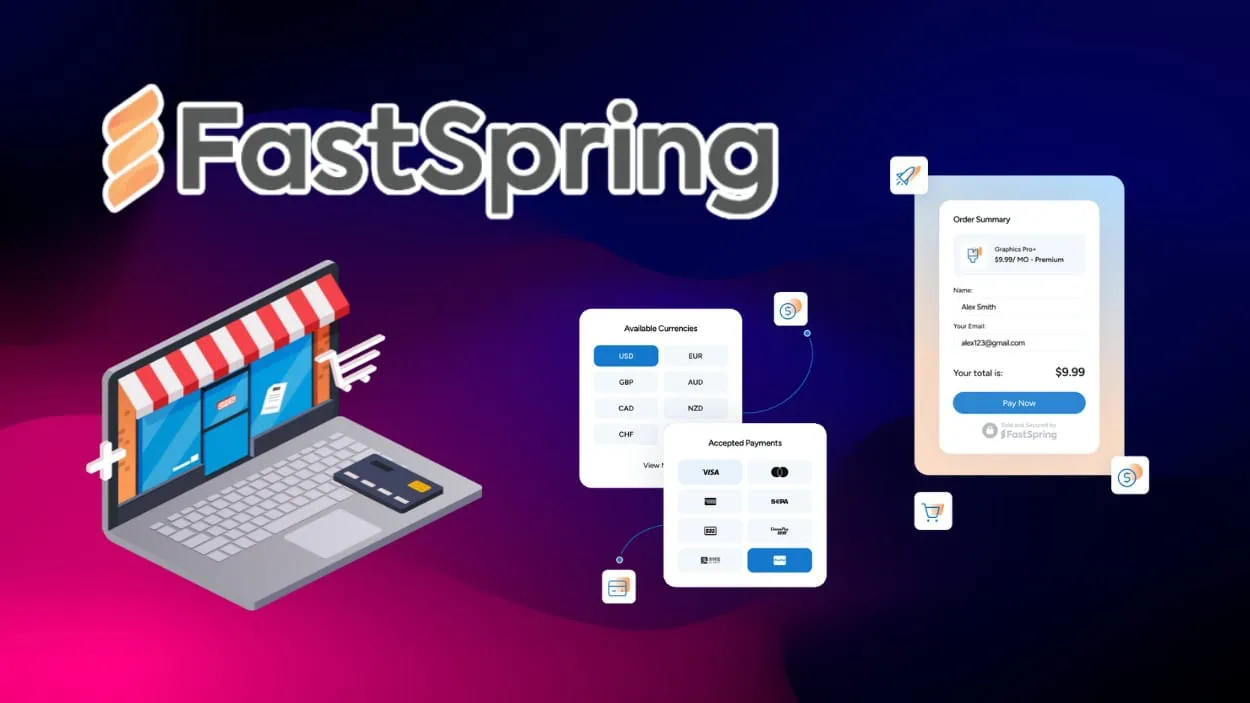






FastSpring, the Santa Barbara-headquartered merchant of record, powers over a billion dollars in annual worldwide transactions per its About FastSpring page across 200+ regions, and processes payments in 240+ countries or territories worldwide. The platform closed recent quarters with a fresh currency (Taiwanese Dollar) and a fresh check from LLR Partners on May 5, 2026.
Key Takeaways
- Per FastSpring, the platform processes over a billion dollars in annual worldwide transactions as merchant of record for digital product companies.
- Per the Merchant of Record product page, the platform is set up to sell in 200+ regions with 20+ currencies and languages and dozens of payment methods.
- FastSpring processes payments in 240+ countries or territories globally.
- FastSpring files and pays more than $54 million in VAT, GST, and sales taxes on behalf of customers every year.
- Customers see a 20% higher checkout completion rate when local payment methods and local currencies are available.
- The platform’s smart-dunning rebill engine recovers as much as 35% of failed subscription rebills.
Editor’s Choice
- Per the About FastSpring page, FastSpring is the leading merchant of record for global digital product companies and powers over a billion dollars in worldwide transactions every year.
- On May 5, 2026, FastSpring secured a strategic investment from LLR Partners, joining existing backer Accel-KKR on the cap table.
- The Global Payments platform supports 35+ of the top global currencies.
- FastSpring was founded on June 28, 2005, with only $30,000 in seed capital.
- LLR Partners has raised over $7.5 billion across more than 130 portfolio companies.
- Accel-KKR manages more than $23 billion in cumulative capital commitments.
FastSpring Global Reach by the Numbers
FastSpring’s reach spans three concentric surfaces: regions where sellers can transact, countries where payments are processed, and currencies displayed at checkout.
- FastSpring is set up to sell in over 200 regions around the world, so sellers using the platform are automatically ready to transact wherever their customers are.
- Payments are processed in over 240 countries or territories around the world.
- The Global Payments platform supports 35+ of the top global currencies for checkout display.
- The platform localizes checkout in over 20 languages.
- FastSpring processes over a billion dollars in annual worldwide transactions across this global footprint.
| Coverage dimension | Value | Definition |
|---|---|---|
| Regions supported for selling | 200 | Regions where sellers can go live on the FastSpring platform |
| Countries or territories for payment processing | 240 | Countries or territories where the underlying payment rails reach |
| Top global currencies supported | 35 | Currencies FastSpring supports at checkout |
| Languages available | 20 | Checkout localization languages |
| Annual worldwide transactions processed | 1,000,000,000 | Aggregate transaction volume flowing through FastSpring |
Source: FastSpring / Merchant of Record product page / Global Payments product page / About FastSpring page
Payment Methods Supported by FastSpring
FastSpring accepts credit and debit cards on every transaction, then layers in bank-transfer methods and digital wallets that vary by country.
- Credit and debit cards are accepted for all transactions.
- Bank transfer methods include iDEAL (Netherlands, EUR), Pix and Pix Automatico (Brazil, BRL), and UPI plus UPI AutoPay (India, INR).
- On-request bank methods include ACH Direct Debit (US), Klarna Pay Now (5 European countries), SEPA Direct Debit (14 EU countries), and Wire Transfers (global, 7 currencies).
- Digital wallet coverage spans Amazon Pay, Apple Pay, Google Pay, PayPal, Mercado Pago (Brazil, Chile, Mexico), Toss Pay (South Korea), Kakao Pay (South Korea), and WeChat Pay (China).
- Southeast Asian methods on the “coming soon” roadmap include OVO (Indonesia), PromptPay (Thailand), QRIS (Indonesia), and VietQR (Vietnam).
- FastSpring markets a 20% reduction in cart abandonment when local payment methods are offered alongside cards.
| Payment method category | Named methods | Regional focus |
|---|---|---|
| Cards | Credit and debit cards | Global |
| Bank transfer, all sellers | iDEAL, Pix, Pix Automatico, UPI, UPI AutoPay | Netherlands, Brazil, India |
| Bank transfer, on request | ACH Direct Debit, Klarna Pay Now, SEPA Direct Debit, Wire Transfers | US, EU, Global |
| Digital wallets | Amazon Pay, Apple Pay, Google Pay, PayPal, Mercado Pago, Toss Pay, Kakao Pay, WeChat Pay | Global + Asia + LatAm |
| Coming soon | OVO, PromptPay, QRIS, VietQR | Southeast Asia |
Source: FastSpring Developer Documentation / Payment Methods Accepted by FastSpring
The MoR model’s value shows in the local-methods column: iDEAL, UPI, and Pix are near-mandatory in the Netherlands, India, and Brazil, respectively, and each addition means a contract, a settlement rail, and a tax jurisdiction FastSpring absorbs.

Recent Developments
- On May 5, 2026, FastSpring announced a strategic investment from LLR Partners, an all-in-one digital commerce platform milestone that adds LLR to existing backer Accel-KKR.
- “FastSpring’s mission is to help technology companies grow without the friction and risk of managing complex global payments, tax, and compliance requirements on their own,” said David Nachman, CEO of FastSpring, in the announcement.
- “We see a unique opportunity to back one of the most experienced and capable teams within the ecommerce enablement category,” said Devon Bembery, Vice President at LLR Partners.
- FastSpring supports UPI and UPI AutoPay for the Indian market, the rail that processes over 75% of India’s digital retail transactions.
- In Brazil, the payment ecosystem relies heavily on local card networks like Elo and Hipercard alongside Pix, per FastSpring’s blog on emerging-market payments.
FastSpring Currency Coverage and Localization
FastSpring’s currency footprint operates in two layers: the display and settlement currencies exposed at checkout, and the country-level default currency and language mappings enforced by the platform’s IP-based geolocation.
- The Global Payments platform supports 35+ of the top global currencies for shopper-facing pricing.
- Checkout localization covers over 20 languages across the 200+ selling regions.
- The stated conversion benefit is direct: shoppers who see their preferred local payment methods and prices in their own local currency are 20% more likely to complete checkout.
- Wire transfer settlement is offered globally in 7 currencies.
| Currency dimension | Value |
|---|---|
| Top global currencies supported at checkout | 35+ |
| Languages available for checkout localization | 20+ |
| Wire transfer settlement currencies | 7 |
| Regions covered by the payments platform | 200+ |
| Cart abandonment reduction with local mix | 20% |
Source: FastSpring / Global Payments product page / Developer Documentation
Currency and language coverage compounds the payment-method effect at checkout.
FastSpring Corporate History and Ownership
FastSpring is now a two-fund-backed private company two decades on.
- FastSpring was founded on June 28, 2005, by a distributed team of four tech founders, including Dan Engel.
- The company launched with only $30,000 in initial capital, a bootstrapped foundation the current leadership still cites when marking the 20th anniversary.
- CEO David Nachman leads FastSpring today; co-founder Dan Engel is now Founder and Managing Partner of Santa Barbara Venture Partners.
- The legal entity is Bright Market, LLC dba FastSpring, headquartered at 801 Garden Street, Santa Barbara, California.
- Per the May 5, 2026 announcement, FastSpring is headquartered in Santa Barbara and is now backed by two financial partners: Accel-KKR (existing backer) and LLR Partners (new strategic investor).
- The combined investor footprint is substantial: LLR Partners has raised over $7.5 billion across 130+ portfolio companies, and Accel-KKR manages over $23 billion in cumulative capital commitments.
Merchant of Record Model and Compliance Scale
The MoR model is the lever behind every other FastSpring statistic: buy from seller, resell to shopper, own the tax, fraud, and support exposure.
- FastSpring files and pays more than $54 million in VAT, GST, and sales taxes on behalf of customers every year, the clearest single measure of the platform’s compliance-workload scale.
- The MoR compliance framework covers PSD2, SCA, GDPR, CCPA, Economic Nexus, and dozens of local regulations.
- Support runs on a 24/7 multi-tier model with tickets prioritized by urgency rather than business size.
- Fraud prevention is described as multi-layer AI-assisted, provided alongside compliance management on customers’ behalf.
- As merchant of record, FastSpring’s enterprise-grade platform offloads the operational complexities of payments, subscriptions, and international tax compliance for AI, SaaS, gaming, software, and digital product companies of all sizes scaling globally.
By the numbers: As merchant of record, FastSpring files and pays more than $54 million in VAT, GST, and sales taxes for its seller base every year, according to the platform’s own Merchant of Record product page. That compliance workload spans PSD2, SCA, GDPR, CCPA, Economic Nexus, and dozens of local regulations, a footprint most digital sellers cannot replicate in-house.
FastSpring Office Footprint
FastSpring’s real-estate footprint mirrors its three heaviest tax regimes.
- FastSpring operates 7 offices worldwide: Santa Barbara (HQ), Austin, Amsterdam, Halifax, Belfast, Singapore, and Dublin.
- The Santa Barbara headquarters is at 801 Garden Street; the Amsterdam office is at Fred. Roeskestraat 115, and the Dublin office is at WeWork Bankside, Charlemont St.
- The Singapore office is at 60 Anson Road #17-135.
- The Halifax office sits at 5475 Spring Garden Road Suite 600, and the Belfast office is at Arthur House, 41 Arthur Street.
| Office | City | Region |
|---|---|---|
| Headquarters | Santa Barbara, California | North America |
| Austin | Austin, Texas | North America |
| Amsterdam | Amsterdam, Netherlands | EMEA |
| Halifax | Halifax, Nova Scotia | North America |
| Belfast | Belfast, Northern Ireland | EMEA |
| Singapore | Singapore | APAC |
| Dublin | Dublin, Ireland | EMEA |
Source: FastSpring / About FastSpring page
Emerging Market Payment Adoption Context
FastSpring’s regional payment-method priorities line up with two of the most-cited emerging-market payment stories.
- India has over 700 million internet users, per a Nielsen study cited by FastSpring, a market where mobile-first, bank-linked rails skipped a generation of card infrastructure.
- Credit card penetration in India remains strikingly low, with fewer than 5% of Indians owning a credit card, per Times of India data cited by FastSpring.
- UPI (Unified Payments Interface) processes over 75% of all digital retail transactions in India, making UPI acceptance a near-mandatory feature for global sellers targeting the Indian market.
- Brazil’s Pix system, launched by the Central Bank of Brazil, now serves 153 million users and has been adopted by 68% of mobile wallet users in the country.
- Beyond Pix, Brazil’s payment ecosystem relies heavily on local card networks like Elo and Hipercard; around 20% of Brazilian customers use local cards like Elo.
Why it matters: In markets where credit cards reach fewer than 5% of the population, PayPal and international card networks alone will not carry a checkout to acceptable conversion. That is the practical case for the merchant-of-record model. FastSpring’s contract with Pix, UPI, or Kakao Pay lets a US SaaS seller reach a Brazilian, Indian, or Korean shopper without local incorporation.
FastSpring Subscription Management and Rebill Recovery
Subscription rebill failure is the quiet drain on SaaS revenue. FastSpring’s subscription platform positions its dunning engine as the recovery lever.
- FastSpring’s smart-dunning rebill engine recovers as much as 35% of failed subscription rebills through feature handling, notifications, and retry logic.
- The platform’s subscription analytics surface MRR, ARR, and churn reporting directly in the FastSpring application or via BI export.
Recovered rebills at this scale can pay for the MoR fee tier by themselves for subscription businesses.
FastSpring Leadership Team
- David Nachman leads FastSpring today as CEO, 20+ years after the company’s founding, with the company backed by Accel-KKR.
- “We are excited to grow FastSpring alongside experienced partners who share our vision,” Nachman said in the announcement, signaling continuity through the ownership expansion.
FastSpring in the Broader Digital Wallet Landscape
- Gartner projects that by 2026, at least 500 million smartphone users will regularly make verifiable claims using a digital identity wallet.
- “The market is entering a transition period as PDI solutions are starting to mature, which in the next five years will reduce the demand for standalone IDV,” said Akif Khan, VP Analyst at Gartner.
- FastSpring’s own digital-wallet stack includes Apple Pay, Google Pay, PayPal, Amazon Pay, Kakao Pay, Toss Pay, WeChat Pay, and Mercado Pago.
Digital wallets are moving from novelty to default in most emerging-market checkouts, and Gartner’s 500-million-user projection is the demand-side signal MoR platforms like FastSpring watch when deciding which wallet contract to sign next.
Is FastSpring a Payment Gateway or Merchant of Record?
FastSpring is explicitly a merchant of record, not a payment gateway. As merchant of record, FastSpring’s enterprise-grade platform offloads the operational complexities of payments, subscriptions, and international tax compliance for its sellers. That distinction is why FastSpring files more than $54 million in annual VAT, GST, and sales taxes on customers’ behalf under the MoR structure.
How Much Does FastSpring Cost?
FastSpring does not publish a self-serve rate card on its website; pricing is negotiated per seller. The company positions itself for AI, gaming, SaaS, software, and digital product companies of “all sizes”. The bundled fee absorbs payment processing, tax filing, fraud losses, chargeback handling, and buyer support, which is the trade sellers evaluate against a raw gateway plus their own compliance stack.
Conclusion
FastSpring’s public numbers sketch a merchant of record that has scaled past bootstrapped origins: over a billion dollars in annual worldwide transactions, 200+ regions of selling coverage, and 240+ countries of payment processing, with more than $54 million in taxes filed annually on customers’ behalf. The May 5, 2026 LLR Partners investment adds a second private-equity backer alongside Accel-KKR as global commerce migrates away from stitched-together gateway plus tax plus fraud stacks.