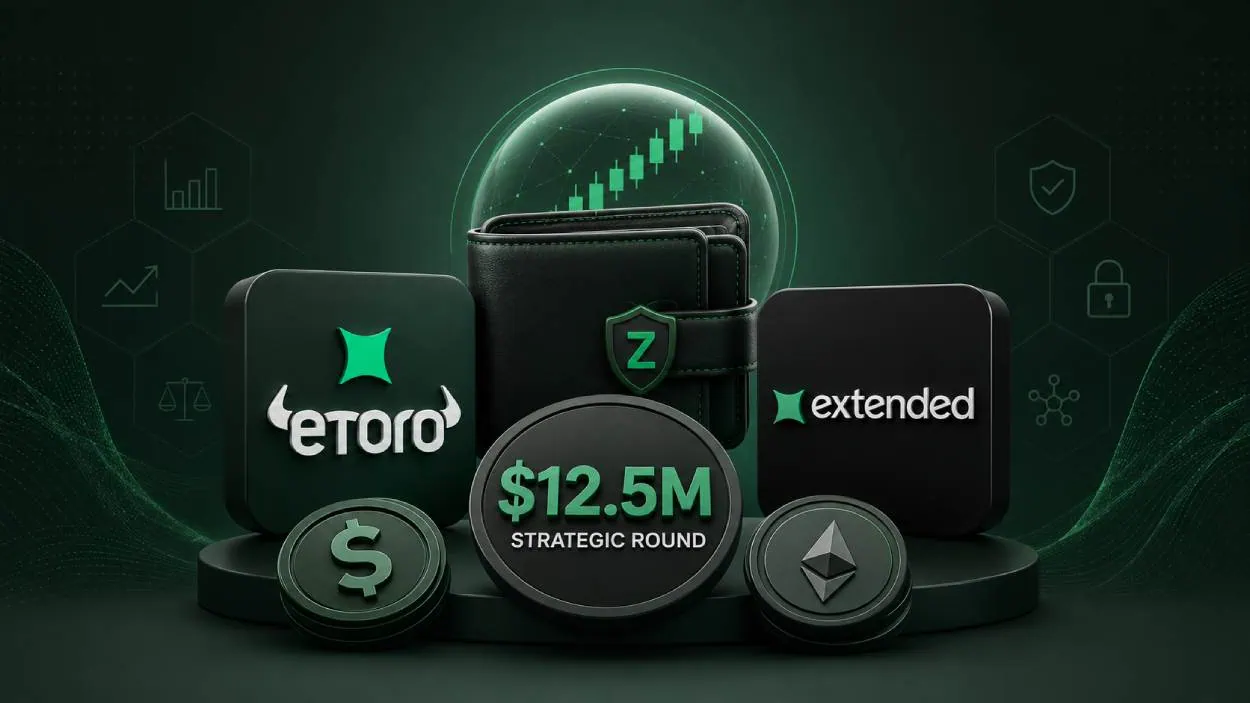






eToro led a $12.5 million strategic funding round in Extended, an onchain perpetual-futures exchange, with Jump Crypto also joining the round. The deal ties into a plan to build Extended’s engine into Zengo, eToro’s self-custody wallet.
Key Takeaways
- eToro led a $12.5 million strategic funding round in Extended, with Jump Crypto also participating.
- The round is tied to a partnership to integrate Extended’s perpetual-futures engine into Zengo, the self-custody wallet eToro acquired earlier in 2026, expanding eToro’s reach into Decentralized Finance Markets.
- Extended runs a unified-margin system spanning crypto and TradFi collateral, with up to 100x leverage and full self-custody, founded by a team of former Revolut employees.
- The platform is secured by StarkWare’s StarkEx, a validity-proof Layer-2 engine that settles trades trustlessly on Ethereum while users keep custody.
- eToro’s net crypto trading contribution fell to approximately $15.4 million in Q1 2026, down from approximately $49.0 million a year earlier, per eToro Group’s own Investor Relations disclosures.
What Happened?
Extended said in its announcement that eToro led a $12.5 million strategic funding round, with Jump Crypto also joining. The raise is tied to a partnership under which eToro plans to integrate Extended’s perpetual-futures engine directly into Zengo, the self-custody wallet eToro acquired earlier in 2026, so users can trade onchain derivatives while retaining custody of their assets.
Extended describes itself on its official site as a platform that “replaces siloed markets with a unified margin system,” letting traders use crypto and TradFi assets as collateral, with up to 100x leverage, full self-custody, and verifiable execution. The exchange was built by an experienced team of former Revolut employees, a pedigree tracking with the broader neobank-founders-in-crypto pattern.
That non-custodial architecture runs on StarkWare’s StarkEx, a validity-proof Layer-2 engine designed to run a decentralized perpetuals exchange that gives users self-custody and settles transactions trustlessly, batching trades off-chain while validating them through a smart contract on Ethereum. That is a structural choice, not a cosmetic partnership.
eToro leads a strategic investment in Extended@eToro is now a strategic investor in Extended. The investment round also marks the beginning of a partnership between Extended and @Zengo, a self-custody wallet recently acquired by eToro. The partnership will focus on expanding… pic.twitter.com/WZRDQq3Sqw
— Extended (@extendedapp) July 2, 2026
Zengo, Custody, and the Compliance Perimeter
Folding Extended’s engine into Zengo puts a regulated, publicly traded brokerage in the position of routing users toward self-custodial onchain leverage products it does not directly hold. MiCA’s crypto-asset service provider rules and US derivatives oversight both turn on who custodies client assets. A broker distributing access to a non-custodial engine, without holding the position itself, sits in a different compliance lane than one running its own custodial derivatives book.
Extended is self-custodial by design, so the open question is where eToro’s own regulatory perimeter ends once it becomes the entry point, not the custodian, for 100x-leverage derivatives trades. eToro is not alone chasing that structure.
Robinhood has pushed its own onchain and tokenized-asset expansion, and both firms are racing to become an “everything exchange” pairing a regulated front end with non-custodial derivatives rails. A single account increasingly spans custodial equities, custodial crypto, and non-custodial onchain derivatives, each governed by a different rulebook.
Extended’s Scale and eToro’s Crypto Slide
Extended has processed more than $245 billion in cumulative volume across more than 100 perpetual markets, as of June 2026. eToro’s own crypto business is moving the other direction: eToro’s net crypto trading contribution, meaning net trading income from cryptoasset derivatives plus crypto revenue less the cost of crypto revenue, was approximately $15.4 million in Q1 2026, down from approximately $49.0 million a year earlier, according to results eToro published on its investor relations site.
Read against that decline, the Extended deal looks less like more custodial crypto trading and more like a pivot toward owning the onchain infrastructure layer. eToro Group EVP of corporate development and strategy Elad Lavi framed the investment as a response to user demand for DeFi access and a step in expanding eToro’s Web3 ecosystem.

CoinLaw’s Takeaway
This $12.5 million funding round reads as eToro trading a shrinking crypto-trading line for a stake in the infrastructure underneath onchain derivatives. Rather than rebuild a custodial perpetuals desk to chase declining trading revenue, eToro is funding a non-custodial engine it can wire into a wallet it already owns.
That captures distribution and equity upside without the custody risk of holding leveraged crypto positions itself, a materially different bet than the one eToro’s Q1 numbers reflect. It lines up with the same “everything exchange” instinct now visible at Robinhood, where regulated brokerages want a seat at the onchain-derivatives table without becoming the counterparty.
The unresolved part is where responsibility sits once Zengo users are a few taps from 100x leverage on a platform eToro does not custody. Extended’s self-custody design pushes legal responsibility toward the user and the protocol, but eToro is still the brand behind the app, the funder of the engine, and the distributor putting the feature in front of customers.