


• Skip to primary navigation
  • Skip to main content
  • Skip to primary sidebar
  • Skip to footer
CoinLaw LogoCoinLaw

Bringing Crypto and Finance Closer to You

  • Latest News
  • Statistics
  • About
  • Contact
Subscribe
CoinLaw Logo
  • Latest News
  • Statistics
  • About
  • Contact
Subscribe
Home » Investments

S&P 500 Statistics 2026: The Data Smart Investors Watch Now

Published on: December 26, 2025
Barry Elad
Written By
Barry Elad
Barry Elad
Founder & Senior Journalist • 560 Articles
Barry Elad is a finance and tech journalist who loves breaking down complex ideas into simple, practical insights. Whether he's exploring fi... See full bio
LATEST POSTS:
How to Understand Crypto Market Cycles 2026: Winning Moves
How to Participate in a Crypto Airdrop Safely 2026: Avoid Scams
Toast Statistics 2026: ARR, GPV & Revenue Data
Kathleen Kinder
Reviewed By
Kathleen Kinder
Kathleen Kinder
Senior Editor • 1,727 Articles
Kathleen Kinder brings over 11 years of experience in the research industry, with deep expertise in finance, cryptocurrency, and insurance. ... See full bio
LATEST POSTS:
Kraken Launches Seamless On Chain Trading for Solana Tokens
The Knowledge Gap in Crypto: Why New Traders Need Education More Than Ever
Kentucky Sues Kalshi and Polymarket Over Illegal Sports Bets
S&P 500 Statistics
As Featured In
Bloomberg LogoForbes LogoFortune LogoCoinDesk LogoCoinMarketCap Logo
Share on LinkedIn ChatGPT Perplexity Share on X Share on Facebook

The S&P 500 remains the benchmark for U.S. large‑cap equity performance, reflecting the broader economy’s health and investor sentiment. This index influences retirement portfolios, institutional asset allocations, and global capital flows. Across industries, fund managers use S&P 500 data to calibrate risk models, while corporate strategists gauge competitive positioning against this broad market barometer. In this article, we unpack the latest 2025 S&P 500 statistics, from performance and methodology to market structure and risk measures.

Editor’s Choice

  • The S&P 500 closed at a record high of 6,932.05 on December 24, 2025, underscoring ongoing market strength.
  • As of late 2025, the index comprised ~503 constituents with free‑float market‑cap weighting.
  • The S&P 500 captures ~80% of U.S. equity market capitalization.
  • The market cap of all constituents recently exceeded $61 trillion.
  • The top 10 firms account for ~38% of the total index weight.
  • Technology dominates with sector allocations above ~30% of the index.
  • Minimum market cap for inclusion rose to $22.7 billion in 2025.

Recent Developments

  • In December 2025, the S&P 500 notched a record close at ~6,909.79, propelled by tech gains.
  • Sectors outside technology have shown broadening participation, easing narrow market breadth concerns.
  • Banking giants added ~$600 billion in market value in 2025, outperforming the broader index.
  • Analysts see 2026 as a year of modest growth (3–5%) after three double‑digit years.
  • Several consumer and cyclical stocks rallied strongly in 2025, diversifying leadership.
  • AI and data center infrastructure trends continue to influence stock upgrades.
  • Equal‑weight S&P 500 ETFs briefly outperformed cap‑weighted indexes early in 2025.

Global Markets Performance

  • Japan led global equity markets in 2025, finishing the year with a +24% year-to-date return, the strongest performance among major economies.
  • UK stocks delivered a solid +20% YTD gain, supported by strong earnings momentum and improving investor sentiment late in the year.
  • European equities ended 2025 up +17%, reflecting steady recovery across major EU markets despite mid-year volatility.
  • China recorded a +16% YTD return, rebounding strongly after mid-year weakness and renewed institutional inflows.
  • The U.S. market posted a +14% YTD increase, recovering sharply after April and maintaining upward momentum into year-end.
  • India closed 2025 with a +9% return, remaining positive throughout the year with comparatively lower volatility than peers.
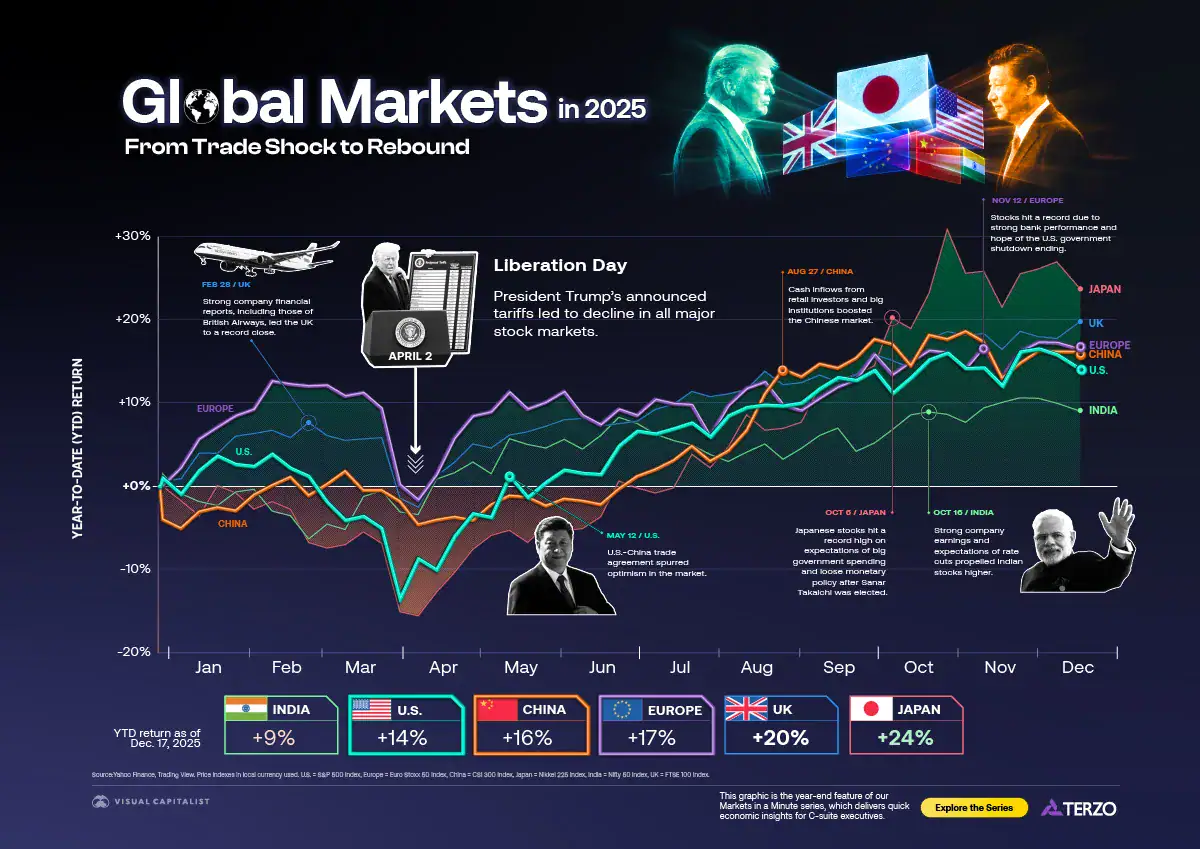
Global Markets Performance
(Reference: Visual Capitalist)

S&P 500 Index Definition and Methodology

  • S&P 500 total market capitalization reached $57.05 trillion in September.​
  • Index hit an all-time high of 6,906 points with $61.6T market cap on December 23.​
  • Year-to-date total return stands at 19.35% including 1.49% dividends.​
  • Comprises 503 stocks from 500 large-cap companies due to dual-class shares.​
  • Minimum market cap requirement increased to $22.7 billion effective July 1.​
  • Top constituent Nvidia holds 7.5% weight in the index.​
  • The top 10 stocks account for nearly 40% of the total index weight.​
  • September rebalance added 3 companies (APP, HOOD, EME) and removed 3.​
  • Quarterly rebalancing typically sees 20-25 changes annually.
Newsletter Img
Don't chase the news. Let us curate it.

You get one weekly briefing with only the stories that matter. If the market is quiet, we skip it.

✅ Join readers from Visa, Vanguard, and the FDIC.

Calendar Year and YTD Performance Highlights

  • The index opened in 2025 at 5,868.55 on January 2.​
  • YTD total return reached 19.35% with 17.86% price return and 1.49% dividends as of December 24.​
  • Closed at 6,932.05 on December 24 after hitting 6,937.32 intraday high.​
  • January delivered a 2.3% return amid early volatility.​
  • Q3 total return contributed 8.1% bringing YTD to 14.8% through September.​
  • August posted a 2.75% gain while November saw a -0.48% dip.​
  • The tech sector led with a 21.8% YTD gain, driving overall performance.​
  • Index hit all-time highs 28 times through Q3.​

S&P 500 End-of-Year Forecasts Overview

  • Forecasts cluster tightly around the mid-6,000 range, with several major institutions targeting 6,500 for the S&P 500.
  • Long Forecast stands out as the most bullish, projecting an aggressive 8,848 year-end level, well above the consensus.
  • Wells Fargo expects the index to reach 7,007, signaling confidence in sustained equity momentum.
  • Deutsche Bank and Ed Yardini both forecast 7,000, reinforcing a strong upside outlook among top strategists.
  • Bank of America projects a moderate 6,666, aligning closely with broader market expectations.
  • CoinPrice Forecast estimates 6,791, positioning it slightly above the central forecast band.
  • Traders Union anticipates 6,571, reflecting a cautious but positive market trajectory.
  • Benzinga expects 6,506, placing it near the lower end of institutional projections.
  • Morgan Stanley, Goldman Sachs, UBS, and JP Morgan converge at 6,500, highlighting a clear consensus anchor for year-end expectations.
S&P 500 End-of-Year Forecasts Overview
(Reference: FXOpen UK)

Volatility, Drawdowns, and Bear Market Statistics

  • VIX averaged around 20 through most of the year before settling at 17.77 on December 24.​
  • VIX spiked above 60 during April’s “Liberation Day” crash from under 17 in eight sessions.​
  • The maximum intra‑year drawdown measured about 19% during the spring 2025 selloff.
  • April 3 saw a 4.84% single-day drop amid $6.6 trillion two-day market value loss.​
  • Early-year maximum drawdown hit 10% below the historical average of 14% intra-year.​
  • No bear market occurred as declines stayed above the -20% threshold.​
  • VIX closed at 14.00 on December 23 with 10.84% 30-day realized volatility.​
  • S&P 500 experienced a 19% intra-year decline during the tariff uncertainty period.​
  • Volatility peaked at 25.76 on November 20 before the year-end decline.

Market Capitalization and Index Weighting Breakdown

  • As of late 2025, the total index market cap exceeded $61 trillion.
  • The top 10 stocks accounted for roughly 38% of the total weight.
  • Nvidia alone held about 7.31% of the index’s weight.
  • Apple and Microsoft followed with ~6.45% and ~5.78% weight, respectively.
  • Amazon contributed ~3.96% of the total weight.
  • Alphabet’s class shares added ~6.06% collectively.
  • Smaller constituents make up the balance of the market cap beyond the mega‑caps.
  • The concentration of top firms shapes index dynamics and risk exposure.

Sector Allocation and Industry Composition

  • Information Technology dominated at ~34.6% of the index weight.
  • Financials were next with over 13% weighting.
  • Communication Services and Consumer Discretionary each hovered near ~10%.
  • Healthcare comprised close to ~9.8%.
  • Energy and Materials represented smaller allocations under ~5% each.
  • Sector diversification evolves with market rotations and economic cycles.
  • Performance across sectors varied significantly year‑to‑date.
S&P 500 Sector Weights

S&P 500 vs Other U.S. Indices (Dow, Nasdaq, Russell)

  • The S&P 500 captures ~80% of U.S. equity market capitalization, making it broader than many benchmarks.
  • At the end of September 2025, the S&P 500 finished up ~3.5%, compared with the Nasdaq up ~5.6% and the Dow up ~1.9% for the same period.
  • Historically, since 2000, the S&P 500 has grown ~131% in real terms, close to the Nasdaq’s inflation‑adjusted increase.
  • The Russell indexes (e.g., Russell 1000) follow slightly different inclusion rules and often show broader midcap exposure versus the S&P 500’s large‑cap tilt.
  • The S&P 500’s float‑adjusted market cap weighting contrasts with the Dow’s price‑weighted methodology, leading to different performance dynamics.
  • Over long cycles, tech‑heavy benchmarks like the Nasdaq often outperform during innovation‑led rallies, while Dow stocks may lag in high‑growth periods.
  • The S&P 500 is more representative of the broader economy than the narrower Dow’s 30 stocks.
  • Equity ETFs tracking each index show variations in sector exposures, contributing to performance differences during market rotations.

Risk and Risk‑Adjusted Return Measures

  • Year‑to‑date total return measured about 19.3% through late December 2025, including price gains and dividends.
  • Sharpe ratio reached 0.92 over a 1-year period and 0.89 long-term.​
  • Sortino ratio stood at 1.26, focusing on downside volatility.​
  • 3-year annualized Sharpe ratio hit 1.45 amid strong performance.​
  • 5-year annualized return delivered 14.95% with 0.9 Sharpe.​
  • Daily VaR forecast measured 2.48% on December 12.​
  • Expected Shortfall reached 3.02% for tail risk estimation.​
  • 25% drop probability calculated at 4.6% short-term.​
  • Annual volatility averaged 19.53% over the past year.

Largest S&P 500 Companies by Weight and Market Cap

  • Nvidia led with ~7.31% weight.
  • Apple held about ~6.45%.
  • Microsoft represented around ~5.78%.
  • Amazon stood at roughly ~3.96%.
  • Alphabet (Classes A & C) combined near ~6.06%.
  • Meta Platforms hovered above ~2.4%.
  • Broadcom, Tesla, Berkshire Hathaway, and JPMorgan Chase rounded out the top ten.
Largest S&P 500 Companies by Index Weight

Valuation Metrics (P/E, P/B, CAPE) Over Time

  • Trailing P/E ratio stands at 31.28 versus the historical mean of 16.19.​
  • Forward P/E multiple measures 23.39 above the 10-year average of 18.7.​
  • Shiller CAPE ratio reached 39.42, exceeding the long-term average of 27.68.​
  • Price-to-book ratio hit 5.62 compared to the historical median of 2.91.​
  • Q2 P/B value recorded 5.008, up 6.84% quarter-over-quarter.​
  • September forward P/E peaked at 28.72 amid earnings expectations.​
  • Market trades 90% overvalued by P/E compared to historical norms.​
  • August trailing P/E measured 28.80 with 4.66% year-over-year growth.

Earnings, Revenue, and Margin Trends

  • 85% of S&P 500 companies beat EPS estimates in Q3, highest in four years.​
  • Q3 blended EPS growth accelerated to 9.2% year-over-year with 7.0% revenue growth.​
  • 82% beat rate and 77% revenue beats exceeded five- and ten-year averages.​
  • Q3 net profit margin improved to 13.1% from 12.5% prior year.​
  • Consensus EPS growth hit 13.1% marking the fourth straight double-digit quarter.​
  • The top seven stocks accounted for 26% of total index earnings.​
  • Information Technology sector delivered 27.1% EPS growth and 15.4% revenue.​
  • Forward 12-month EPS reached $292, up 7.4% year-to-date.​
  • The financial sector posted 23.7% EPS growth, led by insurance and capital markets.

S&P 500 Inclusion Criteria and Eligibility Rules

  • Minimum unadjusted market cap requirement stands at $22.7 billion effective July 1.​
  • Float-adjusted market cap must equal at least 50% of the $22.7 billion total company threshold.​
  • S&P 500 targets companies at the 85th percentile of the S&P Total Market Index market caps.​
  • January 2 update raised threshold from $18.0 billion to $20.5 billion.​
  • June 30 announcement increased the minimum by 10.7% to $22.7 billion from $20.5 billion.​
  • Public float requires a minimum of 50% of shares outstanding available for trading.​
  • Companies need positive GAAP earnings in the most recent quarter plus the sum of the prior four quarters.​
  • Quarterly rebalances added 24 companies and removed 21 through year-end.​
  • S&P DJI committee evaluates U.S. domicile with primary listing on NYSE or Nasdaq.

Rebalancing, Additions, and Deletions Statistics

  • 24 companies added and 21 removed through quarterly rebalances.​
  • December rebalance added CRH, CVNA, and FIX effective December 22.​
  • September additions included HOOD, APP, and EME replacing MKTX, CZR, and ENPH.​
  • August added IBKR amid mid-year eligibility reviews.​
  • March 24 added DASH, TKO, WSM with EXE in the energy sector.​
  • July 23 incorporated HES, and July 18 added ANSS in technology.​
  • May 19 added COIN while removing DFS in financials.​
  • Total turnover reached 15 additions and 15 deletions from June 2024 to May.​
  • Rebalances typically occur third Friday of March, June, September, and December.

Frequently Asked Questions (FAQs)

What percentage of U.S. stock market capitalization does the S&P 500 cover?

The S&P 500 represents about 80% of U.S. equity market capitalization.

What was the S&P 500’s year‑to‑date return through late 2025?

The S&P 500’s YTD price return was around ~12.0% to ~13.7% in 2025, depending on the reference period.

What is the approximate year‑over‑year growth in the S&P 500 market cap from last year?

The S&P 500 market cap grew by around 17% year‑over‑year compared to the previous year.

How many sectors are represented in the S&P 500 under standard GICS classifications?

The S&P 500 includes 11 major industry sectors defined by the GICS framework.

Conclusion

The S&P 500 continues to reflect dynamic market shifts, from elevated valuations and strong earnings growth to periodic rebalancing and evolving inclusion criteria. Its performance against other major U.S. indices underscores its central role in global investing, while risk and valuation trends highlight both opportunities and caution points for portfolios. Whether through historical return patterns, sector rotations, or changing corporate fundamentals, the S&P 500 remains a vital lens into the U.S. equity landscape. Investors should monitor how earnings trajectories, market concentration, and macro signals will shape returns ahead.


This article has been reviewed and fact-checked by Kathleen Kinder. CoinLaw follows strict Publishing Principles and a documented Fact-Check Policy to ensure accuracy, transparency, and editorial independence across all content. Our statistics are verified using a documented Research Process.

Add CoinLaw as a Preferred Source on Google for instant updates! Follow on Google News
Share ChatGPT Perplexity

References

  • Statista
  • Statista
  • Statista
  • Yahoo Finance
  • Global Trading
  • Reuters
  • IndexBox
Barry Elad

Barry Elad

Founder & Senior Journalist


Barry Elad is a finance and tech journalist who loves breaking down complex ideas into simple, practical insights. Whether he's exploring fintech trends or reviewing the latest apps, his goal is to make innovation easy to understand. Outside the digital world, you'll find Barry cooking up healthy recipes, practicing yoga, meditating, or enjoying the outdoors with his child.

Related Posts

Russell Statistics 2026: Winners, Volatility & Value
Investments

Russell Statistics 2026: Winners, Volatility & Value

Dividend Investing Statistics 2026: Smarter Profit Plays
Investments

Dividend Investing Statistics 2026: Smarter Profit Plays

Stock Market Participation Statistics 2026: Surges Now
Investments

Stock Market Participation Statistics 2026: Surges Now

Disclaimer: The content published on CoinLaw is intended solely for informational and educational purposes. It does not constitute financial, legal, or investment advice, nor does it reflect the views or recommendations of CoinLaw regarding the buying, selling, or holding of any assets. All investments carry risk, and you should conduct your own research or consult with a qualified advisor before making any financial decisions. You use the information on this website entirely at your own risk.

Reader Interactions

Leave a Comment Cancel reply

Primary Sidebar

Connect With Us

facebook x linkedin google-news telegram pinterest whatsapp email
google-preferred-source-badge Add as a preferred source on Google

You Should Also Read

Wilshire 5000 Statistics 2026: Growth, Risk & Returns
S&P Global Statistics 2026: Shocking Growth Data
Dow Jones Statistics 2026: Surging Trends Revealed

Table of Contents

  • Editor’s Choice
  • Recent Developments
  • Global Markets Performance
  • S&P 500 Index Definition and Methodology
  • Calendar Year and YTD Performance Highlights
  • S&P 500 End-of-Year Forecasts Overview
  • Volatility, Drawdowns, and Bear Market Statistics
  • Market Capitalization and Index Weighting Breakdown
  • Sector Allocation and Industry Composition
  • S&P 500 vs Other U.S. Indices (Dow, Nasdaq, Russell)
  • Risk and Risk‑Adjusted Return Measures
  • Largest S&P 500 Companies by Weight and Market Cap
  • Valuation Metrics (P/E, P/B, CAPE) Over Time
  • Earnings, Revenue, and Margin Trends
  • S&P 500 Inclusion Criteria and Eligibility Rules
  • Rebalancing, Additions, and Deletions Statistics
  • Frequently Asked Questions (FAQs)
  • Conclusion
Connect on Telegram

Footer

CoinLaw Logo

Bringing Finance Closer to You.

Connect With Us

Follow Us on Google News

Editorial & Trust

  • About
  • Publishing Principles
  • Fact-Check Policy
  • Corrections Policy
  • Ethics Policy
  • Disclaimer
  • Cookie Policy

Worth Checking

  • Best Cloud Mining Platforms
  • Millennial vs. Gen Z Banking
  • Ethereum Gas Fees Statistics
  • Binance vs. Coinbase Statistics
  • Zelle vs. Venmo Statistics
  • Traditional Banks vs. Neobanks
  • Crypto Exchange Hack Statistics
Contact Us
13570 Grove Dr #189,
Maple Grove, MN 55311,
United States
10 a.m. – 6 p.m. | Every day

Copyright © 2024–2026 CoinLaw. All Rights Reserved. Powered by the HODL Force ❤️

  • Privacy Policy
  • Terms
Manage your privacy

To provide the best experiences, we and our partners use technologies like cookies to store and/or access device information. Consenting to these technologies will allow us and our partners to process personal data such as browsing behavior or unique IDs on this site and show (non-) personalized ads. Not consenting or withdrawing consent, may adversely affect certain features and functions.

Click below to consent to the above or make granular choices. Your choices will be applied to this site only. You can change your settings at any time, including withdrawing your consent, by using the toggles on the Cookie Policy, or by clicking on the manage consent button at the bottom of the screen.

Functional Always active
The technical storage or access is strictly necessary for the legitimate purpose of enabling the use of a specific service explicitly requested by the subscriber or user, or for the sole purpose of carrying out the transmission of a communication over an electronic communications network.
Preferences
The technical storage or access is necessary for the legitimate purpose of storing preferences that are not requested by the subscriber or user.
Statistics
The technical storage or access that is used exclusively for statistical purposes. The technical storage or access that is used exclusively for anonymous statistical purposes. Without a subpoena, voluntary compliance on the part of your Internet Service Provider, or additional records from a third party, information stored or retrieved for this purpose alone cannot usually be used to identify you.
Marketing
The technical storage or access is required to create user profiles to send advertising, or to track the user on a website or across several websites for similar marketing purposes.
Statistics

Marketing

Features
Always active

Always active
  • Manage options
  • Manage services
  • Manage {vendor_count} vendors
  • Read more about these purposes
Manage options
  • {title}
  • {title}
  • {title}
Manage your privacy
To provide the best experiences, we use technologies like cookies to store and/or access device information. Consenting to these technologies will allow us to process data such as browsing behavior or unique IDs on this site. Not consenting or withdrawing consent, may adversely affect certain features and functions.
Functional Always active
The technical storage or access is strictly necessary for the legitimate purpose of enabling the use of a specific service explicitly requested by the subscriber or user, or for the sole purpose of carrying out the transmission of a communication over an electronic communications network.
Preferences
The technical storage or access is necessary for the legitimate purpose of storing preferences that are not requested by the subscriber or user.
Statistics
The technical storage or access that is used exclusively for statistical purposes. The technical storage or access that is used exclusively for anonymous statistical purposes. Without a subpoena, voluntary compliance on the part of your Internet Service Provider, or additional records from a third party, information stored or retrieved for this purpose alone cannot usually be used to identify you.
Marketing
The technical storage or access is required to create user profiles to send advertising, or to track the user on a website or across several websites for similar marketing purposes.
Statistics

Marketing

Features
Always active

Always active
  • Manage options
  • Manage services
  • Manage {vendor_count} vendors
  • Read more about these purposes
Manage options
  • {title}
  • {title}
  • {title}
Company
  • About Us
  • Our Team
  • Our Mission
  • Core Values
Discover
  • glossary icon
    Glossary
  • Stats
    Stats Research Process
  • Brand Guide Icon
    Brand Assets
Categories
  • Cryptocurrency
  • Payments
  • Finance
  • Banking
  • Insurance
Cryptocurrency
Coinbase vs Kraken Statistics 2026: Volume, Fees, Licenses
Solana vs Ethereum Statistics 2026: TVL, Fees, Validators, ETFs
Uniswap vs PancakeSwap Statistics 2026: Head-to-Head DEX Data
Cryptojacking Statistics 2026: 80+ Cloud, Cost & Threat Numbers
MetaMask vs Phantom Wallet Statistics 2026: Big Growth Data
Crypto Wallet Ecosystem Statistics 2026: Addresses, Security, Adoption
Payments
Toast Statistics 2026: ARR, GPV & Revenue Data
Rapyd Statistics 2026: TPV, Valuation & Licences
Marqeta Statistics 2026: TPV, Revenue and Customer Mix
Digital Payments Statistics 2026: Market Size, Users, and Growth
Cash App vs Venmo vs Zelle Statistics 2026: What You Must Know Now
Worldpay Statistics 2026: Massive Payment Growth
Finance
Emergency Fund Statistics 2026: How Much Americans Have Saved (and How Much They Should)
Financial Advisor Statistics 2026: Headcount, AUM, and Demographics
Wealth Inequality Statistics 2026: Hidden Wealth Divide
Blockchain in Supply Chain Finance Statistics 2026: Trade Breakthrough
Blockchain in Healthcare Finance Statistics 2026: Cost Breakthrough
AI-Powered Robo Trading Statistics 2026: Big Insights
Banking
N26 Statistics 2026: Customers, Deposits, Revenue and the BaFin Growth Cap
Revolut vs Monzo Statistics 2026: Customers & Profit
Islamic Banking Statistics 2026: Assets, Growth, and Top Markets
Credit Union Statistics 2026: Assets, Members, Loans
Banking API Statistics 2026: Market Size, Adoption, and Growth
Citigroup Statistics 2026: Growth Secrets Inside
Insurance
Lemonade Insurance Statistics 2026: Customers, In-Force Premium, Loss Ratio, Pet & Auto Segments
Chubb Statistics 2026: Powerful Data Insights
Virtual Reality In Insurance Statistics 2026: Innovations, Risks, and Opportunities
US Life Insurance Industry Statistics 2026: Growth Facts
US Auto Insurance Industry Statistics 2026: What You Must Know Now
UK Insurance Industry Statistics 2026: Growth Data
Categories
  • Cryptocurrency
  • Investments
  • Compliance
  • Fintech
  • Finance
Cryptocurrency
AllUnity Launches Sweden’s First Regulated Krona Stablecoin
Franklin Templeton Bets on Bitcoin With New Dividend ETFs
Algorand Unveils Bold Quantum Security Roadmap for 2027
Custodia, Vantage Launch Dual Token for Deposits and Stablecoins
Morgan Stanley Files Low Fee Ethereum, Solana ETFs
Kraken Launches Seamless On Chain Trading for Solana Tokens
Investments
Ark Invest Buys $18M Coinbase Shares, Dumps Robinhood
Nvidia Unveils Huge $20B Bond Raise to Power AI Growth
Binance SpaceX IPO Offer Attracts Massive $557M Demand
Metaplanet Acquires Siiibo in Major Bitcoin Expansion Move
Morpho Raises $175M at $2B Value as MORPHO Token Jumps
Pyth Launches Groundbreaking 24/7 Stock and Commodity Indices
Compliance
Europe Tightens Crypto Rules With New €10K Cash Ban
WhiteBIT Wins Key MiCA License in Austria for EU Growth
CFTC Slaps Lifetime Trading Ban on Celsius Founder Mashinsky
Kentucky Sues Kalshi and Polymarket Over Illegal Sports Bets
Judge Deals Blow to Michelle Bond in FTX Campaign Case
BitGo Opens Fast Track to MiCA Compliance for Crypto Firms
Fintech
South Korea Weighs Big Crypto Transfer Boost for Fintechs
Calais Makes History With UBS uMINT Collateral on Bybit
Bybit Unveils Powerful Broker API With Ultra Low Latency Access
Bitget and xStocks Bring SpaceX IPO Access Onchain
Bybit Launches IPO Express With Tokenized SpaceX Access
Pred Launches Sports Prediction Markets for FIFA World Cup
Finance
Kalshi Targets IPO After Massive Growth and $22B Valuation
Coinbase Sparks New Race With 1:1 Backed Tokenized Stocks
Bitmine Launches $300M Preferred Stock to Buy More ETH
Coinbase Lists SpaceX Pre IPO Perpetual Futures
Binance Expands Into US Stocks With New bStocks Service
SEC Clears Paxos to Settle U.S. Stocks on Blockchain
Newsletter Img

Too much noise in crypto?

We respect your time. You get one high-impact briefing a week. If the market is quiet, so are we.

✅ Join readers from Visa, Vanguard, and the FDIC.
Newsletter Img

The Weekly Briefing

We track the market 24/7. You get a 5-minute summary. If it’s quiet, we skip it.

✅ Read by pros at Visa, Vanguard, and the FDIC.