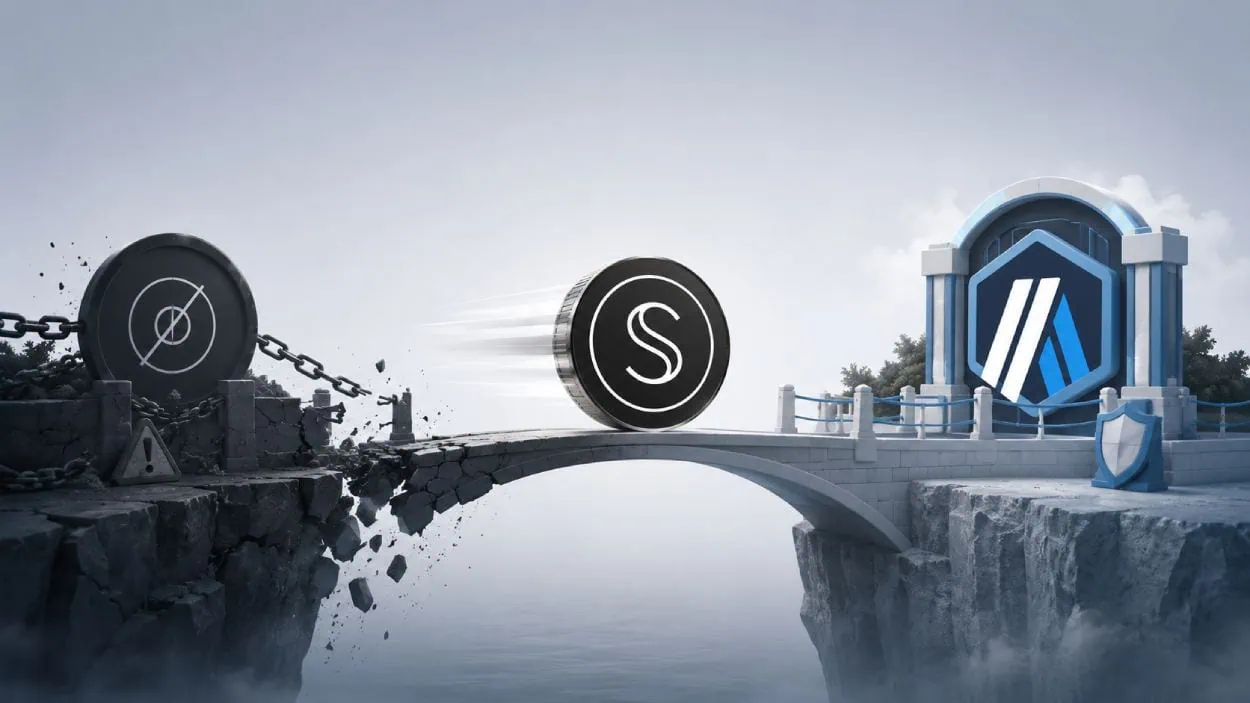






Secret Network’s governance forum proposed on July 7, 2026, migrating SCRT from Cosmos to Arbitrum, an Ethereum layer-2 network. The plan requires community approval before it can proceed.
Key Takeaways
- Secret Network’s official forum proposed a one-time balance snapshot on September 1, 2026, to mint a new ERC-20 SCRT token on Arbitrum.
- The snapshot counts native and staked SCRT, but excludes sSCRT, bridged SCRT, contract-held tokens like LP positions, and IBC assets.
- SCRT Labs cited rising AI-driven exploit risk against Secret’s older Cosmos codebase as a core migration rationale.
- An Axelar-Secret IBC bridge exploit demonstrated vulnerabilities in Cosmos infrastructure, though it did not touch native SCRT or Secret’s privacy protocol.
- Official Cosmos L1 support ends September 1, 2026 regardless of the vote outcome, though validators could keep the existing chain running independently.
What Happened?
Secret Network’s governance forum posted a formal proposal to relocate SCRT from its native Cosmos blockchain to Arbitrum, according to SCRT Labs. The migration hinges on a one-time snapshot of native and staked SCRT balances, including unbonding stake, which would be used to mint an equivalent ERC-20 SCRT token on the Layer 2 network. The move would put SCRT alongside other assets in Decentralized Finance Market once liquidity migrates to Arbitrum.
Per SCRT Labs, sSCRT (Secret’s privacy-wrapped token), SCRT bridged onto other chains, tokens held in contracts such as liquidity-pool positions, and IBC-transferred assets will not be captured.
Why Secret Network Wants Out?
SCRT Labs frames the move as a security decision, not just a liquidity play. The forum post argues that “old code is becoming dramatically easier to analyze” as AI tools advance, making legacy codebases in shrinking ecosystems progressively easier targets.
— Secret Network (@SecretNetwork) July 7, 2026
The proposal puts it bluntly: old code is becoming dramatically easier to analyze as models get better at spotting contract vulnerabilities. That argument gained urgency after the Axelar-Secret IBC bridge exploit outlined above.
The incident exposed vulnerabilities in Cosmos-side bridge infrastructure, though it did not touch native SCRT, Secret’s core privacy protocol, or its confidential compute model. Secret Network’s own proposal treats the bridge’s security exposure as the most serious factor behind the move.
The exploit hit a bridge, not Secret’s privacy engine, but it still supplied the proposal’s strongest evidence that stale infrastructure was already a live liability.
Cosmos Support Ends Regardless of the Vote
Official Cosmos support ends on the same date, whether or not token holders approve the Arbitrum migration, though validators could keep the existing chain running independently. That puts governance participants on a fixed clock.
A “yes” vote gets a coordinated relaunch on the new network; a “no” vote leaves an orphaned Cosmos chain with no official backing.
SCRT Labs said the venture “needs a new stable home” and named the Ethereum ecosystem as that home. For SCRT to endure, it needs a new stable home. The Ethereum ecosystem is that home.
The proposal pairs the chain move with tokenomics changes. Annual inflation would drop from 9% to 5%, staking incentives would shift toward governance participation rather than validator rewards, and SCRT Labs would wind down protocol development while open-sourcing its remaining code. Those changes take effect only if the community approves the migration.

Implications for Cosmos App Chains
The rationale here extends past one token. If AI-assisted code analysis is genuinely lowering the cost of finding exploits in older smart-contract stacks, every Cosmos-era app-chain launched in Secret’s 2020 cohort faces the same calculus Secret just made public. A shrinking, low-liquidity appchain is a worse defensive position now than it was five years ago, not because the code changed, but because the tools attacking it did.
Secret’s bridge history makes the case concrete: the Axelar-Secret IBC bridge incident demonstrated vulnerabilities in Cosmos infrastructure before the migration proposal formalized the response.
The vote also tests whether a mid-cap Cosmos project can execute a full chain migration without losing its community mid-transition. A “yes” outcome hands SCRT holders an ERC-20 token on the new network; a “no” outcome leaves validators running a chain SCRT Labs has already said it will stop supporting.
CoinLaw’s Takeaway
This is a defensive migration dressed as a modernization plan, and the two framings aren’t in tension. Secret Network is trading a smaller, aging Cosmos ecosystem for Arbitrum’s deeper liquidity and more actively audited tooling, using a real bridge loss as the proof point that stale infrastructure is now a live liability rather than a theoretical one.
The snapshot mechanics matter more than the headline: anyone holding sSCRT, LP positions, or IBC-transferred SCRT needs to convert back to native or staked SCRT before the cutoff or lose eligibility for the new token, regardless of how the governance vote turns out.
Nothing here is final. SCRT Labs can propose the move and set the technical deadline for ending Cosmos support, but the ERC-20 relaunch itself still requires token holders to approve it in a community vote. A rejected proposal would not undo the end of official Cosmos support; it would just leave validators to decide whether to keep the chain alive on their own, without the team that built it.