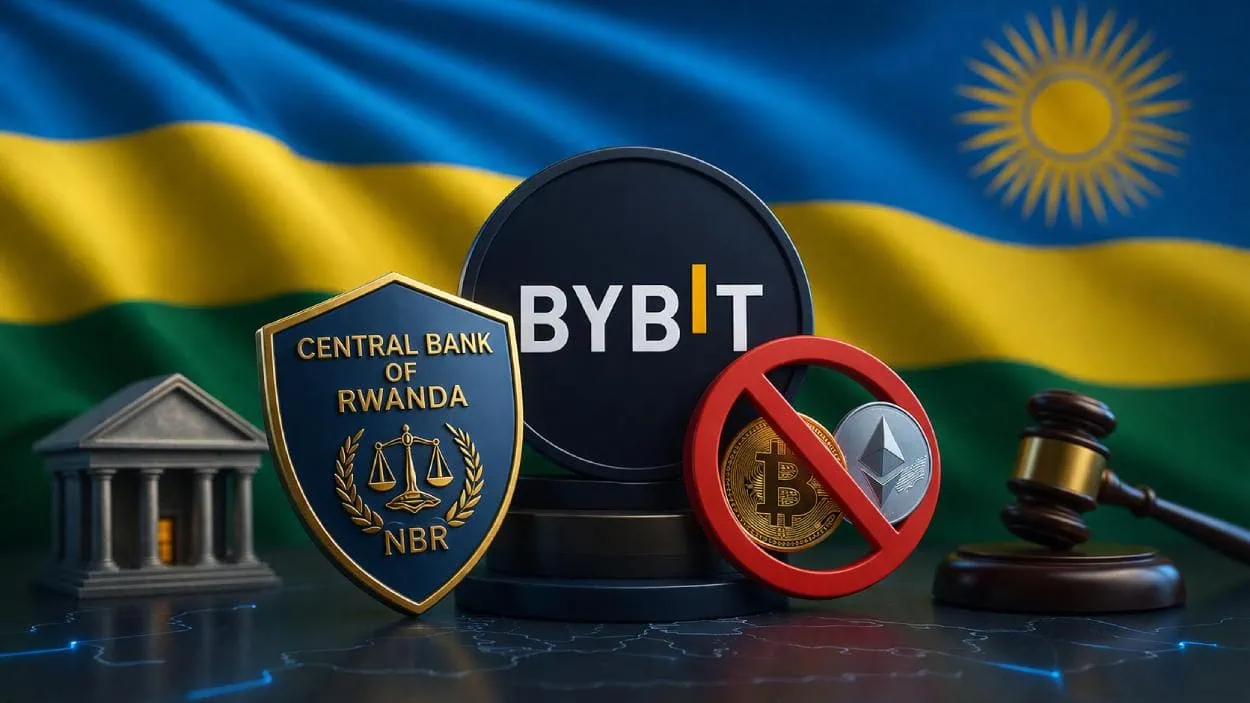






Rwanda’s central bank has issued a fresh warning against cryptocurrency use involving the local currency following a new feature rollout by crypto exchange Bybit.
Key Takeaways
- Rwanda’s central bank reaffirmed that crypto use tied to the franc is prohibited.
- Warning came after Bybit enabled Rwandan franc trading on its P2P platform.
- Authorities highlighted financial risks and lack of legal protection for users.
- Country continues to develop a regulated crypto framework with strict controls.
What Happened?
Rwanda’s central bank responded quickly after Bybit announced support for the Rwandan franc on its peer-to-peer platform. The regulator clarified that crypto transactions involving the local currency remain banned under existing laws. It also warned users about risks and confirmed that only the franc is recognized as legal tender.
Please be reminded that the Rwandan Franc (FRW) is the only legal tender in #Rwanda.
— Central Bank of Rwanda (@CentralBankRw) April 5, 2026
Crypto-assets are NOT authorized for payments, FRW conversion, or P2P trading involving FRW under the current framework.
The public is urged to avoid such transactions due to serious financial… https://t.co/elY0cht67h
Central Bank Responds to Bybit Move
The National Bank of Rwanda issued a public statement reaffirming its long standing position on digital assets. It clearly stated that crypto assets are not allowed for payments, currency conversion, or peer to peer trading involving the Rwandan franc.
Officials also stressed that licensed financial institutions are not permitted to facilitate any conversion between the franc and crypto assets. This reinforces the country’s strict regulatory stance and limits the role of traditional banking in crypto related activities.
The warning followed Bybit’s announcement that users could buy and sell cryptocurrencies using the Rwandan franc through its peer-to-peer marketplace. The platform also introduced incentives such as bonuses and commissions to attract traders and merchants.
Risks Highlighted for Users
Regulators warned that engaging in crypto transactions carries serious financial risks, especially in an unregulated environment. They emphasized that users do not have legal protection or recourse in case of losses.
This is a key concern. Unlike traditional banking systems, crypto transactions often lack mechanisms for refunds or dispute resolution. Authorities urged residents to avoid such activities for now and remain cautious.

Rwanda’s Long Standing Crypto Ban
Rwanda has maintained a cautious approach toward crypto since 2018. Authorities have consistently prioritized financial stability and protection of the local currency over rapid adoption of digital assets.
Despite global growth in crypto usage, Rwanda continues to rank low in adoption levels, with data from Chainalysis showing limited transaction volumes in 2024 and 2025. This places it behind regional leaders like Nigeria and South Africa.
Regulation in Progress with Strict Controls
While the ban remains in place, Rwanda is actively working on a regulated framework for digital assets. In 2025, the central bank and the Capital Markets Authority introduced a draft proposal targeting virtual asset service providers.
Key elements of the framework include:
- Ban on using crypto as legal tender.
- Restrictions on mining and mixer services.
- Controls on tokens linked to the local currency.
- Licensing system for compliant crypto firms.
A revised version of the bill gained traction in 2026, receiving Cabinet approval and progressing through early parliamentary stages. It is currently under committee review.
At the same time, Rwanda is exploring a state backed digital currency, known as the e franc rwandais, which is still in its early development phase.
A Growing Clash Between Innovation and Regulation
The situation reflects a broader global trend. Crypto platforms are expanding quickly, offering new ways for users to access digital assets. However, regulators are moving more cautiously, aiming to protect users and maintain control over financial systems.
Peer-to-peer trading, in particular, presents challenges. It allows users to transact directly, often bypassing traditional financial institutions. While this increases accessibility, it also reduces regulatory oversight.
What This Means for Users?
For now, the message from authorities is clear. Crypto transactions involving the Rwandan franc are not authorized, and anyone participating does so at their own risk.
Users are advised to stay informed and carefully evaluate both the benefits and risks before engaging with such platforms.
CoinLaw’s Takeaway
In my experience, this is a classic example of regulators trying to catch up with fast moving crypto innovation. I found Rwanda’s approach very deliberate. Instead of rushing into adoption, it is focusing on control and structure. While that may slow down growth in the short term, it could actually build a more stable ecosystem in the long run. Still, the tension between platforms like Bybit and regulators is only going to increase from here.