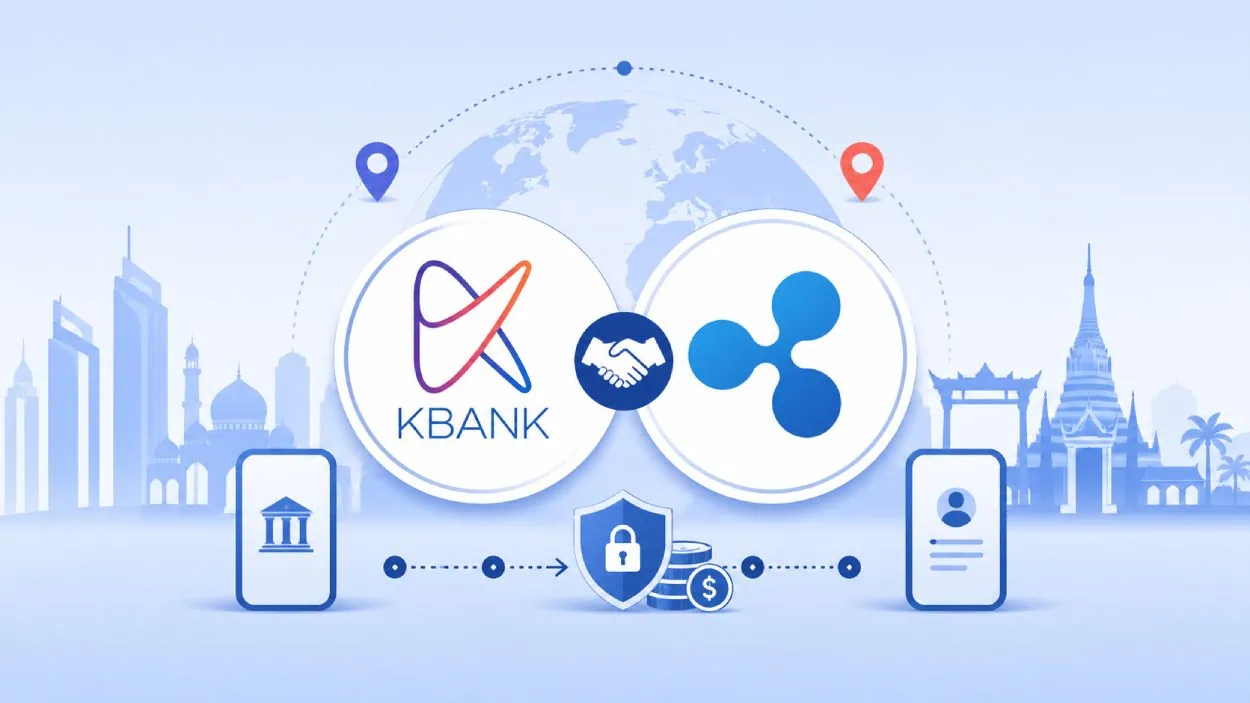






South Korea’s digital lender KBank has partnered with Ripple to test blockchain-based cross border remittance solutions.
Key Takeaways
- KBank and Ripple are running a multi phase proof of concept for blockchain remittances.
- Testing now includes on chain transfers across UAE and Thailand corridors.
- The partnership focuses on speed, cost efficiency, and transparency improvements.
- The collaboration could expand into live remittance services and digital asset use cases.
What Happened?
KBank has entered a strategic partnership with Ripple to explore blockchain powered international money transfers. The collaboration is currently in its second testing phase, focusing on system stability and real world applicability.
The initiative aims to evaluate whether Ripple’s infrastructure can significantly improve existing remittance systems in terms of speed, cost, and transparency.
🇰🇷JUST IN: South Korea’s KBank has partnered with @Ripple to pilot blockchain-based international remittances.
— The Crypto Times (@CryptoTimes_io) April 27, 2026
The PoC will test Ripple’s SaaS wallet “Palisade” for on-chain transfers to countries like UAE and Thailand.
Aiming to cut costs, improve speed, and boost… pic.twitter.com/RdWafidXat
KBank and Ripple Advance Blockchain Remittance Testing
KBank, one of South Korea’s leading internet-only banks, has formally teamed up with Ripple to test blockchain technology for cross-border payments. The agreement was signed at the bank’s headquarters in Seoul, with senior executives from both companies present.
The partnership centers on a proof of concept study designed to validate the efficiency of blockchain based remittances. This includes assessing improvements in:
- Transaction speed
- Cost structure
- Transparency and traceability
Ripple brings its global payments network, which is already used by over 100 financial institutions, into the collaboration. KBank plans to integrate this infrastructure into its existing remittance model to test performance gains.
Testing Moves Into On Chain Environment
The project has already completed its first phase, where KBank verified a wallet-based remittance system through a dedicated application interface.
In the second phase, testing has progressed into a virtual environment, where on chain transfers are being evaluated for stability. This includes cross-border corridors such as:
- United Arab Emirates
- Thailand
KBank is now using Ripple’s Palisade platform, a software-as-a-service wallet solution that meets international security standards. This shift is expected to support a more scalable and compliant deployment model.
The bank had previously used an in-house wallet during initial testing but has now transitioned to Ripple’s infrastructure to improve efficiency and performance.

Broader Digital Asset Collaboration in Focus
Beyond remittances, both companies are exploring expanded cooperation in digital assets. Discussions include:
- Enhancing KBank’s overseas remittance framework.
- Leveraging blockchain for financial services innovation.
- Exploring stablecoin based transaction models.
KBank has already signed memorandums of understanding for stablecoin-based transactions in key international markets, indicating a broader ambition to modernize its global payment systems.
Ripple, meanwhile, continues to expand its enterprise offerings. The company launched its RLUSD stablecoin in 2024 and has applied for a US trust bank charter, signaling deeper integration into traditional finance.
Regulatory Momentum Supports Innovation
The partnership comes as South Korea prepares to introduce the Digital Asset Basic Act, which is expected to provide clearer guidelines for blockchain and crypto related activities.
KBank’s position in the ecosystem is also strengthened by its role as the sole banking partner of Upbit, one of the country’s largest crypto exchanges. This relationship has significantly boosted its user base, which reportedly grew from around 2 million in 2020 to 15 million last year.
The collaboration with Ripple aligns with a broader trend of traditional financial institutions embracing blockchain technology under evolving regulatory frameworks.
Industry Voices Highlight Strategic Importance
KBank CEO Choi Woo hyung said:
Ripple Asia Pacific Managing Director Fiona Murray added:
CoinLaw’s Takeaway
I see this partnership as a serious signal that blockchain remittances are moving closer to real world adoption. In my experience, banks rarely invest this deeply in proof of concept trials unless they see long term value.
What stands out to me is the shift from basic testing to on chain simulations across real corridors like UAE and Thailand. That is where things get practical, not theoretical.
I also found KBank’s rapid growth through its crypto exchange partnership very telling. It shows that traditional banking and digital assets are no longer separate worlds. They are merging fast, and partnerships like this are accelerating that shift.