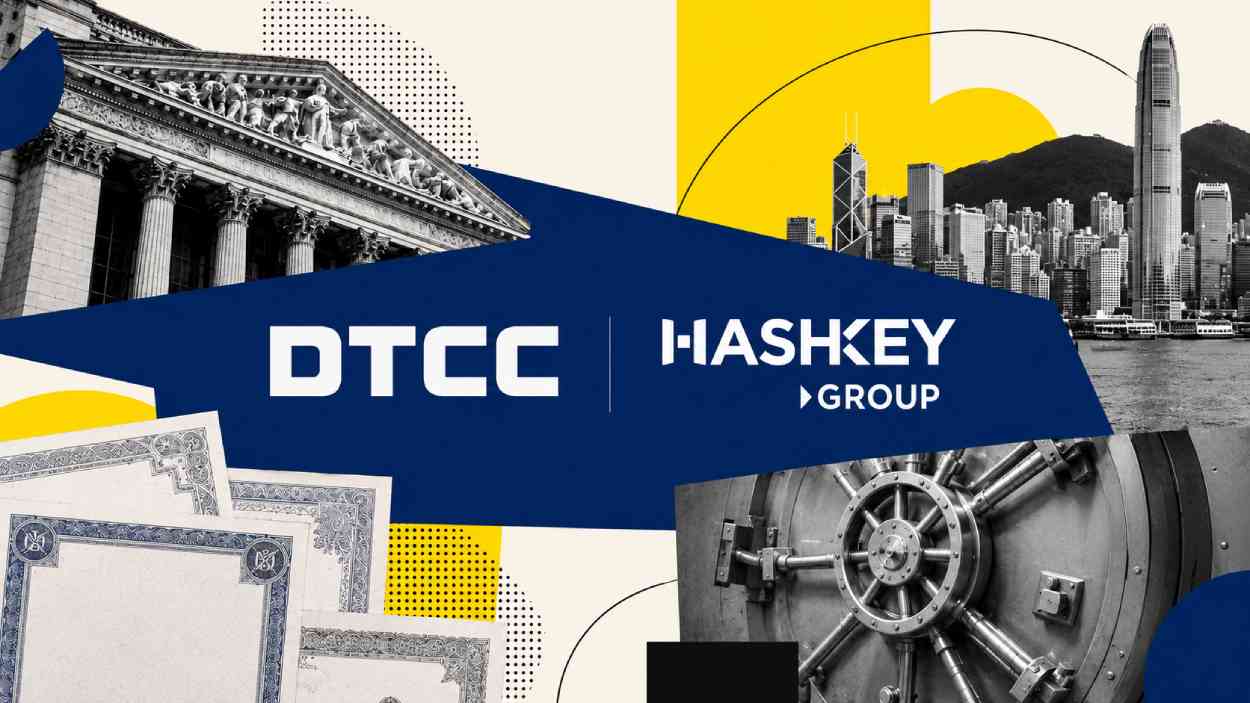






HashKey Group said on 2nd September, 2026 that it has joined the Depository Trust & Clearing Corporation’s Digital Assets Advisory Services Industry Working Group, the first Asian digital asset service provider on the panel. The seat is advisory and carries no DTC membership.
The Big Picture
- HashKey Group is the first Asian digital asset firm on DTCC’s tokenization advisory panel.
- DTCC plans to launch standardized tokenization services in October 2026, after live production trades in July.
- $114 trillion sits in Depository Trust Company custody, the pool the service draws eligible securities from.
- HashKey counts more than 100 members. DTCC’s May 4 release named more than 50.
- Membership grants no DTC access and no claim on the finished service.
HashKey takes the first Asian seat
HashKey Group joined alongside JPMorgan Chase, Goldman Sachs, Nasdaq and the New York Stock Exchange, the company said. The panel advises on how tokenized securities are issued, settled and safeguarded.
The two accounts disagree on size. HashKey puts the group at more than 100 financial institutions, asset managers and digital asset firms. DTCC’s May 4 release counted “over 50 firms,” and the depository has not published a refreshed roster since.
HashKey runs trading, asset management and on-chain infrastructure businesses in Hong Kong, Singapore, Japan and Bermuda. It has worked on tokenization since 2023 and sits in the Hong Kong Monetary Authority’s Project Ensemble Architecture Community, established in May 2024, plus the Tokenised Bond Expert Group formed this June. Ensemble tests how tokenized deposits and wholesale central bank money settle tokenized asset trades, the same design now sold commercially as tokenized bank deposits.
📢 HashKey Group has joined the Depository Trust & Clearing Corporation (DTCC) Digital Assets Advisory Services Industry Working Group as the first Asian digital asset service provider.@The_DTCC is a core post-trade infrastructure provider, with its subsidiary, The Depository… pic.twitter.com/eseiH3G92g
— HashKey Group (@HashKeyGroup) September 2, 2026
October launch keeps the securities inside DTC custody
The service will let DTC participants mint tokenized versions of securities already at the depository. These digital twins never pull the underlying instrument out of the regulated custody chain, and holders can move the tokens to approved wallets or convert them back.
DTCC ran its first production tokenized transactions on 07/15/2026, covering collateral pledges, securities lending, equity token transfers and delivery versus payment trades in U.S. Treasuries and repo. The trades executed across DTCC’s private Hyperledger Besu network and the public Canton Network. JPMorgan converted holdings of the Invesco QQQ Trust ETF, then posted tokenized collateral against CME Group margin requirements.
DTCC President and CEO Frank La Salla said:
The October release ships with compliance and distribution controls, holding issuance and corporate action automation for later versions.
What the seat does not settle?
Neither firm disclosed an integration, a joint product or a commercial agreement. Working group members supply technical and operational feedback without authority over DTCC’s systems.
Two questions stay open. How many firms are in the group, given the gap between published counts? And which HashKey-arranged instruments could ever qualify as DTC-custodied collateral?
Institutions holding tokenized money market ETFs, bonds or notes arranged through HashKey can check which custody chain those instruments sit in, since DTCC’s model reaches only securities the depository itself holds.

CoinLaw’s Takeaway
The seat buys standards influence. The depository’s custody total measures what it already keeps, and the October design deliberately leaves those securities in place while a token points at them. Rules for how that pointer behaves across custody, collateral and settlement decide which Asian issuers can plug into US post-trade infrastructure, and on what terms.
Hong Kong is the credential HashKey carries. Its regulator ran live tokenized bond and deposit work under a licensing regime while most jurisdictions were still consulting, and Asia’s pipeline is thickening around it, from Japanese equities moving on-chain to sovereign bond pilots. Whether any of that lands inside a US depository standard is unmeasurable today. The panel has no vote, and DTCC has said nothing about how member input becomes product.