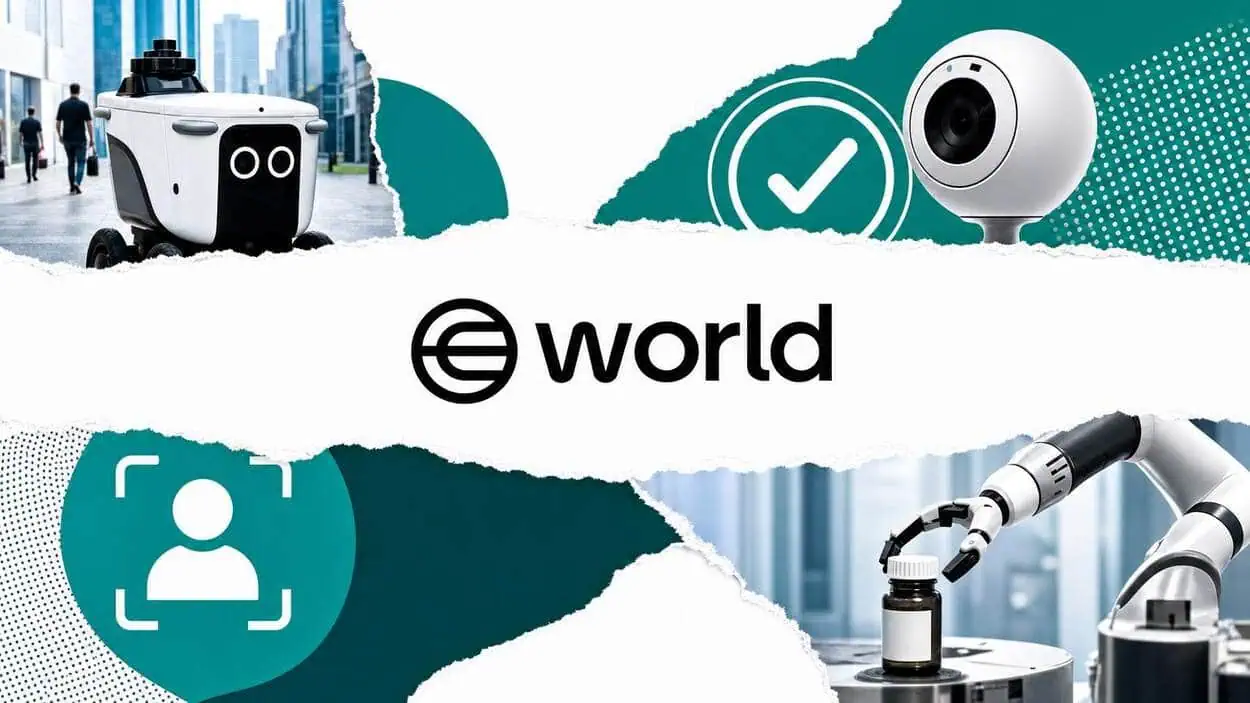







World ID verification became available to robots and machines running peaqOS on August 21, 2026, letting an autonomous machine confirm it is dealing with a real, unique person without receiving that person’s name, face or identity documents.
The Big Picture
- World ID proofs are now callable by machines running peaqOS, with no API key and no charge for each verification.
- peaqOS checks every proof against World’s verification API and stores the result on the machine’s order record.
- Delivery robots can confirm the recipient is the same person who placed the order before unlocking a sealed compartment.
- World Network says its aim is to sustain uniqueness and privacy at the scale of seven billion people.
- Operators can drop PINs, pickup codes and account signups, all of which can be shared, stolen or turned into stored personal data.
World ID goes live on robotic.sh for peaqOS machines
The integration lets a machine request a World ID proof and read the result before it acts. World, the identity network formerly called Worldcoin, uses zero-knowledge proofs so a person can demonstrate through World App that they are a real, unique human while the machine receives only the proof. The same flow can establish that whoever completes an action is the one who started it.
Machines that deal with people directly have leaned on PINs, pickup codes, accounts or identity documents. Codes can be shared or stolen, the announcement said, and conventional identity checks push the cost the other way, since the operator ends up collecting and retaining personal information it may not want to hold. World ID hands the machine a proof and keeps the underlying identity out of the transaction, an approach that will look familiar to anyone following electronic KYC adoption.
peaqOS brings @worldnetwork‘s World ID to robots and machines
— peaq (@peaq) August 21, 2026
A machine can now check two things about the person in front of it: is it a real human, and the one who actually placed the order?
Nothing else is revealed. No name, no face, no ID. Free to verify.
→ peaqOS… pic.twitter.com/b6qP4xAPJi
How a verification actually runs?
The operator registers a World app and passes its rp_id to peaqOS as providerCredentials.worldId. There is “No API key or secret“, according to the robotic.sh service listing, just a World app identifier. The agent then submits World’s IDKit response payload, or the individual fields: proof, merkle_root, nullifier, nonce and action.
peaqOS calls World’s verify endpoint at /api/v4/verify and stores what comes back. Verification is deterministic per proof and keyed by the nullifier, a value that stays stable for one human on one action, letting a machine enforce a one-per-human rule without keeping a database of who collected what. Failed checks leave a trail too, since peaqOS returns World’s error to the agent and writes it onto the failed order run.
Money never touches the peaqOS rail here. The listing describes the service as credential-gated rather than payment-gated: peaqOS records the order and the execution but runs no market payment, and any fees World introduces later settle with World directly. Machine identity comes from peaq decentralized identifiers (DIDs), discovery happens through the Machine Market, and the resulting record is auditable with proof metadata redacted, so an operator can show a verification happened without holding the person behind it. World App’s messaging and payments overhaul already put a verified-human signal in front of consumers.
What the medication demo shows, and what it does not?
The worked example in the announcement is a medication delivery. A patient verifies through World App before the order is accepted, and the delivery robot receives a zero-knowledge proof in place of the patient’s name. At the pharmacy, the pharmacist verifies before the medication goes into the robot’s compartment and the compartment is sealed. On arrival the patient verifies again, which is how the system establishes that the recipient is the human associated with the order before the compartment opens.
That scenario demonstrates the integration. It is not a disclosed deployment, and the published material stops at what the capability does and how it is called. Four things it leaves open:
- Which operators, if any, are running World ID checks on machines in the field today?
- What World may charge for verifications once fees enter the picture, given peaqOS carries none?
- How a redacted audit record satisfies regulators who expect a named chain of custody for controlled goods?
- What a legitimate recipient does when they have no World App or no verified World ID?
Operators already running peaqOS machines can check two things now: whether their action strings are scoped tightly enough that a stable nullifier does not link one person’s activity across unrelated interactions, and what verification errors their failed order runs are retaining.

CoinLaw’s Takeaway
The value sits in what the machine stops holding. A delivery operator that never receives a name has nothing to breach, nothing to retain under a data-minimization obligation, and no account system to build before a customer can use a robot. That is a smaller compliance surface than the pickup-code and signup model it replaces.
Distribution is the harder question. Proof of human only works if the person standing in front of the robot already holds World App with a verified World ID, which ties machine-side adoption to how far World App has spread among consumers in the areas where these fleets operate. The rails on the machine side have been filling in quickly, from agent-initiated stablecoin payments to on-chain machine identity, and this closes the last gap on the human end of those interactions. That makes consumer app penetration the ceiling on uptake.