

• Skip to primary navigation
  • Skip to main content
  • Skip to primary sidebar
  • Skip to footer
CoinLaw LogoCoinLaw

Bringing Crypto and Finance Closer to You

  • Latest News
  • Statistics
  • About
  • Contact
Subscribe
CoinLaw Logo
  • Latest News
  • Statistics
  • About
  • Contact
Subscribe
Home » Compliance

Synthetic Identity Fraud Statistics 2026: Hard Numbers, Big Threats

Published on: January 6, 2026
Steven Burnett
Written By
Steven Burnett
Steven Burnett
Research Analyst • 241 Articles
Steven Burnett has over 15 years of experience across finance, insurance, banking, and compliance-focused industries. Known for his deep res... See full bio
LATEST POSTS:
NFT Regulatory Framework 2026: Global Status and Compliance Map
DeFi Regulation Status by Country 2026: A Global Compliance Map
What Is MiCA Regulation? The EU Crypto Rulebook Explained
Kathleen Kinder
Reviewed By
Kathleen Kinder
Kathleen Kinder
Senior Editor • 1,727 Articles
Kathleen Kinder brings over 11 years of experience in the research industry, with deep expertise in finance, cryptocurrency, and insurance. ... See full bio
LATEST POSTS:
Europe Tightens Crypto Rules With New €10K Cash Ban
WhiteBIT Wins Key MiCA License in Austria for EU Growth
AllUnity Launches Sweden’s First Regulated Krona Stablecoin
Synthetic Identity Fraud Statistics
As Featured In
Bloomberg LogoForbes LogoFortune LogoCoinDesk LogoCoinMarketCap Logo
Share on LinkedIn ChatGPT Perplexity Share on X Share on Facebook

Synthetic identity fraud has grown from a niche concern to one of the most urgent threats facing financial services, ecommerce platforms, and government benefit systems. By blending real personal data with fabricated details, fraudsters create convincing false identities that can pass verification checks and exploit systems at scale. This trend affects banks’ underwriting and lending processes, and it also undermines trust in digital interactions. In this article, we break down the latest statistics, financial impacts, and trends shaping synthetic identity fraud.

Editor’s Choice

  • Estimated U.S. economic losses from synthetic identity fraud could reach $30 – $35 billion annually.
  • U.S. lenders faced over $3.3 billion in exposure to synthetic identities tied to new accounts in recent data.
  • Fraud rates rose for 67% of financial institutions in 2025.
  • 8.3% of digital account creations were suspected fraudulent in H1 2025.
  • AI/deepfake concerns were cited by 64% of industry respondents as a top fraud threat.
  • Synthetic fraud’s reach is expanding beyond finance into e-commerce and public benefits sectors.

Recent Developments

  • AI and generative models are now central tools for creating harder‑to‑detect synthetic identities, automating large‑scale fraud.
  • Fraudsters are increasingly using deepfake IDs and synthesized documents to bypass identity checks.
  • The uptick in synthetic identity fraud comes as financial institutions face higher fraud pressures overall; 67% of banks and fintechs saw fraud rates climb in 2025.
  • Digital account creation fraud risks continue to rise, with 8.3% of digital onboarding attempts flagged as suspicious in early 2025.
  • Firms report AI/deepfakes as a primary identity fraud concern, cited by 64% of respondents.
  • Predictions for 2026 highlight stolen biometric data as a new vector for synthetic identity creation.
  • Synthetic identity fraud trends increasingly overlap with broader cybercrime trends driven by AI automation.

Fraud Types by Frequency and Financial Impact

  • Bust-out fraud is the most frequent fraud type, accounting for 21% of all fraud cases, while also driving 16% of total financial losses, highlighting its scale and repeat nature.
  • Authorized Push Payment (APP) fraud represents 17% of fraud incidents and contributes 16% of overall losses, making it one of the costliest fraud categories per incident.
  • Account takeover fraud makes up 13% of fraud occurrences and 12% of financial losses, reflecting its continued dominance in digital and credential-based attacks.
  • ACH fraud shows a balanced impact, responsible for 10% of fraud frequency and 10% of total losses, indicating consistent monetary damage per case.
  • Chargeback (friendly) fraud accounts for 10% of fraud cases but only 9% of losses, suggesting high volume but lower average loss values.
  • Check fraud also represents 10% of fraud activity and 9% of losses, reinforcing its persistence despite declining check usage.
  • Identity theft fraud stands out for its outsized financial impact, generating 12% of total losses from just 7% of cases, pointing to higher loss severity per incident.
  • Money muling contributes 5% of fraud incidents and 6% of financial losses, reflecting its role as an enabler in broader fraud networks.
  • Synthetic identity fraud accounts for only 4% of fraud frequency yet drives 7% of financial losses, underscoring its high cost and long-duration nature.
  • Wire fraud remains relatively limited, representing 4% of fraud cases and just 3% of financial losses, compared with more scalable digital fraud schemes.
Fraud Types by Frequency and Financial Impact
(Reference: Alloy)

What Is Synthetic Identity Fraud?

  • Synthetic identity fraud involves creating a new fake identity by combining real personal data with fabricated details to open credit lines or other accounts.
  • Synthetic identity fraud accounts for up to 80% of new account fraud cases.​
  • Businesses lose an estimated $20–$40 billion globally to synthetic identity fraud each year, with U.S. losses alone projected to exceed $23 billion by 2030.
  • US lenders faced $3.3 billion exposure from synthetic identities in H1 2025.​
  • 44% of organizations rank synthetic identity fraud as the top-tracked fraud type.​
  • Synthetic identities were used in 21% of first-party frauds detected in 2025.​
  • AI-enabled fraud losses projected to $40 billion by 2027 from $12.3 billion in 2023.​
  • The life insurance sector links synthetic fraud to $30 billion yearly losses.​
  • 0.08% synthetic government benefit transactions expose $283 million annual risk.
Newsletter Img
Don't chase the news. Let us curate it.

You get one weekly briefing with only the stories that matter. If the market is quiet, we skip it.

✅ Join readers from Visa, Vanguard, and the FDIC.

Financial Losses From Synthetic Identity Fraud

  • Some estimates suggest that synthetic identity fraud has cost the U.S. economy between $30 billion and $35 billion annually.
  • Conservative projections put U.S. losses at $23 billion by 2030 due to synthetic fraud alone.
  • U.S. lenders saw $3.3 billion in exposure to suspected synthetic identities tied to new accounts.
  • Fraud cost trends show an increase in fraud‑related revenue loss for businesses, with U.S. firms losing 9.8% of revenue to fraud on average.
  • Identity fraud costs overall climbed to $27.2 billion in consumer losses in 2024, up 19% year over year.
  • FBI identity fraud complaints in 2025 reflected more than $262 million in losses across various schemes.
  • Cybercrime costs, including identity and synthetic fraud, are projected to rise to $10.5 trillion annually by 2025.
  • Fraudsters often exploit seasonal spending peaks, increasing average losses tied to identity fraud events.

Economic Impact of Identity Fraud by Loss Size

  • Lower-value identity fraud dominates in FinTech, with 23% of incidents resulting in losses of $0–$20,000 and 25% falling in the $20,001–$120,000 range, showing that most FinTech cases involve smaller but frequent losses.
  • Banking-sector identity fraud skews toward higher losses, with 18% of incidents in both the $120,001–$300,000 and $300,001–$470,000 brackets, highlighting greater exposure to mid-six-figure fraud events.
  • Across all surveyed sectors, the most common loss range is $20,001–$120,000, accounting for 20% of identity fraud incidents, making it the single largest loss bracket overall.
  • Severe identity fraud losses above $300,000 represent a meaningful share of cases, totaling 27% in banking when combining the $300,001–$470,000 and $470,001–$800,000 ranges.
  • High-value fraud exceeding $800,000 remains less frequent but impactful, accounting for 8% of banking incidents and 6% across all sectors, reinforcing the outsized damage of large-scale identity fraud.
  • FinTech firms report fewer extreme losses, with only 3% of cases exceeding $1.2 million, compared with 8% in banking, suggesting differences in account limits, transaction controls, and customer profiles.
  • A small but notable share of respondents reported uncertain loss amounts, with 5% across all sectors selecting “Don’t know”, pointing to measurement and reporting gaps in identity fraud assessments.
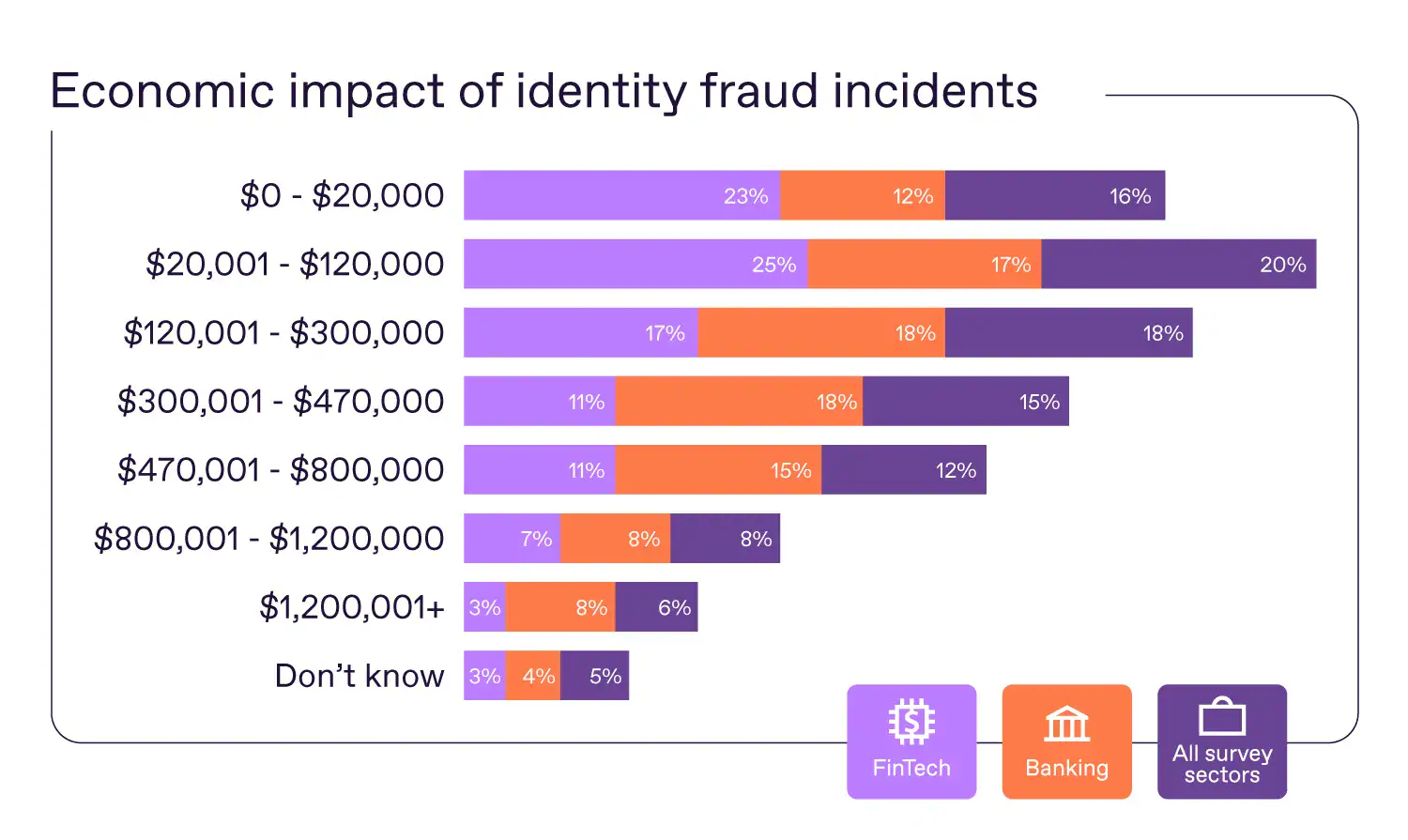
Economic Impact Of Identity Fraud By Loss Size
(Reference: Regula Forensics)

Synthetic Identity Fraud In Banking And Lending

  • Fraudulent activity in financial services rose about 21% between 2024 and 2025, driven by identity and synthetic schemes. Many banks now flag 1 in every 20 verification attempts as potentially fraudulent.
  • 62% of banks say digital onboarding is the highest risk point for synthetic identity fraud exposures.
  • Reported identity and related fraud losses in financial services reached $12.5 billion in 2024, up 25% over 2023, with synthetic identities a growing driver.
  • Large banks reported fraud losses roughly four times the industry average, highlighting the magnitude of synthetic and related threats.
  • U.S. lenders faced $3.3 billion in exposure to synthetic identities tied to newly opened accounts through 2024.
  • Financial institutions increasingly rely on behavioral and public data signals to fight synthetic fraud before credit is extended.
  • Traditional KYC and static identity checks struggle to keep pace with fraud sophistication powered by AI‑generated identity data.
  • Customer trust in identity verification remains low, with only 13% of consumers feeling fully secure opening new accounts.

Credit Cards And Consumer Finance

  • Synthetic account fraud attempts grew 153% from late 2023 to early 2024, reflecting the rising use of fictitious identities to open credit cards and lines of credit.
  • Overall identity fraud cases, including credit card fraud, rose significantly, with 323,459 credit card fraud reports in H1 2025, up about 51% year over year.
  • New account fraud represents approximately 90% of all credit card fraud, often tied to synthetic identities.
  • Identity‑related financial fraud accounts increased 12% annually since 2020, a trend expected to continue.
  • Americans aged 30‑39 reported the highest identity fraud reports, often related to credit card and loan fraud.
  • Cross‑border and digital banking fraud channels contribute to rising fraud volumes in consumer finance.
  • Advanced AI tools help fraudsters refine credit‑application documents, challenging traditional prevention methods.
  • Consumer confidence in credit safety remains weak, with rising fraud alerts impacting financial behavior.

Share of Fraud Attributed to Synthetic Identities

  • Synthetic identities account for over 80% of new account fraud.​
  • Synthetic accounts represent 80% of all new account fraud in certain segments.​
  • 21% of first-party frauds detected in 2025 used synthetic identities.​
  • Over 80% of new-account fraud is attributed to synthetic personas.​
  • Synthetic identity fraud accounts for up to 85% of life insurance identity fraud.​
  • Sophisticated fraud nearly tripled to 28% of attempts in 2025.
Share Of Fraud Attributed To Synthetic Identities

Government Benefits And Public Sector

  • 0.08% of government benefit transactions involve synthetic identities, exposing $283 million annual risk.​
  • Synthetic identities targeted government programs like unemployment and welfare during pandemic payouts.​
  • Medicare lost $60 billion to various fraud types, including synthetic identities, in 2017.​
  • Synthetic fraud was used to intercept tax returns and benefits, with federal False Claims Act recoveries at $3.7 billion in 2017.​
  • Government benefit programs are vulnerable to synthetic ID claims, diverting funds from legitimate recipients.​
  • Synthetic identity fraud exploits public sector systems for tax fraud and entitlement programs.​
  • 0.08% synthetic rate in government identity verifications highlights persistent public sector risk.​
  • Fraudsters use children’s SSNs for synthetic IDs in benefits, undetected for years.

E-commerce and Digital Payments

  • Global e-commerce and online payment fraud is projected at $48 billion annually.​
  • 40% of global ecommerce fraud attacks originate from the U.S.​
  • Online merchants lose 2.9% of revenue on average to fraud.​
  • Fraud management costs average 10% of revenue for e-commerce merchants.​
  • E-commerce marketplaces hit 19.2% net fraud rate, nearly five times the global average.​
  • Synthetic identity document fraud surged 311% in North America in Q1 2025.​
  • Financial services net fraud rate exceeds 5.5% of online identity verifications.​
  • Payment method fraud rate reaches 6.6%, surpassing ID document fraud.​
  • Digitally presented media is 300% more likely to be AI-generated or altered.

Detection Rates And Time To Detect Synthetic Identities

  • Net fraud rate in financial services exceeds 5.5% of verifications.​
  • Global identity fraud rate stands at 2.2%.​
  • Deepfake voice detection accuracy is as low as 38.2%.​
  • Human detection of deepfake audio at 48% accuracy.​
  • Payment method fraud rate reaches 6.6%.​
  • 13% of companies have anti-deepfake protocols.​
  • Real-time systems prevent 85% more fraudulent transactions.​
  • Deepfake files projected at 8 million.​
  • Synthetic identities develop undetected for months.
Detection Rates And Time To Detect Synthetic Identities

Victim Demographics And Vulnerable Populations

  • Millennials comprise 42% of identity theft reports.​
  • 30-39 age group accounts for 21% of all claims.​
  • Generation Z represents 21% of reports.​
  • Adults 60+ suffer 41.46% of total financial losses.​
  • People 20-29 are most likely (44%) to report fraud losses.​
  • 24.6% of victims were victimized three times.​
  • 63% of cybersecurity leaders are concerned about deepfakes.​
  • 60% of organizations are unprepared for deepfake threats.​
  • 71% globally unaware of deepfakes.

Data Breaches Fueling Synthetic Identity Fraud

  • Global net fraud rate exceeds 4% of online identity verifications for the third year.​
  • Digitally presented media is 300% more likely to be AI-generated or altered.​
  • E-commerce marketplaces hit with 19.2% net fraud rate.​
  • Financial services net fraud rate surpasses 5.5% of verifications.​
  • Crypto/lending platforms see 38% YoY fraud increase.​
  • Impersonation fraud accounts for over 85% of attacks.​
  • Synthetic identities are used in 21% of first-party frauds.​
  • 44% of firms rank synthetic identity fraud as the top-tracked type.​
  • Digital forgeries comprise 35% of document fraud.​
  • Synthetic identity fraud causes 80% of credit card fraud losses.

Synthetic Identities And AI / Deepfake‑Driven Fraud

  • Deepfake‑powered fraud has surged dramatically; files created with deepfake technology grew from ~500,000 in 2023 to ~8 million in 2025.
  • Fraud attempts leveraging deepfake content have climbed more than 2,000% over the last three years, illustrating rapid criminal adoption.
  • In some sectors, deepfakes now account for roughly 6.5% of all fraud attacks, reflecting the scale of AI misuse.
  • Deepfake fraud tied to credential phishing and social engineering has jumped over 3,000%, driven by automated spear phishing and AI‑generated content.
  • Traditional deepfake detection remains challenging: human detection rates are under 25% for high‑quality video manipulations.
  • Around one in every five biometric fraud attempts involves deepfakes, where attackers employ face swaps and animated selfie manipulation to defeat verification systems.
  • A large industry survey found 64% of fraud professionals cite deepfakes as a top fraud concern, second only to broader identity misuse issues.

Synthetic Identity Fraud Attack Methods And Tactics

  • First-party synthetic identity fraud accounts for 21% of detections.​
  • Impersonation fraud comprises over 85% of online attacks.​
  • 2% of fake documents are generated by AI tools like ChatGPT.​
  • AI-enabled fraud is projected to reach $40 billion by 2027.​
  • Synthetic identities are used in 1 in 5 first-party frauds.​
  • Multi-step fraud attacks rose 180% YoY.​
  • 1 in 10 adults encountered AI voice cloning scams.​
  • 77% of AI voice scam victims reported financial losses.​
  • Deepfake injection bypasses basic verification checks at scale.​
  • Credential stuffing employs human-like variability via AI.

Technology Solutions For Detecting Synthetic Identities

  • Behavioral biometrics achieves 98.7% accuracy against synthetic fraud.​
  • Universal deepfake detector reaches 98% accuracy.​
  • AI-powered fraud detection reduces false positives by 75-90%.​
  • Behavioral biometrics detects with <220ms latency.​
  • 2% of fake documents generated by AI tools were detected.​
  • Real-time ML prevents 85% more fraudulent transactions.​
  • Liveness detection combined with AI improves accuracy to 99.1% on real IDs.​
  • AI analyzes thousands of security features per document.​
  • Federated learning preserves privacy in ML models.​
  • Networks cover 180 billion compromised identities.

Frequently Asked Questions (FAQs)

What percentage of new account fraud can be attributed to synthetic identity fraud?

Up to 80% of all new account fraud is estimated to be driven by synthetic identity fraud.

What dollar value is projected for synthetic identity fraud losses in the U.S. by 2030?

Synthetic identity fraud could generate $23 billion in losses in the U.S. by 2030.

How much average revenue loss did U.S. companies report due to all fraud types, including synthetic identity, in 2025?

U.S. businesses reported losing 9.8% of annual revenue to fraud in 2025.

What share of merchants identified synthetic identity fraud as their most common fraud loss source?

16% of merchants reported synthetic identity fraud as their most common source of fraud losses.

Conclusion

Synthetic identity fraud stands as a core threat across finance, ecommerce, and public services, driven by data breaches, AI‑driven deepfakes, and evolving fraud tactics. Losses continue to escalate, and synthetic schemes now outpace traditional identity theft in sophistication and scale. While detection challenges persist, advances in behavioral analytics, layered authentication, and AI‑powered identification tools promise stronger defenses, but only if organizations adopt them proactively.

As fraud tactics evolve faster than ever, the gap between attack innovation and defense readiness will determine how tightly systems can resist synthetic abuse. Continuous investment in detection technology and cross‑industry collaboration will be essential to curbing these threats.


This article has been reviewed and fact-checked by Kathleen Kinder. CoinLaw follows strict Publishing Principles and a documented Fact-Check Policy to ensure accuracy, transparency, and editorial independence across all content. Our statistics are verified using a documented Research Process.

Add CoinLaw as a Preferred Source on Google for instant updates! Follow on Google News
Share ChatGPT Perplexity

References

  • Statista
  • Statista
  • The World Economic Forum
  • Sumsub
  • alloy.com
  • Mitek Systems
  • Neural Technologies
Steven Burnett

Steven Burnett

Research Analyst


Steven Burnett has over 15 years of experience across finance, insurance, banking, and compliance-focused industries. Known for his deep research and data analysis skills, Steven transforms complex topics into clear, actionable insights. At CoinLaw, he contributes in-depth articles on financial systems, regulatory trends, and lending practices, helping readers make informed decisions with confidence.

Related Posts

SIM Swapping Statistics 2026: How to Stay Safe
Compliance

SIM Swapping Statistics 2026: How to Stay Safe

Phishing and Wallet Drainer Incidents Statistics 2026: Hidden Threats Now
Cryptocurrency

Phishing and Wallet Drainer Incidents Statistics 2026: Hidden Threats Now

ATM Fraud Statistics 2026: Essential Statistics and How to Stay Safe
Payments

ATM Fraud Statistics 2026: Essential Statistics and How to Stay Safe

Disclaimer: The content published on CoinLaw is intended solely for informational and educational purposes. It does not constitute financial, legal, or investment advice, nor does it reflect the views or recommendations of CoinLaw regarding the buying, selling, or holding of any assets. All investments carry risk, and you should conduct your own research or consult with a qualified advisor before making any financial decisions. You use the information on this website entirely at your own risk.

Reader Interactions

Leave a Comment Cancel reply

Primary Sidebar

Connect With Us

facebook x linkedin google-news telegram pinterest whatsapp email
google-preferred-source-badge Add as a preferred source on Google

You Should Also Read

Digital Payment Fraud Statistics 2026: Alarming Trends Now
Insurance Fraud Statistics 2026: Big Insights
Insurance Fraud Detection Statistics 2026: Data-Driven Insights and Detection Techniques

Table of Contents

  • Editor’s Choice
  • Recent Developments
  • Fraud Types by Frequency and Financial Impact
  • What Is Synthetic Identity Fraud?
  • Financial Losses From Synthetic Identity Fraud
  • Economic Impact of Identity Fraud by Loss Size
  • Synthetic Identity Fraud In Banking And Lending
  • Credit Cards And Consumer Finance
  • Share of Fraud Attributed to Synthetic Identities
  • Government Benefits And Public Sector
  • E-commerce and Digital Payments
  • Detection Rates And Time To Detect Synthetic Identities
  • Victim Demographics And Vulnerable Populations
  • Data Breaches Fueling Synthetic Identity Fraud
  • Synthetic Identities And AI / Deepfake‑Driven Fraud
  • Synthetic Identity Fraud Attack Methods And Tactics
  • Technology Solutions For Detecting Synthetic Identities
  • Frequently Asked Questions (FAQs)
  • Conclusion
Connect on Telegram

Footer

CoinLaw Logo

Bringing Finance Closer to You.

Connect With Us

Follow Us on Google News

Editorial & Trust

  • About
  • Publishing Principles
  • Fact-Check Policy
  • Corrections Policy
  • Ethics Policy
  • Disclaimer
  • Cookie Policy

Worth Checking

  • Best Cloud Mining Platforms
  • Millennial vs. Gen Z Banking
  • Ethereum Gas Fees Statistics
  • Binance vs. Coinbase Statistics
  • Zelle vs. Venmo Statistics
  • Traditional Banks vs. Neobanks
  • Crypto Exchange Hack Statistics
Contact Us
13570 Grove Dr #189,
Maple Grove, MN 55311,
United States
10 a.m. – 6 p.m. | Every day

Copyright © 2024–2026 CoinLaw. All Rights Reserved. Powered by the HODL Force ❤️

  • Privacy Policy
  • Terms
Manage your privacy

To provide the best experiences, we and our partners use technologies like cookies to store and/or access device information. Consenting to these technologies will allow us and our partners to process personal data such as browsing behavior or unique IDs on this site and show (non-) personalized ads. Not consenting or withdrawing consent, may adversely affect certain features and functions.

Click below to consent to the above or make granular choices. Your choices will be applied to this site only. You can change your settings at any time, including withdrawing your consent, by using the toggles on the Cookie Policy, or by clicking on the manage consent button at the bottom of the screen.

Functional Always active
The technical storage or access is strictly necessary for the legitimate purpose of enabling the use of a specific service explicitly requested by the subscriber or user, or for the sole purpose of carrying out the transmission of a communication over an electronic communications network.
Preferences
The technical storage or access is necessary for the legitimate purpose of storing preferences that are not requested by the subscriber or user.
Statistics
The technical storage or access that is used exclusively for statistical purposes. The technical storage or access that is used exclusively for anonymous statistical purposes. Without a subpoena, voluntary compliance on the part of your Internet Service Provider, or additional records from a third party, information stored or retrieved for this purpose alone cannot usually be used to identify you.
Marketing
The technical storage or access is required to create user profiles to send advertising, or to track the user on a website or across several websites for similar marketing purposes.
Statistics

Marketing

Features
Always active

Always active
  • Manage options
  • Manage services
  • Manage {vendor_count} vendors
  • Read more about these purposes
Manage options
  • {title}
  • {title}
  • {title}
Manage your privacy
To provide the best experiences, we use technologies like cookies to store and/or access device information. Consenting to these technologies will allow us to process data such as browsing behavior or unique IDs on this site. Not consenting or withdrawing consent, may adversely affect certain features and functions.
Functional Always active
The technical storage or access is strictly necessary for the legitimate purpose of enabling the use of a specific service explicitly requested by the subscriber or user, or for the sole purpose of carrying out the transmission of a communication over an electronic communications network.
Preferences
The technical storage or access is necessary for the legitimate purpose of storing preferences that are not requested by the subscriber or user.
Statistics
The technical storage or access that is used exclusively for statistical purposes. The technical storage or access that is used exclusively for anonymous statistical purposes. Without a subpoena, voluntary compliance on the part of your Internet Service Provider, or additional records from a third party, information stored or retrieved for this purpose alone cannot usually be used to identify you.
Marketing
The technical storage or access is required to create user profiles to send advertising, or to track the user on a website or across several websites for similar marketing purposes.
Statistics

Marketing

Features
Always active

Always active
  • Manage options
  • Manage services
  • Manage {vendor_count} vendors
  • Read more about these purposes
Manage options
  • {title}
  • {title}
  • {title}
Company
  • About Us
  • Our Team
  • Our Mission
  • Core Values
Discover
  • glossary icon
    Glossary
  • Stats
    Stats Research Process
  • Brand Guide Icon
    Brand Assets
Categories
  • Cryptocurrency
  • Payments
  • Finance
  • Banking
  • Insurance
Cryptocurrency
Coinbase vs Kraken Statistics 2026: Volume, Fees, Licenses
Solana vs Ethereum Statistics 2026: TVL, Fees, Validators, ETFs
Uniswap vs PancakeSwap Statistics 2026: Head-to-Head DEX Data
Cryptojacking Statistics 2026: 80+ Cloud, Cost & Threat Numbers
MetaMask vs Phantom Wallet Statistics 2026: Big Growth Data
Crypto Wallet Ecosystem Statistics 2026: Addresses, Security, Adoption
Payments
Toast Statistics 2026: ARR, GPV & Revenue Data
Rapyd Statistics 2026: TPV, Valuation & Licences
Marqeta Statistics 2026: TPV, Revenue and Customer Mix
Digital Payments Statistics 2026: Market Size, Users, and Growth
Cash App vs Venmo vs Zelle Statistics 2026: What You Must Know Now
Worldpay Statistics 2026: Massive Payment Growth
Finance
Emergency Fund Statistics 2026: How Much Americans Have Saved (and How Much They Should)
Financial Advisor Statistics 2026: Headcount, AUM, and Demographics
Wealth Inequality Statistics 2026: Hidden Wealth Divide
Blockchain in Supply Chain Finance Statistics 2026: Trade Breakthrough
Blockchain in Healthcare Finance Statistics 2026: Cost Breakthrough
AI-Powered Robo Trading Statistics 2026: Big Insights
Banking
N26 Statistics 2026: Customers, Deposits, Revenue and the BaFin Growth Cap
Revolut vs Monzo Statistics 2026: Customers & Profit
Islamic Banking Statistics 2026: Assets, Growth, and Top Markets
Credit Union Statistics 2026: Assets, Members, Loans
Banking API Statistics 2026: Market Size, Adoption, and Growth
Citigroup Statistics 2026: Growth Secrets Inside
Insurance
Lemonade Insurance Statistics 2026: Customers, In-Force Premium, Loss Ratio, Pet & Auto Segments
Chubb Statistics 2026: Powerful Data Insights
Virtual Reality In Insurance Statistics 2026: Innovations, Risks, and Opportunities
US Life Insurance Industry Statistics 2026: Growth Facts
US Auto Insurance Industry Statistics 2026: What You Must Know Now
UK Insurance Industry Statistics 2026: Growth Data
Categories
  • Cryptocurrency
  • Investments
  • Compliance
  • Fintech
  • Finance
Cryptocurrency
Indian Crypto Firms Face ED Action Over ₹2,500 Crore Transfers
AllUnity Launches Sweden’s First Regulated Krona Stablecoin
Franklin Templeton Bets on Bitcoin With New Dividend ETFs
Algorand Unveils Bold Quantum Security Roadmap for 2027
Custodia, Vantage Launch Dual Token for Deposits and Stablecoins
Morgan Stanley Files Low Fee Ethereum, Solana ETFs
Investments
Ark Invest Buys $18M Coinbase Shares, Dumps Robinhood
Nvidia Unveils Huge $20B Bond Raise to Power AI Growth
Binance SpaceX IPO Offer Attracts Massive $557M Demand
Metaplanet Acquires Siiibo in Major Bitcoin Expansion Move
Morpho Raises $175M at $2B Value as MORPHO Token Jumps
Pyth Launches Groundbreaking 24/7 Stock and Commodity Indices
Compliance
Europe Tightens Crypto Rules With New €10K Cash Ban
WhiteBIT Wins Key MiCA License in Austria for EU Growth
CFTC Slaps Lifetime Trading Ban on Celsius Founder Mashinsky
Kentucky Sues Kalshi and Polymarket Over Illegal Sports Bets
Judge Deals Blow to Michelle Bond in FTX Campaign Case
BitGo Opens Fast Track to MiCA Compliance for Crypto Firms
Fintech
South Korea Weighs Big Crypto Transfer Boost for Fintechs
Calais Makes History With UBS uMINT Collateral on Bybit
Bybit Unveils Powerful Broker API With Ultra Low Latency Access
Bitget and xStocks Bring SpaceX IPO Access Onchain
Bybit Launches IPO Express With Tokenized SpaceX Access
Pred Launches Sports Prediction Markets for FIFA World Cup
Finance
Kalshi Targets IPO After Massive Growth and $22B Valuation
Coinbase Sparks New Race With 1:1 Backed Tokenized Stocks
Bitmine Launches $300M Preferred Stock to Buy More ETH
Coinbase Lists SpaceX Pre IPO Perpetual Futures
Binance Expands Into US Stocks With New bStocks Service
SEC Clears Paxos to Settle U.S. Stocks on Blockchain
Newsletter Img

Too much noise in crypto?

We respect your time. You get one high-impact briefing a week. If the market is quiet, so are we.

✅ Join readers from Visa, Vanguard, and the FDIC.
Newsletter Img

The Weekly Briefing

We track the market 24/7. You get a 5-minute summary. If it’s quiet, we skip it.

✅ Read by pros at Visa, Vanguard, and the FDIC.