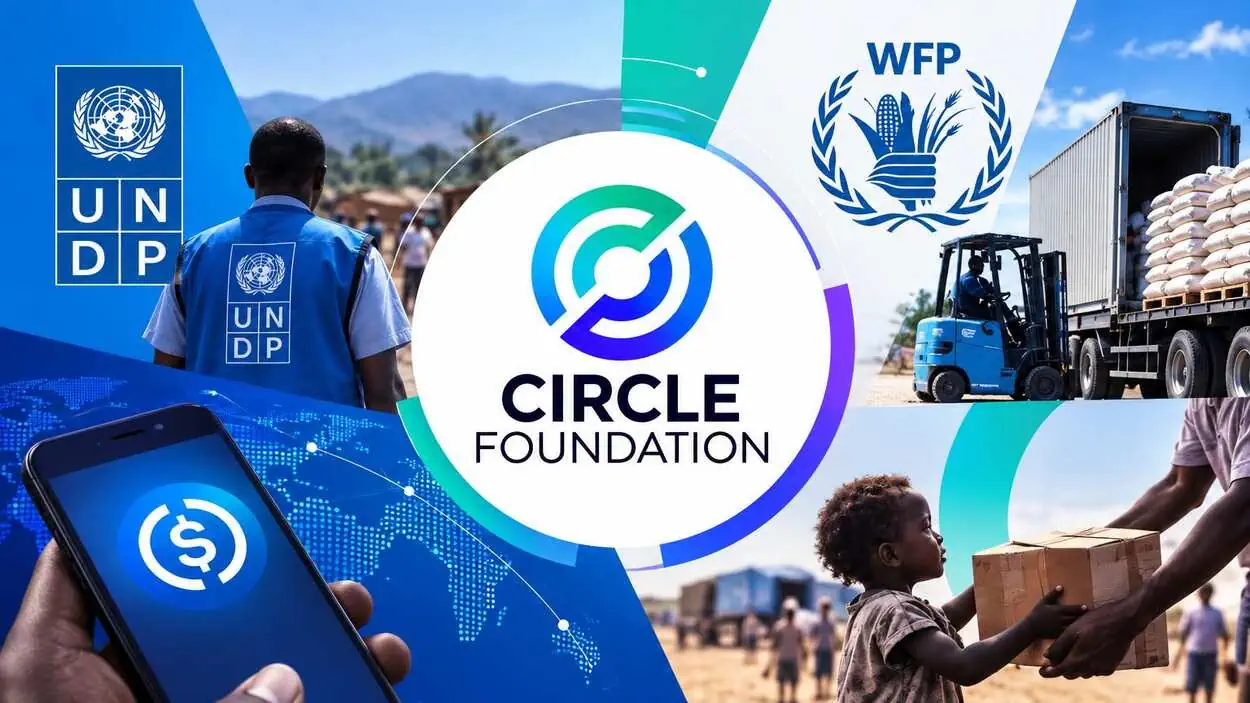






Circle Foundation on 25th September, 2026 announced grants to the United Nations Development Programme (UNDP) and the World Food Programme (WFP). The funding pushes stablecoin aid payments from pilots toward routine use.
The Brief
- Circle Foundation, seeded by Circle Internet Group’s 1% equity pledge, is funding separate digital payment programs at UNDP and WFP.
- UNDP will use its grant to set up the Digital Asset Innovation Pool for regulated payment stablecoins in development programs.
- WFP plans to test two to three country payment corridors over three years with local financial providers and markets.
- The announcement from Circle and the two agencies does not disclose grant amounts or name a specific stablecoin.
UNDP moves four pilots toward regular delivery
UNDP will create and run the Digital Asset Innovation Pool with the grant, according to the joint announcement. The Pool builds on UNDP’s SDG Blockchain Accelerator, led by its Alternative Finance Lab. Those pilots covered four settings:
- Digital Cash-for-Work payments in Aleppo, Syria.
- Disbursements built for low-connectivity conditions in Haiti.
- A remittance-linked community investment model in Guatemala.
- Mobile wallets tied to existing cash-agent networks in The Gambia.
Country Offices now get structured implementation support, regulatory and operational guidance, and beneficiary safeguards. They also get tools to track delivery time, cost and reach.
“Getting resources to people should not be the most difficult or expensive part of delivering a programme,” said Robert Pasicko, Team Lead at the UNDP Alternative Finance Lab.
The agencies drew a clear limit around the tool. “The Pool is not intended to replace established banking channels,” the release said. It adds an option where conventional systems create high costs, delays or access barriers.
Circle Foundation is supporting two initiatives led by @UNDP and @WFP to advance digital payments and financial infrastructure for development and humanitarian action.https://t.co/SeDkNrUAiV
— Circle (@circle) September 25, 2026
WFP builds the back office first
A separate grant goes to World Food Program USA. It supports WFP and the WFP Innovation Accelerator in building the institutional base for regulated, stablecoin-enabled payments.
The spending list is mostly plumbing. It covers governance and risk frameworks, treasury and reconciliation systems, and compliance tools built to hold up across multiple country operations. It also funds local fintech and mobile money integration.
Independent, sector-wide research on cost, speed and operational feasibility is also in scope. The release calls it the humanitarian sector’s “first real benchmarks” on stablecoin-enabled payments.
Bernhard Kowatsch, Director of the WFP Global Accelerator and Ventures, said the support lets WFP test these payments in real-world contexts. He added that the aim is to build the evidence, partnerships and infrastructure needed to scale responsibly.
Elisabeth Carpenter, Circle’s Chief Strategic Engagement Officer and Founding Chair of Circle Foundation, framed the case around cost. She argued that faster, cheaper and more transparent transfers let more of each aid dollar reach people in crisis.
Circle Foundation now funds three layers of UN payments
The two grants extend a pattern. UNHCR launched the Digital Hub of Treasury Solutions (DHoTS) in 2021 as a shared treasury platform. It now brings together 15 UN organizations, including UNDP and WFP. Circle Foundation made its first international grant to DHoTS in January 2026.
The foundation’s money now sits at three points. DHoTS covers the shared treasury layer. UNDP’s Pool covers program payouts. WFP’s grant covers compliance, reconciliation and local mobile money links. Together they span the path from UN treasury to last-mile recipient.
The release still leaves several questions open:
- How large are the two grants?
- Which regulated stablecoins will UNDP and WFP use?
- Which countries will host WFP’s corridor tests?
Circle Foundation is a donor-advised fund managed by Fidelity Charitable, established by Circle in 2025. For NGOs and payment providers already working with these agencies, the independent WFP research is the dataset to watch. WFP’s corridor tests run over the next three years. They are set to generate evidence on efficiency, transparency and resilience for WFP and the wider humanitarian sector.