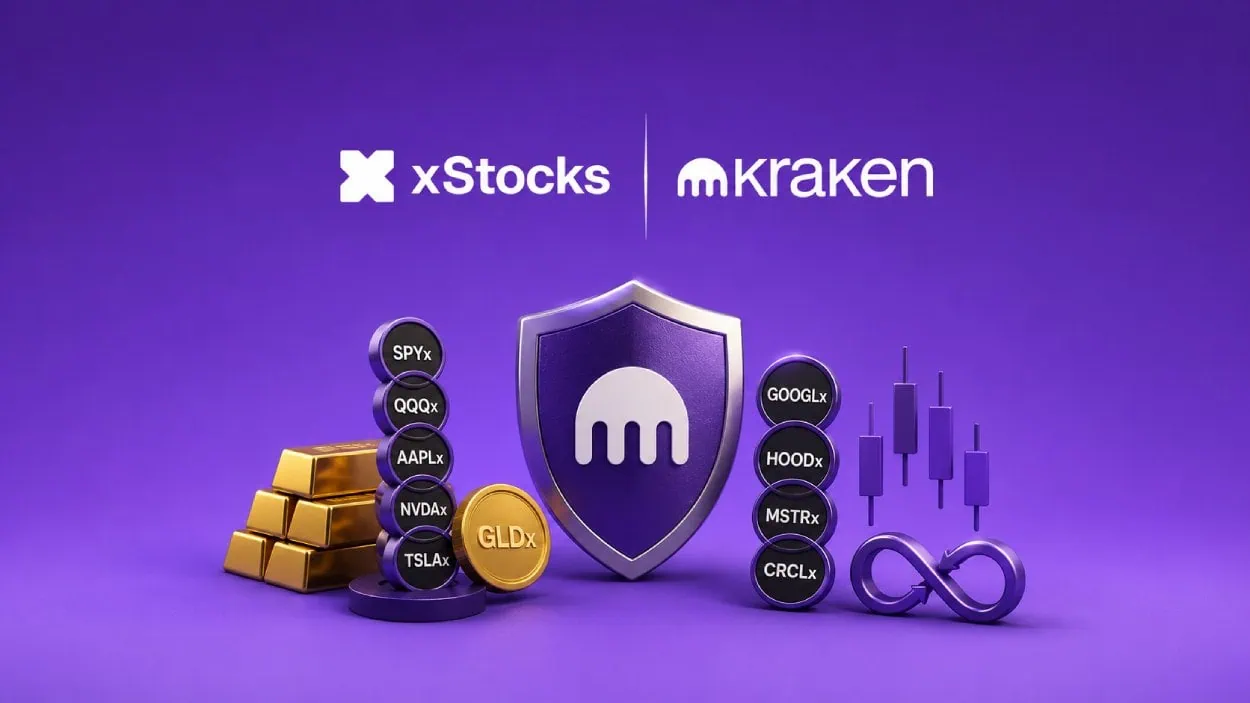







Kraken began letting eligible non-US traders use ten tokenized stocks and ETFs as collateral for futures and margin trading on Kraken Pro, the exchange announced July 3, 2026. Holders can establish leveraged positions using existing xStock holdings without liquidating them first.
Key Takeaways
- Kraken added ten tokenized stock and ETF assets as eligible collateral for futures and margin trading on Kraken Pro.
- Collateral haircuts range from 10% for broad-market ETFs SPYx and QQQx up to 30% for HOODx, MSTRx, and CRCLx, the tokenized wrapper on Circle Internet Group shares.
- Collateral caps reach $1 million for the two broad ETFs, with most individual stocks capped lower.
- The feature excludes US clients, and margin collateral specifically excludes EEA residents while futures collateral includes them.
- The launch follows a June institutional lending model Kraken built with Maple using a bankruptcy-remote vehicle for crypto-backed loans and a May tie-in with Franklin Templeton.
What Happened?
Kraken Pro, according to Kraken’s own blog post dated July 3, 2026, expanded xStocks functionality to permit their use as collateral in futures and margin trading. xStocks are blockchain-based tokens that, per Crypto.news reporting, track more than 60 tokenized U.S. stocks and ETFs, each backed 1:1 and tradable 24 hours a day, five days a week.
Kraken is a major Crypto exchange and the move extends Kraken’s product lineup beyond spot and derivatives trading into tokenized-equity collateral. The structure mirrors patterns visible in Retail investing data, where traders increasingly hold assets for utility beyond simple price exposure.
The ten assets eligible at launch are SPYx, QQQx, AAPLx, GOOGLx, TSLAx, NVDAx, HOODx, MSTRx, GLDx, and CRCLx, tokenized wrappers on the SPDR S&P 500 ETF, Invesco QQQ Trust, Apple, Alphabet, Tesla, Nvidia, Robinhood, Strategy (formerly MicroStrategy), gold, and Circle Internet Group shares. A trader holding NVDAx, for instance, can pledge that position as collateral for a leveraged trade instead of liquidating it first, improving capital efficiency for holders.
NEW: Kraken lets users use tokenized stocks and ETFs as collateral for leveraged crypto trading pic.twitter.com/vEdkC1RzJx
— crypto.news (@cryptodotnews) July 5, 2026
Haircuts and Collateral Limits
Kraken applies a different haircut and dollar cap to each asset, scaling the discount to the underlying stock’s volatility. The two broad-market ETFs get the lightest treatment at a 10% haircut, while the three most volatile names get the steepest at 30%.
| Haircut | Assets | Collateral cap |
|---|---|---|
| 10% | SPYx, QQQx | $1 million each |
| 20% | AAPLx, GOOGLx, TSLAx, NVDAx, GLDx | $100,000 to $250,000 |
| 30% | HOODx, MSTRx, CRCLx | $100,000 to $250,000 |
Kraken said these limits and haircuts may change over time. Eligible xStocks are recognized automatically as collateral on accounts where futures and margin trading are already available, so users do not need to move assets into a separate product before using them.
Jurisdiction Rules Split Futures From Margin
The feature carries a jurisdictional split that traders need to track closely, since the two collateral types don’t follow identical eligibility rules. Futures collateral access extends to eligible clients outside the United States, including the EEA (European Economic Area, the EU plus Iceland, Liechtenstein, and Norway).
Margin collateral, by contrast, is available to eligible clients outside the United States but excludes EEA residents. US clients are excluded from the feature entirely under both product types.
The split suggests futures and margin lending clear different EU regulatory bars for a tokenized-equity product, not one blanket rule.
Kraken paired the feature with a direct risk warning. If the value of your collateral falls, your position may be subject to a margin call or liquidation. A separate line from the exchange put it more bluntly: This is not a risk-free way to access leverage.
Both haircuts and price swings in the underlying stock can trigger a margin call before a trader expects one.

Kraken’s Widening Collateral Stack
The xStocks collateral launch is the third leg of a pattern, not an isolated feature. In June, Kraken and Maple launched an institutional lending model using a bankruptcy-remote vehicle for crypto-backed loans, a product focused on structured credit rather than trader collateral.
In May, Payward and Franklin Templeton announced a partnership to bring tokenized money market products into Kraken’s platform as collateral and cash management tools. Payward is Kraken’s parent company.
Read together, the three moves show Kraken assembling a full collateral stack, tokenized equities, tokenized money-market funds, and institutional warehouse credit, rather than shipping one product at a time. The tokenized-asset market backs up that scale: a recent hackathon report said tokenized stock markets had reached roughly $1.2 billion in market cap, while xStocks had logged more than $25 billion in total transaction volume.
CoinLaw’s Takeaway
This launch converts previously illiquid tokenized-equity exposure into working trading capital, the specific gap it closes. A trader who wanted leverage previously had to sell an xStocks position and re-enter later; the same holding now backs a leveraged position directly. The volatility-scaled haircuts show Kraken pricing that risk asset by asset rather than applying one blanket discount.
The jurisdictional carve-out is the detail worth watching: splitting EEA eligibility between futures and margin suggests EU margin-lending rules are harder to clear than futures rules for a tokenized-equity product. Kraken’s own risk language, a margin call or liquidation risk stacked on top of the built-in haircut, is the clearest statement in the announcement that this is a leverage tool with real downside, not a yield product.