









In the evolving world of blockchain technology, Ethereum has long been a dominant player, especially when it comes to decentralized applications (dApps) and smart contracts. Yet, for all its influence, Ethereum’s gas fees have often been a point of contention. Imagine trying to buy a small item, only to be charged more in transaction fees than the item itself!
This has been the experience for many Ethereum users, especially during periods of network congestion. As Ethereum transitions and adapts, the landscape of gas fees continues to shift, promising both challenges and opportunities for users.
Editor’s Choice
- Basic ETH transfer fees fell to about $0.01 in January 2026, down sharply from 2025 levels.
- Ethereum processed a record 2.89 million transactions on February 7, 2026.
- Ethereum handled 200.4 million transactions in Q1 2026, up about 43% quarter over quarter.
- Layer 2 networks process roughly 2 million daily transactions in 2026, about double Ethereum mainnet volume.
- Ethereum’s daily transaction count hit 2,885,524 on January 16, 2026, the highest on record.
- The network saw about 12.6 million active addresses between January 1 and March 31, 2026.
- Daily active addresses climbed to a three-year high of about 1.03 million on January 16, 2026.
- New wallet creation hit 450,000 in a single day on January 11, 2026.
Recent Developments
- On February 26, 2026, Ethereum’s average gas price was about 0.70 Gwei, far below the 3.146 Gwei recorded a year earlier.
- Average ETH transaction fees were around $0.16-$0.22 in March 2026, down from $0.41 in February 2025.
- Ethereum gas fees dropped to roughly $0.01 in January 2026, showing how sharply mainnet costs have fallen.
- The network processed about 2.6 million transactions on January 17, 2026, without major congestion.
- Layer 2 networks handled close to 2 million daily transactions in 2026, roughly double Ethereum mainnet volume.
- Layer 2s accounted for about 95% of Ethereum’s total transaction throughput by late 2025, heading into 2026.
- Assets held on Ethereum rollups exceeded $37 billion as Layer 2 adoption continued to scale.
- Ethereum recorded 1.98 million transactions on January 2, 2026, extending its run of historic on-chain activity.
Ethereum Gas Fee Snapshot and Network Conditions
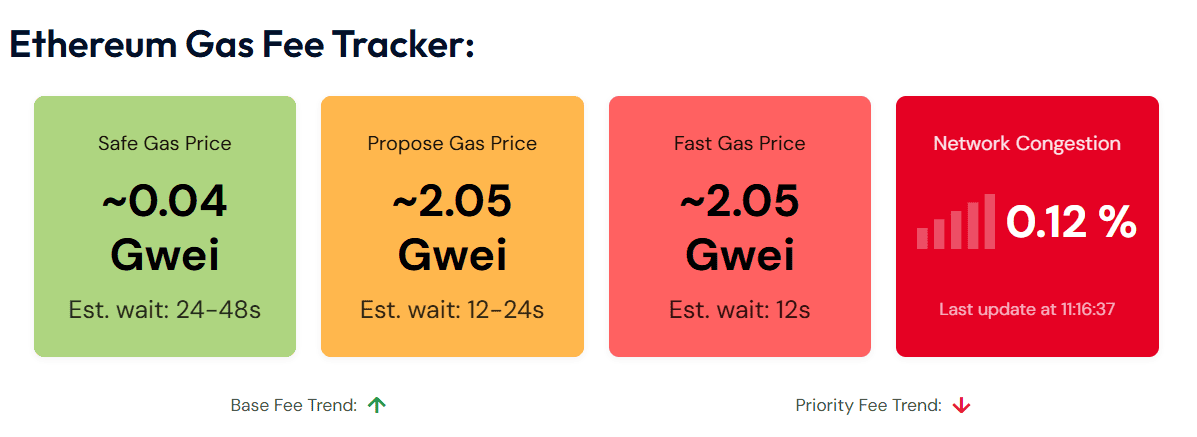
- The safe gas price is currently around 0.04 Gwei, with an estimated transaction time of 24–48 seconds, indicating extremely low-cost network usage.
- The standard (propose) gas price stands at approximately 2.05 Gwei, reducing wait times to about 12–24 seconds for moderately fast confirmations.
- The fast gas price is also about 2.05 Gwei, enabling near-instant transaction processing with an estimated wait time of ~12 seconds.
- Network congestion remains minimal at just 0.12%, reflecting a highly uncongested Ethereum network environment.
- The base fee trend is increasing, suggesting a gradual rise in underlying transaction costs despite low congestion levels.
- Meanwhile, the priority fee trend is decreasing, indicating reduced competition among users to prioritize transactions.
- The narrow gap between propose and fast gas prices (both ~2.05 Gwei) highlights low demand pressure across the network.
- Overall, the data signals a period of efficient transaction processing, with low fees and fast confirmation times across all speed tiers.
Gas and the Ethereum Virtual Machine (EVM)
- Ethereum gas fell to about 0.052 Gwei on April 7, 2026, showing how cheaply the EVM can execute transactions.
- Basic Ethereum gas fees dropped to roughly $0.01 in January 2026 despite record network usage.
- Ethereum processed over 2.88 million transactions in a single day in January 2026 with low EVM fees.
- Average mainnet transaction costs declined to about $0.10-$0.20 after EIP-4844.
- Layer 2 transactions on EVM-compatible rollups cost around $0.001-$0.05.
- Blob capacity reached about 375 KB per block under Ethereum’s new fee model.
- Ethereum’s base fee can still adjust by up to 12.5% per block under EIP-1559.
- Ethereum’s PoS transition cut energy use by about 99.95% while leaving EVM gas accounting intact.
- Layer 2 networks now process more transactions than the Ethereum mainnet combined in 2026.

Understanding Gas in Ethereum
- Common Ethereum transactions cost about $0.15 on average in January 2026.
- Some real-time Ethereum transactions fell below $0.01 in early 2026.
- Layer 2 transaction costs dropped to about $0.001-$0.05, far below mainnet costs of $0.10-$0.20.

- Ethereum’s average gas price was about 0.47 Gwei in early April 2026, down from 1.67 Gwei a year earlier.
- Etherscan showed average gas at just 0.052 Gwei on April 7, 2026.
- Ethereum’s base fee can rise or fall by up to 12.5% per block under EIP-1559.
- Ethereum’s 2026 roadmap includes a target of 100 million gas to boost base-layer throughput.
Factors Influencing Gas Fee Fluctuations
- Ethereum’s average gas price was just 0.052 Gwei on April 7, 2026, showing how low demand pressure can push fees down.
- Basic Ethereum transaction fees fell to around $0.01 in January 2026 after protocol upgrades and Layer 2 expansion.
- Ethereum’s base fee can increase or decrease by up to 12.5% per block, depending on block congestion.
- Blocks above 50% utilization push the base fee higher under EIP-1559.
- High-demand periods once drove Ethereum fees to $196 per transaction at the May 2021 peak.
- Layer 2 transactions can cost under $0.10, reducing pressure on Ethereum mainnet fees.
- Ethereum mainnet fees dropped roughly 95% to $0.01 per transaction by early 2026.
- Daily gas revenue fell from about $23 million at peak to $6.3 million as lower fees reduced burn activity.
- Ethereum’s gas market still uses priority tips, where users bid extra ETH for faster inclusion during congestion.
Top Blockchains by Annual Fee Revenue
- Solana led February 2026 monthly network revenue with $26.7 million.
- Tron ranked second in February 2026 with $24.4 million in monthly revenue.
- Ethereum placed third in February 2026 after generating $23.2 million in monthly revenue.
- BNB Chain recorded $9.3 million in February network revenue.
- Base posted $8.4 million in February revenue, the highest among listed Layer 2 networks.
- Bitcoin generated $5.5 million in February network fees.
- Polygon earned $4.9 million in February revenue.

Concerns About Ethereum Gas Fees
- Basic Ethereum gas fees dropped to about $0.01 in January 2026, down sharply from the $1.50+ concern level.
- Etherscan showed average gas at just 0.052 Gwei on April 7, 2026.
- Ethereum’s daily average gas price was 0.4697 Gwei, down from 1.67 Gwei a year earlier.
- Ethereum processed 2.6 million transactions on January 17, 2026, without major fee spikes.
- ETH traded at $3,319.87 during that January throughput peak, showing that fiat fee sensitivity still depends on ETH price.
- Ethereum’s current ecosystem throughput averaged about 325 TPS across scaling networks, far above Layer 1 alone.
- The Ethereum gas limit had risen to 60 million, roughly 2x higher than a year earlier.
- Post-Merge, Ethereum’s energy consumption remains about 99.95% lower than before the transition.
- Ethereum uses about 0.0026 TWh of energy annually under proof-of-stake.
How Ethereum Gas Powers Transactions
- The sender still pays 1 ETH plus gas, while the receiver gets exactly 1 ETH.
- A validator must stake 32 ETH to process and attest to Ethereum blocks.

- A basic ETH transfer cost about $0.01 in January 2026 and around $0.20 in late February.
- Ethereum handled 2.6 million transactions on January 17, 2026, while keeping gas near record lows.
- Ethereum’s base fee can rise or fall by up to 12.5% per block based on demand.
- Ethereum now has over 1 million active validators securing transactions.
- Proposed fast-confirmation upgrades aim to reduce practical confirmation time from about 12 minutes to 12 seconds.
- Ethereum’s roadmap targets native throughput of 10,000 TPS over time.
Strategies for Users to Optimize Gas Costs
- Ethereum gas fees fell to around $0.01 in January 2026, making timing less critical than in prior years.
- The lowest-fee window is typically 00:00-06:00 UTC, when transactions can be 50%-70% cheaper than midday.
- Saturday and Sunday remain the cheapest days for Ethereum transactions based on historical fee patterns.
- Ethereum’s block gas limit increased to 60 million, improving transaction capacity.
- Ethereum’s 2026 roadmap points toward a potential 200 million gas limit for lower Layer 1 costs.
- Layer 2 networks already process over 1.9 million daily transactions, showing why shifting activity off mainnet saves users money.
- Scheduled blob capacity rose from 6 to 14 blobs per block, helping reduce Layer 2 data costs.
Frequently Asked Questions (FAQs)
Ethereum handled 2.6 million transactions on January 17, 2026.
Average gas fees were around $0.15, with some swaps as low as $0.04.
Many Layer 2 transactions cost under $0.01.
Layer 2 networks cut costs by about 97%-99% versus mainnet.
Conclusion
Ethereum gas fees have long been both a challenge and a catalyst for innovation within the blockchain community. With the introduction of Layer 2 solutions, major updates like the Merge, and upcoming advancements like proto-danksharding, Ethereum is on a promising path toward more accessible and affordable transactions. As developers, users, and stakeholders adapt, Ethereum’s fee structure is likely to become more user-friendly and inclusive, fostering broader adoption and usability. While challenges remain, the roadmap ahead suggests a future where gas fees are less of a barrier and more of a tool for sustainable network growth.





SPSamantha P.
Interesting take on the factors influencing gas fee fluctuations. Thank you.
ARAlex R.
I’ve noticed gas fees have been kinda unpredictable lately, makes planning when to make a move a bit tricky. Barry, your piece on gas fees after The Merge caught my eye. Gives a solid overview without getting too into the weeds. Hang tight, folks. It’s all part of riding the crypto wave.