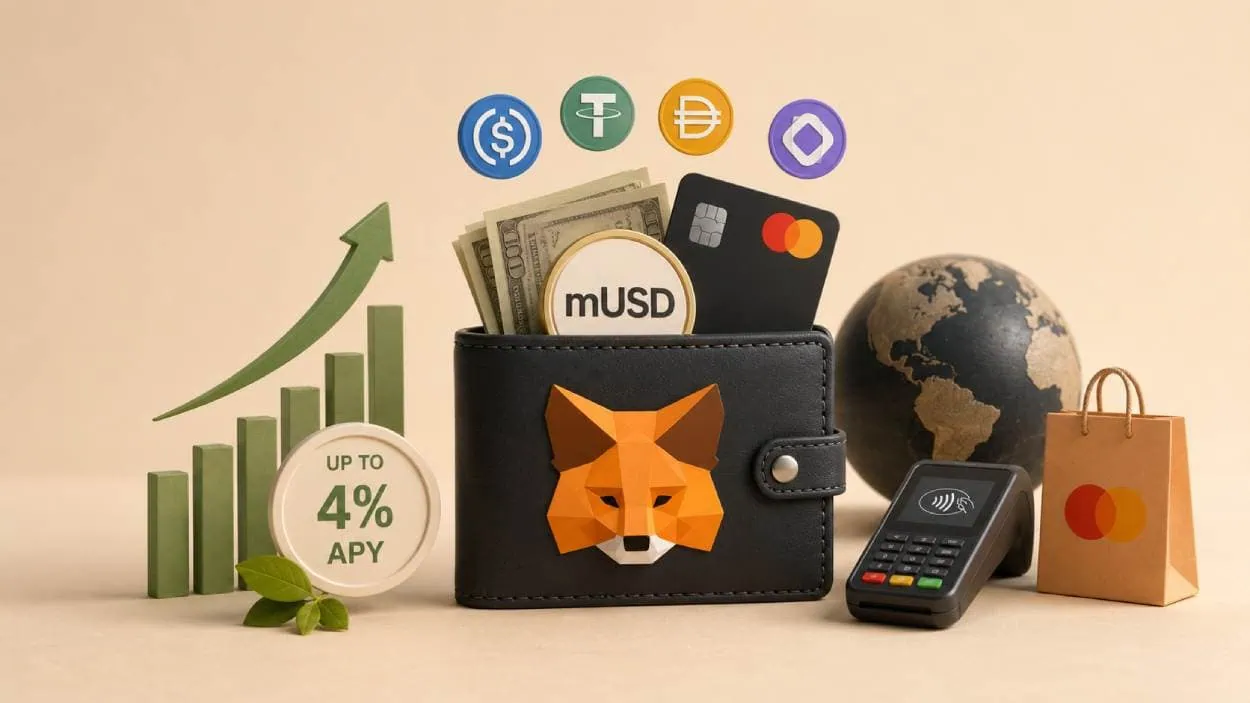







MetaMask Money Account launched on June 30, 2026, a self-custodial balance on the Monad blockchain that earns up to 4% APY through third-party DeFi platforms. Deposited funds convert to mUSD, a dollar-backed stablecoin, spendable at Mastercard merchants worldwide.
Key Points
- The account is a fully liquid Monad-based balance, according to MetaMask, earning up to 4% APY automatically, with no lockups, no fees to open, and no minimums.
- mUSD is backed 1:1 by US dollars and short-term Treasury bills in regulated custody, per MetaMask, and is issued through Bridge, a Stripe company.
- The MetaMask Card works at hundreds of millions of Mastercard merchants worldwide, per MetaMask, returning up to 3% cashback on each purchase into the account.
- Money Account is not a bank account, savings account, or insured deposit product, according to MetaMask, and APY is variable and not guaranteed.
- The account rolls out on MetaMask Mobile v8.0.0 and above for iOS and Android, per MetaMask, with availability varying by region.
What Happened?
Consensys, the Ethereum infrastructure firm co-founded by Joseph Lubin, launched the MetaMask Money Account on June 30, 2026, in one of the wallet’s biggest moves beyond simple crypto storage. The self-custodial, Monad-based account gives users a single interface to trade, send, spend, and earn, keeping them in control of their own assets while their balance starts working the moment it is funded.
Funds convert to mUSD upon deposit, and the account earns APY through third-party DeFi platforms that deploy funds in blockchain protocols. MetaMask states that APY is variable, not guaranteed, and may fluctuate with market conditions, and that earnings begin immediately upon funding.
mUSD is backed 1:1 by US dollars and short-term US Treasury bills held in regulated custody, and is issued through Bridge, a Stripe company. The account is self-custodial, and infrastructure is provided by Veda and Steakhouse Financial.
It’s time to turn your money on.
— MetaMask 🦊 (@MetaMask) June 30, 2026
Introducing the MetaMask Money Account. 🦊 pic.twitter.com/9p2bKlYIjo
Supported deposit assets include mUSD, USDC, USDT, and DAI along with their Aave wrapped versions, and accounts can be funded by debit card, credit card, bank account, PayPal, Apple Pay, or Google Pay. Trading spans tokens, perpetuals, prediction markets, tokenized stocks, ETFs, and commodities.
The MetaMask Card and Spending Layer
The MetaMask Card is accepted at hundreds of millions of Mastercard merchants worldwide, and cardholders receive up to 3% cashback per purchase deposited back into the account. The card converts self-custodial yield into everyday spending without a separate withdrawal step. That reduces the friction of earlier DeFi-to-fiat flows, which typically required moving funds to an exchange before cashing out.
Money Account is rolling out on MetaMask Mobile v8.0.0 and above, with iOS and Android availability in the days after the June 30 launch, and availability varies by region.
What the Risk Disclosure Reveals?
The launch announcement includes a risk disclosure that carries significant legal weight. MetaMask states Money Account is not a bank account, savings account, or insured deposit product, that APY is variable and not guaranteed, and that smart contract, liquidity, protocol, and other risks could in extreme cases result in partial or total loss of funds.
US bank deposits are FDIC-insured to at least $250,000 per depositor at each insured bank, a federal backstop if the bank fails. A Money Account user, by contrast, bears protocol risk directly across decentralized finance markets, with no deposit insurance and no issuer backstop.
The self-custodial structure is also a regulatory positioning choice. In 2022 the SEC charged BlockFi with failing to register its retail crypto-lending product, and the firm settled for $100 million. That action targeted a custodial model, where users handed asset control to a platform in exchange for yield, and other centralized lenders later faced similar SEC charges.
By keeping users in control of their own assets, Money Account distances itself from those enforcement targets. Regulators, however, have not formally adjudicated self-custodial yield wallets as a distinct category. That leaves a live question about how existing securities and lending frameworks apply.
The “availability varies by region” notice is another compliance signal. The EU’s Markets in Crypto-Assets Regulation (MiCA) imposes authorisation and reserve requirements on issuers of asset-referenced tokens and e-money tokens, with particular focus on protecting retail holders of crypto-assets. US federal stablecoin rules, by contrast, are still being finalized.

CoinLaw’s Takeaway
The MetaMask Money Account bundles yield, multi-asset trading, and consumer spending inside a single self-custodial wallet, and does so at consumer scale. The Mastercard integration and the headline yield push DeFi returns into the kind of everyday behavior once reserved for fintech bank accounts. With its Monad architecture, Consensys stakes out the unified-balance wallet as its own territory.
The risk disclosure, however, is the product’s legal center of gravity. A consumer’s intuitive reading of a “yield account” sits a long way from the legal reality: an uninsured DeFi position that carries smart-contract and liquidity risk. And the jurisdiction-by-jurisdiction rollout signals that Consensys treats the regulatory question as still open, not settled, in its major target markets.