






Blockchain and centralized databases both play critical roles in modern finance, but their differences matter. Blockchain powers new financial models like tokenization and stablecoins, while centralized systems still dominate high-speed processing in banks. For example, the USDC stablecoin ecosystem grew nearly 90% year-over-year, reaching $61.3 billion by mid-2025 and climbing further since. Meanwhile, traditional systems remain the backbone of daily transactions worldwide. This article unpacks the latest stats and shows how both technologies shape finance. Continue reading for detailed insights.
Editor’s Choice
- USDC stablecoin circulation: $61.3 billion as of June 30, up 90% year-over-year; reached $65.2 billion by August 10.
- GENIUS Act passes, marking the first U.S. federal framework for stablecoins.
- Blockchain in the banking and financial services market grew from $6.98 billion in 2024 to $10.85 billion in 2025, a 55.3% CAGR.
- Global blockchain tech market: estimated at $31.28 billion in 2024, projected to reach $57.72 billion in 2025.
- Cross-border payments via blockchain are growing at 48% annually, expected to hit $5 trillion by 2025.
- Blockchain users worldwide: over 560 million (≈3.9% of global pop.) in 2025.
- Enterprise blockchain spending is projected to reach $19 billion globally in 2025.
Recent Developments
- Launch of Arc, a blockchain network by Circle for capital markets and FX, testing in fall 2025 and full launch by year-end.
- U.S. GENIUS Act mandates stablecoins to be fully backed 1:1 by high-quality assets.
- Major firms, Bank of America, Citigroup, Walmart, and Amazon, are planning or exploring dollar-backed stablecoins post-GENIUS Act.
- Goldman Sachs and BNY Mellon integrate tokenized money market funds via GS DAP; ~$6.75 billion in assets now tokenized.
- Traditional banks, including HSBC and Bank of America, partner with R3 to adopt the Solana blockchain, shifting from private to optional public chains.
- Tradeweb saw daily trading volume rise 33% year-over-year, reaching $2.5 trillion in May 2025 amid expansions in blockchain initiatives.
- Bank of America projects that stablecoin infrastructure build-out may take 3–5 years, with growing adoption by firms like Visa, PayPal, and Shopify.
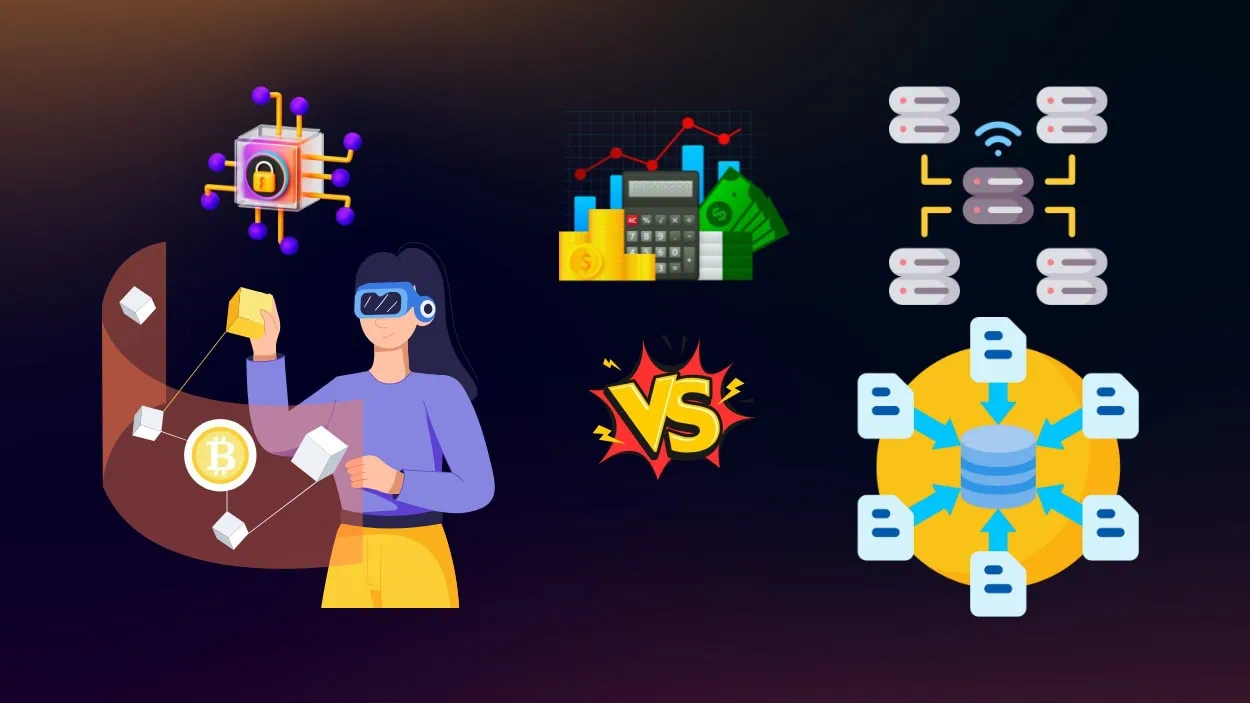
Blockchain vs. Centralized Database: Key Differences
- No third-party dependence in blockchain, while centralized databases rely on administrators and central controls.
- Immutable data: Blockchain data cannot be changed or deleted, but authorized users can alter data in centralized databases.
- Flexibility: Adding or removing parties in blockchain requires no system architecture changes, whereas centralized databases require structural changes.
- Lower maintenance costs are typical for blockchain, while centralized databases face higher management costs.
- Verification in blockchain uses certificate-based validation, while centralized databases rely on usernames and passwords.
- Process flow in blockchain is executed without system changes, but centralized systems need modifications for new processes.
- Blockchain operates with an Open Ledger shared by all users, while centralized databases store data in a single center.
- Blockchain supports Smart Contracts to group transactions, while centralized systems lack grouping structures.
- Timestamps are automatic in blockchain, while centralized databases require them to be added manually.
- Blockchain works without requiring trust between parties, but centralized databases depend on a central authority.
- In blockchain, the process flow is embedded in blocks, while centralized databases must add process flows manually via logging.

Overview of Blockchain Adoption in Finance
- Blockchain spending worldwide is expected to hit $19 billion in 2025.
- An estimated 560 million people (3.9% of the global population) use blockchain tech in 2025.
- Market for blockchain in banking & financial services: $10.85 billion in 2025, up from $6.98 billion in 2024.
- The global blockchain tech market is expanding from $31.28 billion (2024) toward $57.72 billion in 2025.
- Cross-border blockchain payments grew 48% annually, targeting $5 trillion in 2025.
- AI-powered blockchain integration market projected to exceed $703 million in 2025.
- Nearly 90% of businesses surveyed report deploying blockchain in some capacity.

Centralized Database Usage in Financial Systems
- While blockchain grows, centralized databases remain ubiquitous for high-speed trading, real-time settlements, and core banking operations.
- Traditional systems offer low-latency, high-volume processing at scale.
- Most banks and institutions adopting blockchain are doing so in sandbox environments, while keeping legacy centralized ledgers as primary systems.
- Enterprise adoption remains selective and strategic, supplementing rather than replacing centralized databases.
- Centralized systems benefit from robust regulatory infrastructure, data privacy controls, and institutional trust.
- Implementation speed and cost predictability remain advantages of centralized models.
Security Comparison
- Blockchain offers immutable audit trails and tamper-resistant logs, critical for fraud reduction and transparency.
- Centralized databases often carry single points of failure, while blockchain distributes trust across nodes.
- However, blockchain (especially DeFi) faces smart-contract vulnerabilities and hacks.
- Permissioned blockchains (like GS DAP or R3 Corda) rely on centralized governance.
- Regulatory clarity introduced by laws like the GENIUS Act helps standardize security requirements for stablecoins.
- Centralized systems typically ensure security via strong encryption, access controls, and existing compliance protocols.
- Blockchain’s public ledger model boosts transparency, but privacy layers (e.g., zk-proofs) remain less mature.
Top Blockchain Challenges
- 60% of companies cite lack of adoption by other businesses as the biggest hurdle to blockchain growth.
- 49% point to a shortage of skilled professionals who can effectively use and manage blockchain technology.
- 38% of users express a lack of trust, limiting broader acceptance of blockchain systems.
- 37% highlight financial constraints as a major barrier to implementation.
- 35% identify the issue of separate blockchains not working together, underscoring the need for interoperability.

Transparency and Auditability
- 18% of global Letters of Credit (LoC) now rely on blockchain.
- 84% of surveyed financial institutions found greater transparency and trust in trade finance using blockchain platforms.
- Blockchain provides immutable, real-time ledgers that eliminate reconciliation delays.
- Shared access to transaction history fosters trust among all participants.
- Consensus-based validation ensures verifiable, chronological recording.
- Deloitte COINIA enables auditors to load hundreds of thousands of addresses and view 100% of transactions.
- COINIA supports off-chain verification of key ownership across multiple blockchain types.
- Blockchain implementation in auditing improves accuracy, slashes audit time, and boosts trust in financial reports.
- Transparency via blockchain enhances auditors’, regulators’, and investors’ confidence.
Transaction Speed and Performance
- On-chain Bitcoin processes roughly 7 transactions per second (tps), and Visa handles ~10,000 tps.
- Ethereum block times average 12 seconds per block.
- The Lightning Network achieves settlement times under one minute, sometimes in milliseconds.
- FastFabric raised Hyperledger Fabric throughput from 3,000 tps to 20,000 tps.
- Optimizations delivered a 16× performance boost to Fabric.
- Centralized systems like LedgerDB offer low-latency, high-throughput.
- DApps on Ethereum often suffer from high fees and lag under heavy usage.
- Permissioned blockchains with enhancements exceed legacy throughput but still lag centralized systems in speed.
Scalability
- Every node in a blockchain network must process transactions, creating scalability bottlenecks.
- Traditional centralized databases remain more effective for real-time, large-scale processing.
- Hyperledger optimizations improved performance for private blockchain deployments.
- LedgerDB achieves better scalability with blockchain-like features.
- Ethereum’s DApps hit fee surges and latency under high traffic.
- Lightning Network removes on-chain congestion via off-chain transactions.
- High fees during spikes limit DeFi platforms’ scalability.
- Blockchain scalability still trails centralized databases unless enhanced.
Blockchain Industry Adoption
- Banking & Finance leads blockchain adoption with a 30% share, showing its dominance in digital transactions and payments.
- The government sector follows at 13%, using blockchain for transparency, digital IDs, and secure recordkeeping.
- The insurance industry accounts for 12%, leveraging blockchain for fraud detection and claims processing.
- Healthcare and Media, Entertainment & Gaming each hold 8%, reflecting use cases in secure data sharing and digital content ownership.
- Others make up 7%, while Generic and Technology Services each capture 6%.
- Professional Services contribute 4%, while Energy & Utilities and Manufacturing each represent 3%, indicating emerging but smaller adoption areas.

Data Integrity and Immutability
- Blockchain’s immutable ledgers prevent post-recording changes.
- Transparency ensures identical records for auditors, regulators, and users.
- Consensus mechanisms validate and chronicle transactions securely.
- Deloitte COINIA confirms ownership and matches chain data with client records.
- Shared visibility makes it hard to manipulate entries undetected.
- LedgerDB offers immutability with high-speed database features.
- Blockchain’s irreversible record fixes create trust anchors.
- Blockchains retain every change automatically and transparently.
Data Privacy and Confidentiality
- Public blockchains expose transaction data, risking privacy.
- Centralized systems enforce permission-based access.
- LedgerDB merges auditability with access controls.
- Permissioned blockchains mimic centralized privacy controls.
- Deloitte COINIA allows auditors to probe data selectively.
- AI-enhanced blockchain analytics surface suspicious patterns without exposing individual data.
- Centralized systems are more mature in enforcing privacy controls.
Decentralization vs. Centralization
- Public blockchains distribute control across nodes.
- DeFi platforms enable trading and lending without intermediaries but carry higher risks.
- Centralized systems offer control through established governance.
- Hybrid models offer selective decentralization.
- DeFi protocols held ~$25.4 billion in value (45% of total TVL) as of mid‑2025.
- Smart-contract vulnerabilities pose risks to decentralization’s promise.
- Centralized systems dominate in regulation, compliance, and privacy.
Cost Efficiency
- Blockchain migration can yield ~30% lower maintenance costs.
- Faster transactions and fewer intermediaries reduce fees.
- Immutable audit trails cut down reconciliation and compliance costs.
- Blockchain’s 24/7 settlement capability boosts efficiency.
- Public networks may incur high transaction fees during peak activity.
- Centralized systems offer predictable costs and fast scaling.
- Hybrid models balance cost control with transparency gains.
- Deloitte COINIA streamlines audit workflows and reduces labor costs.
Regulatory Compliance
- Only 40 of 138 jurisdictions were “largely compliant” with FATF’s crypto standards as of April 2025.
- Illicit crypto wallet addresses may have received up to $51 billion in 2024.
- 2% of U.S. adults currently use crypto for payments.
- The EU’s MiCA regulation has been fully applicable since December 2024.
- U.S. FIT21 Act, passed in May 2024, clarifies the role of the SEC vs. the CFTC.
- The OECD’s CARF will be adopted by the EU from January 2026.
- Full implementation of U.S. frameworks like GENIUS may take several years.
- Regulatory gaps in one region can cause global implications.
Use Cases in Finance
- Asset tokenization includes real estate, equities, and commodities.
- Tokenized asset market projected to hit $2–$4 trillion by 2030.
- Canton Network pilots tokenized bonds, gold, and gilts.
- USDC is used in capital markets and FX post-GENIUS Act.
- Blockchain supports real-time tracking and settlement in trade finance.
- Use cases span fractional ownership, liquidity, and tokenized bonds.
- DeFi holds ~$25.4 billion in value (45% of total TVL) mid‑2025.
- Blockchain analytics improve fraud prevention without compromising openness.
Adoption Rates in Financial Institutions
- 77% of financial institutions see a compelling case for digital assets.
- Bank of America, Citigroup, and others are exploring tokenized assets.
- Firms are engaging in sandbox trials and pilot programs.
- FedNow and TCH RTP expected to hit 80% adoption by 2026.
- Blockchain in banking & finance market hit $10.85 billion in 2025.
- Authorities push for crypto analytics ahead of new regulations.
- Demand for blockchain-aware fraud controls is growing.
Real‑Time Processing Capabilities
- Blockchain enables 24/7 settlements.
- FedNow adoption highlights need for real-time fraud detection.
- Canton Network supports the fast settlement of bonds and commodities.
- Graph-based detection flags suspicious patterns before settlement.
- Blockchain analytics enable real-time compliance monitoring.
- DeFi platforms process transactions in real time.
- Permissioned blockchains improve throughput with parallel validation.
Impact on Fraud Prevention
- Over $2.17 billion has been stolen from crypto services already in 2025.
- $2.2 billion was stolen from private key compromises.
- Crypto scam losses reached $9.3 billion.
- Investment scams caused $5.8 billion in U.S. losses.

- Synthetic identity fraud and deepfakes are on the rise.
- £1.1 billion lost to fraud in the UK.
- AI-driven detection offers privacy-preserving fraud prevention.
- New laws increase accountability and demand proactive defenses.
Interoperability Challenges
- Canton Network connects institutions, but cross-jurisdiction hurdles persist.
- Tokenized assets depend on oracle reliability.
- Diverse frameworks complicate global deployments.
- Fragmentation between blockchain types creates mapping issues.
- Consistent privacy and auditability are hard to maintain across systems.
- Different tax rules can misalign compliance.
- Interoperability requires regulator-technologist collaboration.
Conclusion
Blockchain and centralized systems continue to evolve in parallel. Regulatory clarity, via the GENIUS Act, MiCA, CARF, and FIT21, is unlocking new potential for stablecoins, tokenization, and digital assets across institutions. Yet challenges remain: fraud rates are rising, especially in crypto, while interoperability and compliance complexity hinder unified adoption. Nevertheless, high adoption intent among 77% of financial firms, innovative use cases like asset tokenization and networks such as Canton, plus emerging tools in real-time fraud analytics, suggest a significant shift is underway. The future of finance may well lie in hybrid models, blending blockchain’s transparency and decentralization with centralized systems’ speed, control, and reliability.