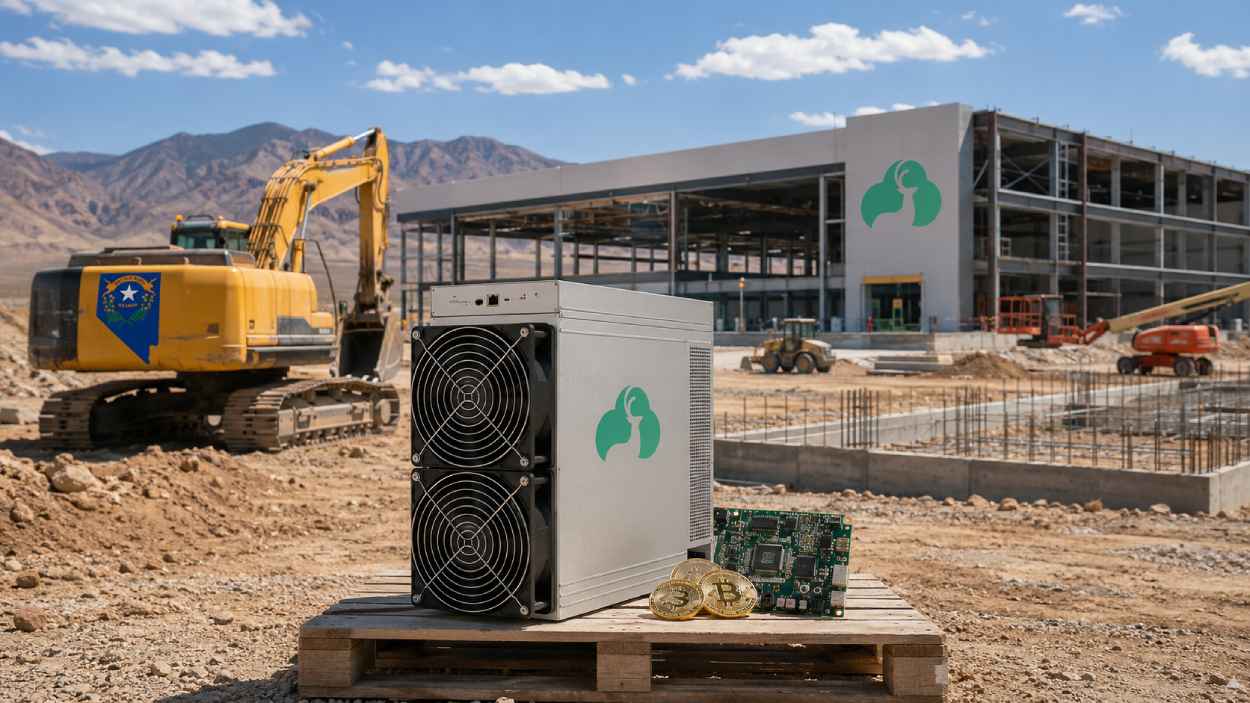







Bitdeer Technologies Group announced on July 9, 2026, that it has broken ground on a $36 million manufacturing facility in Sparks, Nevada. The plant is the company’s first domestic manufacturing and assembly footprint.
Key Takeaways
- Bitdeer Technologies Group broke ground on a $36 million advanced electronics manufacturing facility in Sparks, Nevada, its first domestic production site.
- The 187,000-square-foot plant will assemble Bitdeer’s SEALMINER Bitcoin mining hardware, targeting 10,000 units produced each month once complete.
- Construction is slated for completion by the end of 2026.
- The facility will create 70 high-tech jobs spanning engineering, technician, and support roles in Northern Nevada.
- Paul Hanson, Chairman of Bitdeer Industrial, and Taylor Adams, President and CEO of the Economic Development Authority of Western Nevada (EDAWN), both framed the plant as a win for the region.
What Happened?
The $36 million investment, according to Bitdeer, covers the plant, equipment, and construction of a 187,000-square-foot advanced electronics manufacturing facility, detailed in the company’s announcement. The Sparks facility will complement Bitdeer’s existing U.S. data centers and its innovation hub in San Jose, California.
Paul Hanson, Chairman of Bitdeer Industrial said:
The plant will create 70 high-quality local jobs spanning engineering, skilled technician, and support roles, including opportunities for new entrants to the workforce. Bitdeer said the operations will directly contribute to Northern Nevada’s rapidly expanding electronics manufacturing ecosystem.
@Bitdeer has kicked off construction of its 187,000 sq. ft. advanced electronics #manufacturing facility in Sparks, #Nevada. The $36 million investment establishes $BTDR‘s first US domestic manufacturing and assembly footprint. 🇺🇸
— Bitdeer (@Bitdeer) July 10, 2026
Slated for completion by the end of 2026, the… pic.twitter.com/XLh4YFWcMg
From Asia-Built Rigs to Onshore Assembly
Most publicly traded Bitcoin miners buy ASIC hardware from Asia-based manufacturers rather than build it. Bitdeer’s SEALMINER assembly in Nevada breaks from that model. Peers like Riot Platforms remain hardware buyers, which sharpens the contrast.
The Sparks facility is expected to produce 10,000 SEALMINER units a month once complete. Hanson’s “supply chain resilience” language reads as a hedge against the shipping delays and import friction slowing Asia-built mining hardware.
Nevada’s Bid to Own the Hardware Supply Chain
Taylor Adams, EDAWN’s president and CEO, said the investment reflects the kind of advanced manufacturing and technology development Reno is working to attract. Adams said:
Bitdeer Industrial CEO Catherine Guo said the investment reflects the company’s commitment to Nevada’s diversifying economy and community. Bitdeer holds global headquarters in Singapore and U.S. headquarters in San Jose, California, and operates computing and technology centers in the United States, Norway, Bhutan, and Ethiopia. EDAWN is courting Bitdeer to manufacture hardware in Nevada, an upgrade from simply hosting servers, matching Reno-Sparks’ push into advanced-electronics recruiting.

CoinLaw’s Takeaway
The Sparks project reads as a hedge as much as an expansion of Bitdeer’s $36 million bet on Nevada. Building SEALMINER units in Sparks shortens Bitdeer’s supply chain and gives it a domestic option if shipping delays or import friction ever slow hardware arriving from Asia. A 10,000-unit-a-month line is also large enough to matter beyond Bitdeer’s own fleet, positioning the company to sell finished rigs to other U.S. miners looking to reduce the same import exposure.
The Nevada angle is not incidental. EDAWN’s involvement signals the state is recruiting advanced electronics manufacturing, not only data-center tax breaks, and a NASDAQ-listed miner choosing to build hardware there, rather than simply plug in servers, marks a deeper commitment than the power-purchase agreements that have defined crypto mining’s U.S. footprint so far. It also tests whether a public miner can compress hardware lead times through domestic assembly as reliably as it has learned to secure cheap power abroad.