






Hyundai Card completed a proof of concept verifying stablecoin-based cross-border transfers between Hyundai Motor America and Hyundai Motor Mexico on July 9, 2026. The card and payments unit of Hyundai Motor Group says the test moved real intercompany funds, not a lab simulation.
Key Takeaways
- Hyundai Card, the card and payments unit of Hyundai Motor Group, verified stablecoin-based cross-border transfers between Hyundai Motor subsidiaries in the US and Mexico.
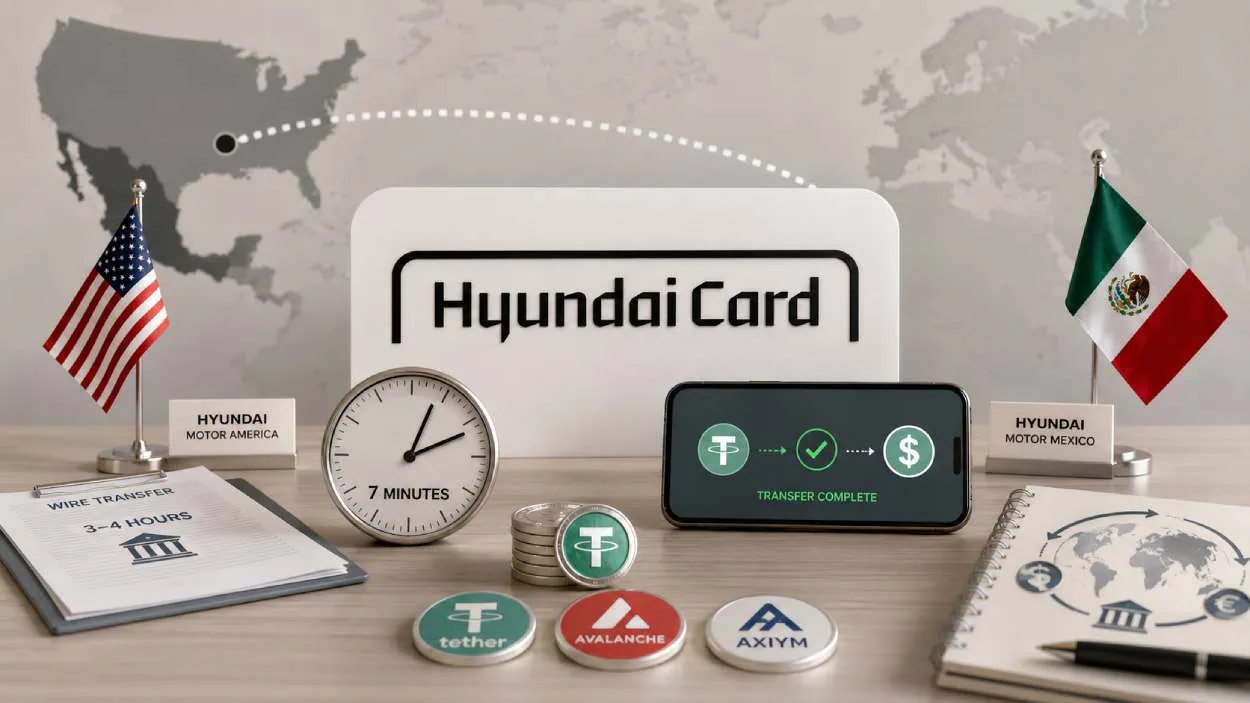
- Hyundai Motor America converted $20,000 into USDT on the Avalanche network and sent it to Hyundai Motor Mexico, which converted it back into US dollars.
- The round trip averaged seven minutes, compared with three to four hours for a conventional bank transfer.
- Tether, Avalanche, and Axiym took part in the test as infrastructure partners, per Hyundai Card.
- A second proof of concept is scheduled for later in July among Hyundai Motor’s European entities, adding Circle and Visa and testing local-currency remittances.
What Happened?
Hyundai Card said Thursday it has verified stablecoin-based cross-border transfers between Hyundai Motor subsidiaries in the US and Mexico. Hyundai Motor America converted $20,000 into USDT and sent the funds to Hyundai Motor Mexico, which converted the stablecoin back into US dollars on arrival.
The entire sequence, conversion, cross-border transfer, verification, and reconversion, took an average of seven minutes, against three to four hours for a conventional bank transfer. Tether, the issuer of USDT, blockchain platform Avalanche, and payments infrastructure firm Axiym took part in the test.
Hyundai Card called this the first stablecoin-based cross-border transfer proof of concept by a Korean card company using stablecoins for an actual intercompany remittance. This PoC is significant because it shows that we have moved beyond a simple technical test and completed preparations for potential real-world adoption, a Hyundai Card official said.
🔥 JUST IN: Hyundai Card says it has completed the first stablecoin-based intercompany payment between Hyundai Motor’s overseas subsidiaries, in a cross-border test between its US and Mexico operations. pic.twitter.com/1Vsl1J0AX1
— Cointelegraph (@Cointelegraph) July 9, 2026
The Compliance Groundwork Behind the Test
Before a dollar moved, Hyundai Card led the design of the transfer structure and process after working with Hyundai Motor to review accounting, tax, legal, and internal control requirements at the overseas units.
That sequencing is the load-bearing detail: most corporate stablecoin pilots stall on paperwork, not blockchain rails. Hyundai Card also built infrastructure in advance to address potential issues throughout the transfer process.
A Second, Broader PoC in Europe
Hyundai Card plans a second proof of concept later this month among Hyundai Motor’s European subsidiaries, adding Circle and Visa as global partners. Unlike the dollar-only US-Mexico round, the next test will cover actual remittances in local currencies rather than dollar-based transfers, letting the firm assess potential savings in currency conversion.
That currency shift matters because the second proof of concept will involve actual remittances based on currencies other than the US dollar, where FX costs run higher than a single-currency transfer. Circle, issuer of USDC, and Visa are set to join the effort as global partners, broadening the rail mix beyond Tether and Axiym.
The pattern is straightforward: a large industrial conglomerate is testing whether stablecoin rails, the same DeFi market infrastructure, can replace correspondent-banking cash movement.
Both PoCs run in dollar terms between overseas units, not the Korean won and not on Korean soil, which lines up with where Seoul’s own stablecoin framework stands. Korea’s Digital Asset Basic Act remains delayed in the National Assembly, with lawmakers divided over who may issue won-denominated stablecoins and whether issuers must be majority-owned by banks or operate through bank-led consortiums.
The Bank of Korea told the National Assembly finance committee that won-denominated stablecoins should be issued by bank-led firms, asking for priority issuance by bank-led consortiums and a formal policy body involving relevant agencies.
The bill had been targeted for completion by the first quarter of 2026; officials have cited an international conflict that began in late February, recent local elections, and delays reorganizing the National Assembly’s committee structure as reasons for the slip in the timeline. Hyundai Card is building live settlement rails offshore, in dollar terms, well outside the legal framework that would eventually have to govern a won-denominated equivalent.

CoinLaw’s Takeaway
This test reads as a treasury-infrastructure story more than a crypto story. The seven-minute transfer of $20,000 is the headline figure, but the compliance work behind it, sequenced ahead of the test rather than bolted on after, is the real proof point.
The European round is the more consequential test. Adding Circle and Visa alongside Tether, and swapping a dollar-to-dollar corridor for local-currency remittances, will test whether the speed and compliance discipline hold once FX conversion and multiple European jurisdictions enter the picture. For multinationals watching this pilot, that compliance template is the detail worth tracking, well ahead of the transfer speed.
It is also worth tracking against Seoul’s own unresolved rulebook. Industry groups have warned that a strict bank-led issuance requirement could limit competition and slow innovation in digital asset services, while the central bank has argued bank-led issuance would better protect financial stability and consumer deposits. That tension over who gets to issue will shape market entry for the same two names already built into Hyundai Card’s own PoCs, Circle and Tether, if a won-pegged track ever opens. Until that dispute clears, a Korean-won version of this settlement rail has no legal pathway to run on.