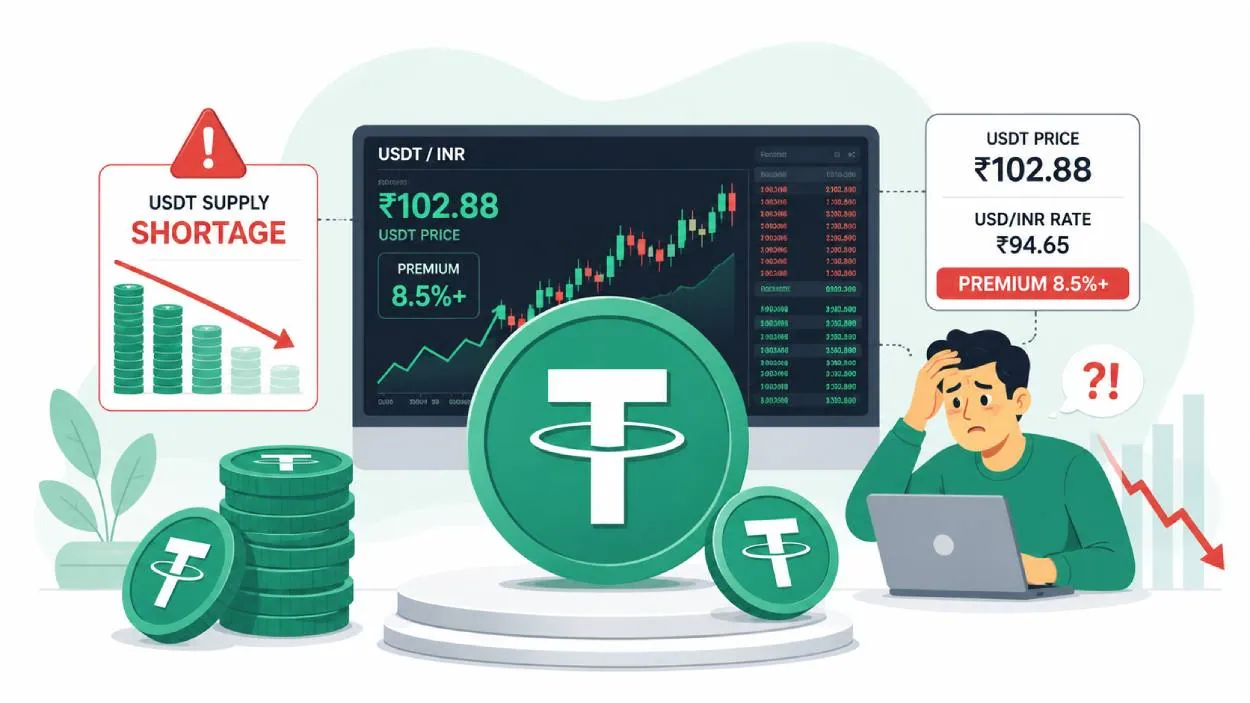







A shortage of USDT in India has pushed the stablecoin’s local premium above 8.5% after enforcement actions disrupted key supply channels.
Key Takeaways
- USDT traded at ₹102.88 in India, far above the official dollar exchange rate of ₹94.65.
- The premium has climbed from its usual 3% to 4% range to more than 8.5%.
- The supply crunch follows enforcement action against crypto based fund transfer networks and remittance channels.
- Market participants say regulatory uncertainty is adding a risk premium to stablecoin prices.
What Happened?
India’s crypto market is facing an acute shortage of USDT, the world’s largest stablecoin by market value. The reduced supply has pushed local prices sharply higher, with traders paying a significant premium to access dollar linked crypto asset.
The supply disruption reportedly came after Indian authorities intensified action against entities involved in crypto foreign exchange services and virtual digital asset transfers, reducing the inflow of USDT into the country.
USDT is now trading at ₹105 while the official USD/INR rate is just ₹94 around 🤯
— Pushpendra Singh (@pushpendrakum) June 29, 2026
That’s an 9%+ premium!
🇮🇳 What’s happening?
• ED crackdown has disrupted USDT remittance channels.
• Massive supply shortage.
• Demand continues to surge.
• Crypto regulations will be…
India’s USDT Premium Surges Above Normal Levels
USDT has long served as the primary gateway to dollar liquidity for Indian crypto traders. Under normal market conditions, the stablecoin typically trades at a premium of around 3% to 4% over the official dollar exchange rate.
That premium has now surged to more than 8.5%, highlighting a growing shortage of crypto dollars in the country.
On Saturday, USDT was quoted at ₹102.88, while the dollar rupee exchange rate closed at ₹94.65 on June 27. The difference reflects one of the highest effective costs for accessing dollar denominated crypto liquidity in recent months.
Traders often use the gap between USDT’s local price and the official exchange rate as a real time indicator of dollar scarcity in India’s crypto ecosystem. The latest spike suggests that the market is facing a significant supply imbalance.
Enforcement Actions Tighten Stablecoin Supply
Reports indicate that the supply crunch followed recent action by India’s Enforcement Directorate against entities allegedly facilitating crypto based money transfers.
The investigation is linked to a ₹250 billion money laundering case and scrutiny surrounding approximately $25 billion in fund transfers conducted through virtual digital assets.
The enforcement push reportedly disrupted informal remittance channels and peer to peer networks that had previously supplied a steady stream of USDT into India.
According to Purushottam Anand, founder of Crypto Legal, the recent rally in USDT prices may also reflect a risk premium driven by regulatory uncertainty.
The combination of lower inflows and fears of further restrictions appears to be pushing traders to pay increasingly higher prices for stablecoins.

Why Stablecoins Matter in India’s Crypto Market?
Stablecoins play a central role in India’s digital asset ecosystem because they allow traders to access dollar denominated liquidity without directly using offshore banking services.
They are widely used for:
- Trading cryptocurrencies such as Bitcoin and Ether.
- Accessing overseas crypto exchanges.
- Facilitating remittance like transactions.
- Managing dollar liquidity and settlements.
When supply is abundant, stablecoin premiums tend to narrow. However, when inflows slow or demand increases, users are often forced to pay significantly above the official dollar rate.
An 8.5% premium also changes the economics of crypto trading. Investors buying USDT at elevated prices need larger gains to break even, reducing arbitrage opportunities and making participation more expensive for smaller traders.
Regulatory Uncertainty Continues to Shape the Market
India has introduced taxes on crypto gains and strengthened anti-money laundering requirements for exchanges, but it still lacks a comprehensive framework for stablecoins and digital asset payments.
The Reserve Bank of India has repeatedly warned that stablecoins could weaken capital controls and pose risks to financial stability.
The latest premium spike underscores the fragile balance between India’s massive crypto user base and its cautious regulatory approach. Unless stablecoin inflows recover or compliant liquidity channels emerge, elevated premiums could persist and keep trading costs high for Indian crypto users.
CoinLaw’s Takeaway
In my experience, sharp premiums like this reveal more than just strong demand for crypto. They expose structural weaknesses in market access. I found the current situation particularly noteworthy because it shows how quickly liquidity can disappear when regulatory pressure hits informal supply channels. Without clearer rules for stablecoins and crypto remittances, Indian users may continue paying a steep price to access digital dollars.