






Coinbase has strengthened its position in Europe after securing a key regulatory license in Luxembourg, while Binance continues searching for a path to maintain broad access across the European Union.
Key Takeaways
- Coinbase has officially established Luxembourg as its European hub under the Markets in Crypto Assets framework.
- A single MiCA license allows Coinbase to offer crypto services across all 27 European Union member states.
- Binance withdrew its Greek licensing application and now plans to seek approval in another European country.
- The approaching July 1 transition deadline is increasing pressure on crypto firms that have not yet secured MiCA authorization.
What Happened?
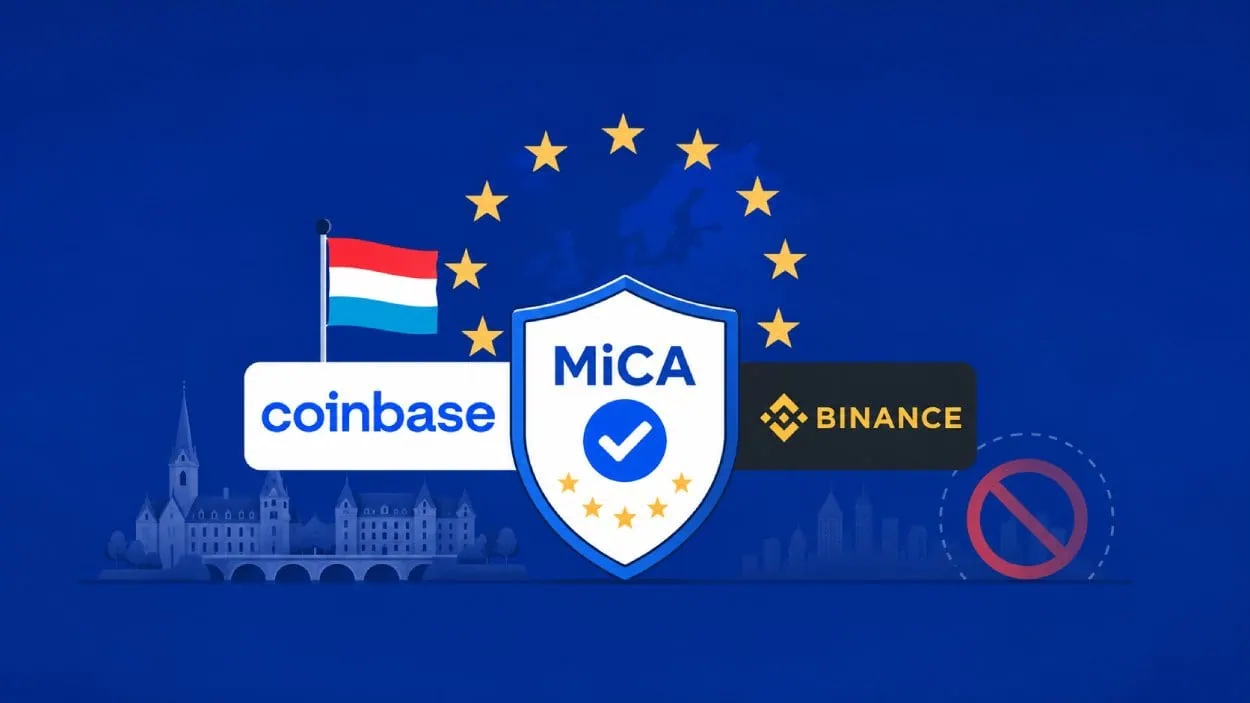
Coinbase has officially chosen Luxembourg as its European headquarters after receiving authorization under the European Union’s Markets in Crypto Assets, or MiCA, framework. The move gives the crypto exchange access to customers across the entire European Economic Area through a single regulatory license.
The development comes as Binance faces regulatory challenges after withdrawing its application for a MiCA license in Greece, highlighting the growing importance of regulatory approval as Europe prepares to fully implement its new crypto framework.
Luxembourg is officially our MiCA home 🇱🇺
— Coinbase 🛡️ (@coinbase) June 24, 2026
We’re looking forward to welcoming users from across the EU to Coinbase. https://t.co/6YiRoJRdJA
Coinbase Establishes Luxembourg as Its European Base
Coinbase announced the opening of its Luxembourg office on June 24, confirming that Coinbase Luxembourg S.A. will serve as its primary European entity under the MiCA framework.
The company received its MiCA authorization from Luxembourg’s Commission de Surveillance du Secteur Financier, allowing it to passport crypto services across all 27 European Union member states without applying for separate national licenses.
The exchange had already secured regulatory approvals in several European countries, including Germany, France, Ireland, Italy, the Netherlands, and Spain. With MiCA now in effect, those separate approvals are complemented by a single framework that simplifies expansion across the region.
Coinbase also highlighted Luxembourg’s well established financial sector, supportive blockchain legislation, and clear regulatory approach as key reasons behind selecting the country as its European home.
In an announcement shared on X, the company said, “Luxembourg is officially our MiCA home.”
Chief Policy Officer Faryar Shirzad also praised the country, saying, “Luxembourg has established itself as the EU’s leading hub for institutional crypto and tokenization.”
MiCA Creates One Gateway to the European Market
The MiCA framework introduces a unified licensing system for crypto companies operating within the European Union.
Instead of applying for approval in every individual country, licensed companies can use one authorization to offer services throughout the bloc after completing the required notification process.
This creates a significant competitive advantage for exchanges that secured approval early. The single license provides access to a market of more than 450 million people, making Europe one of the world’s largest regulated crypto markets.
More than 230 firms have already obtained MiCA approval and are expected to continue serving European customers beyond the July 1 transition deadline.

Binance Faces New Regulatory Challenge
While Coinbase expanded its regulatory footprint, Binance experienced a setback after withdrawing its application for a MiCA license in Greece.
The exchange reportedly made the decision after regulators indicated its application was unlikely to be approved. Binance had submitted the application through a Greek subsidiary earlier this year and is now expected to pursue authorization in another European Union member state.
Despite the setback, Binance maintains that it remains committed to Europe.
“Binance is not leaving Europe,” said Gillian Lynch, the company’s Head of Europe and United Kingdom.
The company also stated that it meets MiCA compliance standards and employs around 1,500 compliance professionals worldwide.
However, Binance remains absent from the European Securities and Markets Authority register of approved MiCA firms as the regulatory deadline approaches.
Luxembourg Emerges as a Crypto Hub
Coinbase’s announcement comes shortly after Ripple received preliminary approval for a Crypto Asset Service Provider license from Luxembourg’s regulator.
If finalized, Ripple’s authorization will support regulated crypto payment and stablecoin services across the European Economic Area.
The back to back announcements further strengthen Luxembourg’s position as a growing center for regulated digital asset businesses, tokenization, and institutional crypto services.
CoinLaw’s Takeaway
In my experience, the European crypto market is shifting from rapid expansion to regulatory credibility. I found that MiCA is rewarding companies that invested early in compliance rather than waiting until the last minute. Coinbase’s approval places it in a strong position to grow across Europe under a single framework, while Binance now faces the challenge of rebuilding regulatory momentum before it can fully compete under the new rules.