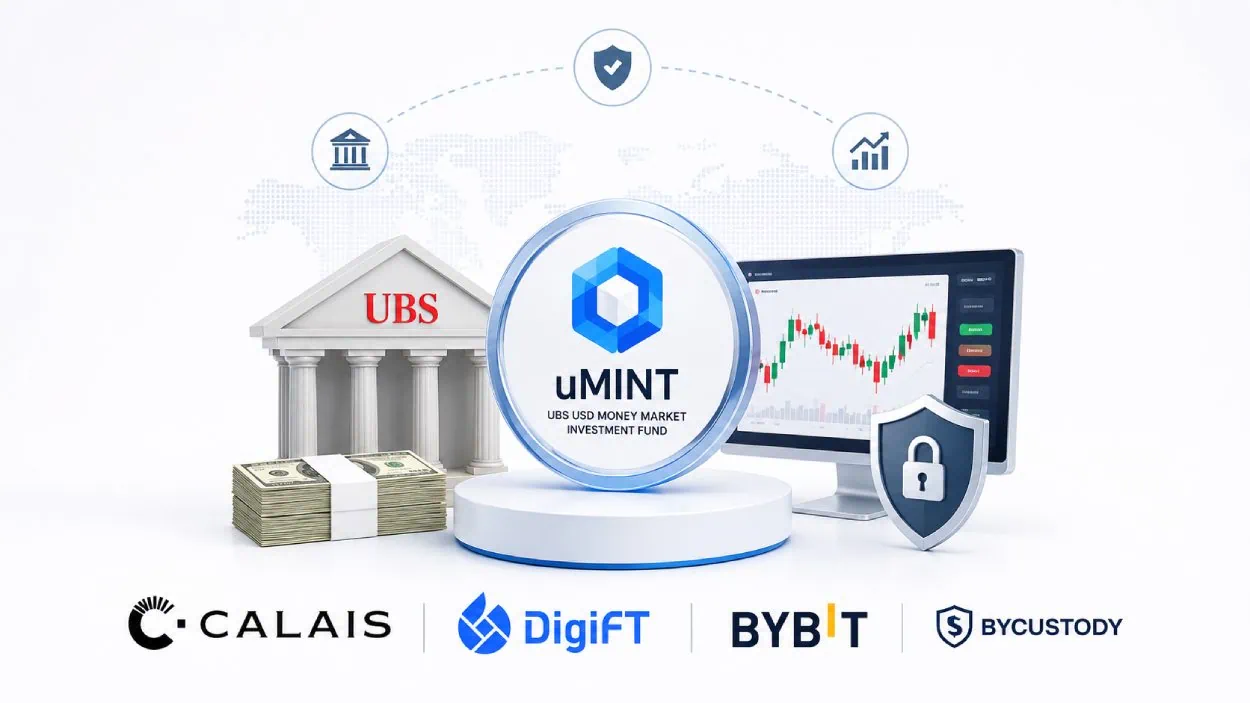







Calais Digital Assets has become the first institutional hedge fund to use UBS uMINT as live trading collateral on Bybit, marking a major step forward for tokenized real world assets in institutional finance.
Key Takeaways
- Calais Digital Assets became the first institutional client to deploy UBS uMINT as off exchange settlement collateral in active trading.
- The transaction was completed through a collaboration involving Bybit, ByCustody, and DigiFT.
- The structure allows institutions to earn yield on collateral while simultaneously using it for trading activities.
- The move highlights growing real world adoption of tokenized assets beyond pilot programs and infrastructure development.
What Happened?
Singapore based Calais Digital Assets has completed the first institutional deployment of UBS uMINT as off exchange settlement collateral on cryptocurrency exchange Bybit. The transaction represents a significant milestone for the tokenized asset sector, demonstrating that regulated blockchain-based financial products can now be used in live institutional trading environments.
The deployment was facilitated through a multi party framework involving DigiFT, the authorized distributor of uMINT, ByCustody, the institutional custody platform of Bybit, and Bybit’s exchange infrastructure.
🚨 Institutional crypto just took a big step forward.@Calais_digital became the first hedge fund to use @UBS uMINT as live trading collateral on @Bybit_Official , allowing it to earn yield while trading.
— CoinLaw (@coinlaw_io) June 18, 2026
The era of idle collateral may be ending. 👀#Crypto #Bybit #Cryptonews pic.twitter.com/cIUBtPkum4
Calais Brings Tokenized Collateral Into Live Trading
The transaction centers around uMINT, a tokenized USD money market investment fund launched by UBS Asset Management. Unlike traditional collateral arrangements where capital remains idle, uMINT allows institutions to continue generating yield while those assets serve as collateral for trading activities.
Under the arrangement, Calais retains ownership of its uMINT holdings within ByCustody’s segregated custody environment. At the same time, the assets are recognized as eligible collateral on Bybit, allowing the fund to execute trades without locking up cash in non yielding accounts.
For quantitative investment firms such as Calais, capital efficiency plays a critical role in portfolio management. The ability to maintain income generating exposure while meeting trading collateral requirements offers a potentially meaningful improvement over conventional settlement structures.
Lily Yan, Founder and CEO of Calais Digital Assets, said:
From Infrastructure Development to Real World Utility
The latest deployment builds on an earlier collaboration between Bybit and DigiFT that established the technical and regulatory foundation for accepting UBS uMINT as trading collateral.
While many tokenization initiatives have focused on infrastructure development and proof of concept projects, the Calais transaction demonstrates practical implementation in an active institutional trading environment.
Industry participants view this as an important evolution for real world assets, commonly referred to as RWAs. The focus is shifting from creating tokenized financial products to proving their usefulness in day to day institutional operations.
Henry Zhang, Founder and Group CEO of DigiFT, emphasized this distinction, stating:

How the Three Layer Structure Works?
The transaction relies on a specialized infrastructure stack designed to separate asset custody from trading deployment.
DigiFT provides regulated access to the tokenized fund and facilitates institutional subscriptions.
ByCustody holds the assets in segregated custody while ensuring they remain eligible as trading collateral.
Bybit recognizes the custodied assets for settlement purposes, enabling trading activity without requiring clients to pre fund positions with cash.
This structure allows institutions to maintain strong custody controls while improving capital efficiency and preserving liquidity.
According to Bybit’s Global Head of RWA and TradFi, Yoyee Wang, the arrangement demonstrates how exchanges, custodians, and regulated distributors can work together to support institutional adoption of digital assets.
Why This Matters for Institutional Adoption?
The transaction signals increasing confidence among professional investors in tokenized financial products issued by established asset managers. It also highlights how blockchain based infrastructure can address long standing challenges related to capital utilization in trading operations.
As more institutions explore tokenized money market funds and other blockchain-based financial instruments, similar collateral models could become increasingly common across digital asset markets.
The successful deployment by Calais offers a real world example of how tokenized assets can move beyond experimentation and deliver measurable operational benefits within institutional trading ecosystems.
CoinLaw’s Takeaway
In my experience, the biggest challenge facing tokenized assets has never been technology. It has been proving real utility. This transaction stands out because it shows a sophisticated institutional hedge fund using a tokenized product in live trading rather than simply holding it as an investment. I found the capital efficiency angle especially important because institutions care less about blockchain buzzwords and more about improving returns, liquidity, and operational efficiency. If more firms follow Calais’s approach, tokenized money market funds could become a standard component of institutional trading infrastructure.