







Health insurance has become a cornerstone of financial security in the United States, helping individuals manage the rising costs of medical care. Imagine navigating a severe health crisis without coverage; it could lead to devastating financial consequences. Over the years, the health insurance industry has evolved into a dynamic ecosystem influenced by technological advancements, regulatory changes, and shifting demographics. Let’s dive into the latest statistics to better understand this pivotal sector.
Editor’s Choice
- Medicare Advantage enrollment reached just over 35 million people in February 2026, up 3% year over year.
- Employer-sponsored health benefit costs are expected to rise 6.7% in 2026, pushing average cost above $18,500 per employee.
- Group health insurance costs for employers are projected to increase about 8.5% in 2026.
- ACA Marketplace premiums are increasing by a median of 15% across 105 insurers in 2026, with 27% proposing hikes of 20% or more.
- Average annual premium costs for subsidized ACA enrollees are projected to rise to $1,904 in 2026 from $888 in 2025.
Recent Developments
- The Inflation Reduction Act caps Medicare insulin costs at $35 per 30-day supply and will limit annual Part D out-of-pocket spending to $2,000 starting in 2025.
- Medicaid and CHIP together cover 75.3 million people nationwide, including 68.0 million on Medicaid and 7.2 million children in CHIP.
- About 48% of Medicaid/CHIP enrollees are children (35.1 million) and 52% are adults (38.5 million), reflecting a post-pandemic shift in program demographics.
- Roughly 28.1% of the U.S. population relies on Medicaid and CHIP, with some states exceeding 33% enrollment.
- Medicare insulin caps are estimated to save about 1.5 million beneficiaries roughly $500 each per year, totaling $761 million in combined annual savings.
- The Inflation Reduction Act’s insulin cap holds monthly costs at or below $35 for all covered insulin products across Medicare Part D and Part B.
- Between December 2024 and January 2026, Medicaid/CHIP enrollment fell by about 4.19 million people, a 5.3% decline amid eligibility unwinding.
International Health Insurance Market
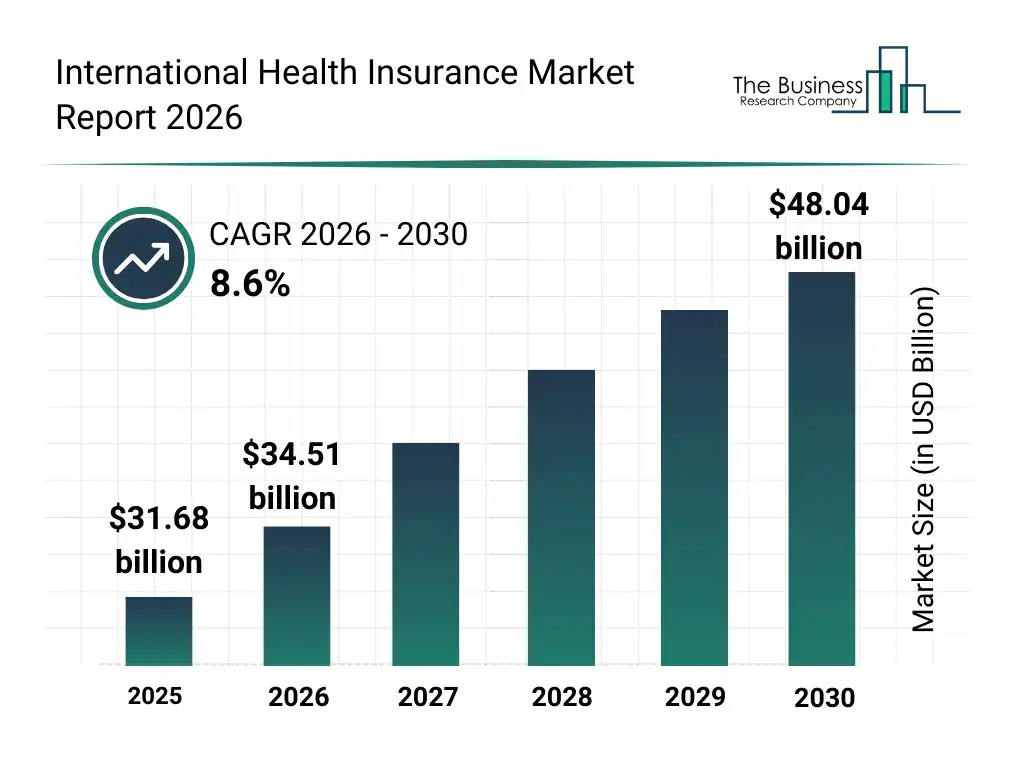
- The international health insurance market was valued at $31.68 billion in 2025, highlighting the growing demand for global healthcare coverage.
- Market size is expected to increase to $34.51 billion in 2026, reflecting continued expansion in cross-border health insurance services.
- By 2027, the market is projected to reach approximately $37.48 billion, driven by rising international mobility and healthcare costs.
- The industry is forecast to grow to around $40.71 billion in 2028, demonstrating strong year-over-year growth momentum.
- In 2029, the global market is expected to surpass $44.21 billion, supported by increasing adoption of private health insurance plans.
- The international health insurance market is projected to reach $48.04 billion by 2030, marking a significant increase from current levels.
- The market is anticipated to expand at a compound annual growth rate (CAGR) of 8.6% between 2026 and 2030.
- Overall, the market is expected to add approximately $16.36 billion in value between 2025 and 2030, representing substantial long-term growth potential.
Gross Written Premium
- Direct premiums written by U.S. private health insurers reached about $1.2 trillion in 2023 and continue to grow.
- The global health insurance market is expected to expand from $2.89 trillion in 2026 to roughly $5.45 trillion by 2035, a 7.32% CAGR.
- Family premiums for employer-sponsored coverage average $26,993 per year, with workers contributing about $6,850 and employers paying $20,143.
- U.S. insurers worldwide collected a total of €7.0 trillion in life, P&C, and health premiums in 2024, with health premiums growing 7.0%.
- U.S. health insurance industry underwriting gains exceeded $12 billion in the first half of 2024, with net income around $16 billion.
- The U.S. life insurance industry reported a 6% increase in direct written premiums to $741 billion in the first half of 2025.

Strategic Priorities of U.S. Health Care Leaders
- Regulatory and policy changes are the dominant concern for healthcare executives, with 80% identifying them as a top strategic priority for 2026.
- Generative AI and agentic AI rank among the leading focus areas, selected by 45% of healthcare leaders as organizations accelerate AI adoption.
- Convergence and consolidation also received 45%, highlighting ongoing merger, acquisition, and partnership activity across the healthcare sector.
- Care delivery transformation is a key objective for 41% of leaders, reflecting efforts to improve patient outcomes and operational efficiency.
- Cybersecurity and data privacy remain critical priorities, with 35% of executives focused on strengthening digital security and protecting sensitive health data.
- Workforce challenges were cited by 32% of respondents, underscoring ongoing concerns about staffing shortages and talent retention.
- 26% of healthcare leaders identified affordability pressures for consumers as a major strategic issue amid rising healthcare costs.
- Nearly one-fifth (19%) of respondents prioritize cloud and digital infrastructure modernization to support future healthcare innovation.
- Macroeconomic headwinds and innovative payment models were each selected by 18% of leaders, reflecting financial and reimbursement-related concerns.
- Manufacturing and supply chain risks remain an area of focus for 13% of healthcare executives.
- Sustainability initiatives were cited by 11% of respondents as part of their long-term organizational strategy.
- Direct-to-consumer prescription platforms and GLP-1 medication adoption each received 8%, indicating growing interest in new healthcare delivery and treatment models.
- Consumer empowerment was identified by 7% of leaders, reflecting efforts to give patients greater control over healthcare decisions.
- Drivers of health, including social and environmental determinants, ranked last at 6%, though they remain part of broader healthcare planning efforts.
- The gap between regulatory concerns (80%) and the next-highest priorities (45%) highlights how significantly policy uncertainty influences healthcare strategy in 2026.

Premium Trends and Cost Analysis
- Average marketplace individual health insurance premiums are about $752 per month, up roughly 7% from the prior year.
- Annual family premiums for employer-sponsored coverage average $26,993 (about $2,249 per month), a 6% increase from 2024.
- Workers contribute an average of $6,850 per year toward family coverage, while employers pay about $20,143.
- Employers project their overall health benefit costs will rise about 7.6%–9% in 2026.
- The standard Medicare Part B premium is $202.90 per month, nearly 10% higher than in 2025.
- Average Medicare Advantage (Part C) premiums are about $11.02 per month, down from $13.32 in 2025.
- Average Medicare Part D prescription drug plan premiums are $34.50 per month, down from $38.31 in 2025.
Health Insurance Coverage by Age Group
- Adults Ages 18–64 (Latest NHIS Estimates): About 69.1% had private insurance coverage, 21%–24% had public coverage, and 11.6% were uninsured.
- Children Ages 0–17 (Latest NHIS Estimates): Around 55.4% had private insurance, 42.2% had public coverage, and approximately 5.1% were uninsured.

Preliminary Health Insurance Premium Rate Increases
- Across 105 ACA Marketplace insurers, the median proposed premium increase is 18% for 2026, more than double the 7% median in 2025.
- Most ACA Marketplace insurers are requesting premium increases in the 10%–20% range for 2026.
- More than 27% of ACA Marketplace insurers are proposing premium increases of 20% or more for 2026.
- Benchmark Marketplace premiums are estimated to rise by an average of 21.7% nationally in 2026.
- KFF estimates ACA Marketplace premiums will rise by an average of 26% in 2026, with benchmark silver premiums up 17% in state-based exchanges and 30% in Healthcare.gov states.
- Marketplace benchmark premiums increased only 2.0% per year on average between 2020 and 2025, compared with the sharp 21.7% jump in 2026.
- Marketplace enrollment is projected to decline by about 21.5%, dropping from 22.3 million people in 2025 to 17.5 million in 2026 as premiums spike.
Medicare Advantage and Public Health Exchange Markets
- Medicare Advantage enrollment reached about 35.8 million people by February 2026, roughly 54% of all Medicare beneficiaries.
- Medicare Part D now covers about 56.1 million beneficiaries, with 31.3 million (about 56%) enrolled through MA-PD plans.
- Stand-alone Part D prescription drug plans (PDPs) enroll about 24.9 million people, or 44% of all Part D beneficiaries.
- Enrollment in Special Needs Plans within Medicare Advantage grew to about 8.2 million, reflecting an 8.6% increase year over year.
- Overall Medicare Advantage enrollment grew about 3% from 2025 to 2026, adding roughly 1.1 million beneficiaries.
- ACA Marketplace enrollment during the latest open enrollment period totaled about 23.1 million sign-ups, then is projected to settle near 17.5 million enrollees over the year.
- Marketplace enrollment is expected to drop about 21.5%, from 22.3 million people in 2025 to 17.5 million this year as subsidies phase down.

Technological Innovations and Digital Transformation
- Around 37% of U.S. adults used telehealth in the past year, and telehealth visit volume remains about 4.8% of all visits, over 2.5 times pre‑pandemic levels.
- More than 12.5% of Medicare beneficiaries received at least one telehealth service in Q2 2025, roughly double pre‑COVID usage.
- AI-powered systems can cut insurance claim processing time by up to 70%, reducing cycle times from about 14 days to under 5 days.
- AI in insurance claims processing is a $0.53 billion market in 2026 and is projected to reach $0.97 billion by 2030 at a 16.2% CAGR.
- Global wearable technology market value is about $257.35 billion in 2026 and is expected to reach $572.73 billion by 2031 at a 17.35% CAGR.
- Global wearable device shipments grew 9.1% year over year to 611.5 million units in 2025 and are projected to rise another 2.2% in 2026.
- AI and automation in health care could generate up to $150 billion in annual U.S. savings by 2026, largely through reduced administrative and claims costs.
Frequently Asked Questions (FAQs)
ACA Marketplace premiums are rising by a median of 15% in 2026, with benchmark silver premiums up about 21.7% and average increases around 26% in many markets.
More than 27% of ACA Marketplace insurers are proposing premium increases of 20% or more for 2026, while most others fall in the 10%–20% range.
The U.S. group health insurance market is about $16.06 billion in 2026 and is forecast to reach $20.23 billion by 2035, growing at a 2.6% CAGR from 2026 to 2035.
The international health insurance market is projected to rise from about $3.8 billion in 2025 to $7.2 billion by 2034, reflecting a 7.3% CAGR.
Annual family premiums for employer-sponsored coverage average $26,993 in 2025 (about $2,249 per month), up 6% year over year, with workers paying $6,850 and employers $20,143.
Conclusion
Technological advancements, regulatory reforms, and a focus on equity and accessibility actively shape the evolving landscape of the health insurance industry. Medicare Advantage enrollment grows at an unprecedented pace, and providers widely adopt telehealth services, showing how the sector embraces innovation to meet modern consumer needs. Rising premiums and regional disparities, however, expose ongoing challenges that demand continuous improvements. Looking ahead, the industry will keep adapting to ensure health coverage remains a cornerstone of Americans’ financial and physical well-being.