






The Zaporizhzhia Nuclear Power Plant, a central flashpoint in the ongoing Russia-Ukraine war, has now emerged as a potential site for cryptocurrency mining, according to Russian President Vladimir Putin.
Key Takeaways
- Putin claims the US wants to establish crypto mining at the Russia-occupied Zaporizhzhia Nuclear Power Plant.
- The facility, once critical to Ukraine’s power grid, has been under Russian control since 2022.
- Negotiations are reportedly ongoing between the US and Russia over joint plant management, excluding or limiting Ukraine’s role.
- Control over the site remains contentious due to its strategic energy and geopolitical significance.
What Happened?
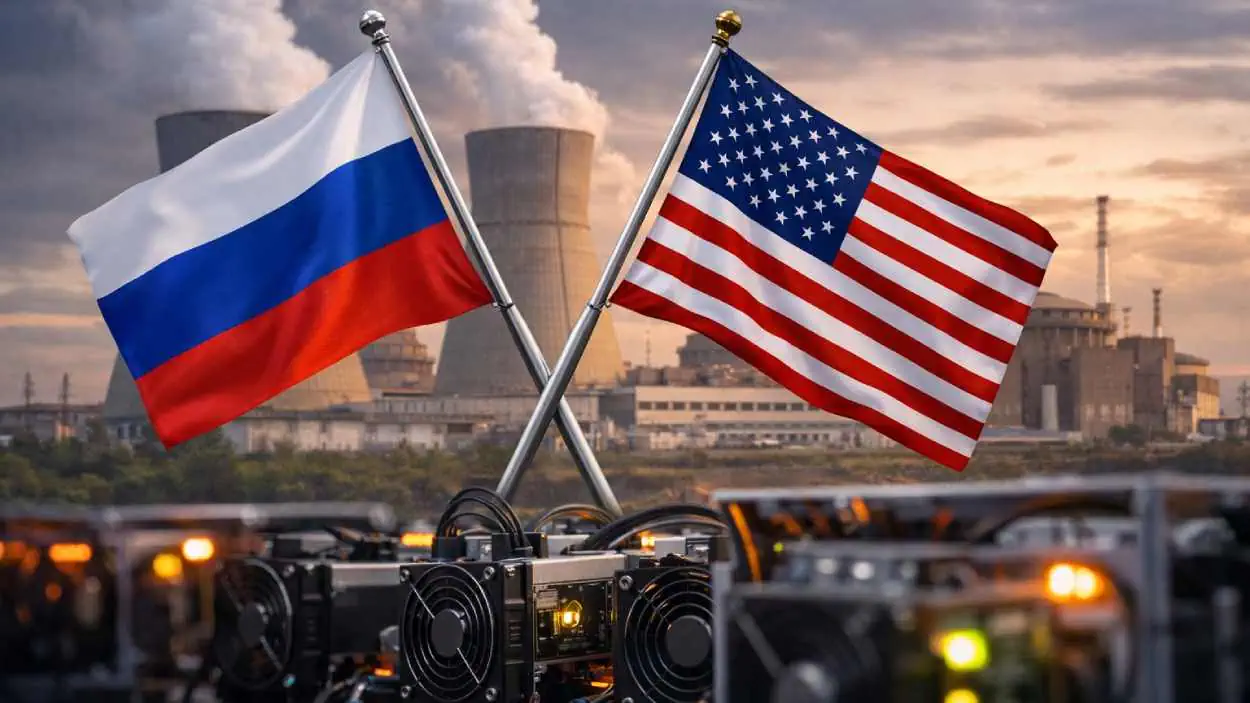
Russian President Vladimir Putin recently told business leaders that the United States has expressed interest in organizing cryptocurrency mining operations at the Zaporizhzhia Nuclear Power Plant (ZNPP), according to Russian news outlet Kommersant. This came during a broader discussion about the plant’s future and a possible joint management plan between Moscow and Washington.
The United States is discussing the possibility of jointly managing the Zaporizhzhia Nuclear Power Plant without Ukraine’s involvement, Putin said.
— KyivPost (@KyivPost) December 25, 2025
He claimed that the US is interested in using the plant for cryptocurrency mining. At the same time, Putin said that electricity… pic.twitter.com/5FwkysGQqP
A Disputed Power Hub
The Zaporizhzhia Nuclear Power Plant, located in southeastern Ukraine near the city of Enerhodar, is Europe’s largest nuclear facility and once accounted for roughly 20 percent of Ukraine’s electricity supply. The plant was seized by Russian forces in March 2022 during the early days of the full-scale invasion and has remained under Russian control since.
According to Putin, the US is interested not only in energy access but also in using the facility to mine cryptocurrencies, possibly Bitcoin. However, he also stated that any electricity generated at the site would still be directed to Ukraine.
Putin claimed that talks between the US and Russia have explored a joint operational framework for the plant, with reports suggesting this arrangement might exclude Ukraine from decision-making. This contrasts with other proposals. According to the BBC, the US has backed a tripartite model involving Russia, Ukraine, and the US as equal stakeholders. Meanwhile, Ukraine proposed a 50-50 partnership with the US, under which both countries would split electricity output, with the US possibly allocating a portion to Russia, as reported by Euronews.
Crypto Mining as a Geopolitical Lever
Although the actual implementation of crypto mining at ZNPP remains speculative, the idea aligns with Russia’s growing interest in regulated digital mining. Since 2024, Russia has legalized crypto mining under strict regulations, including miner registration, taxation, and energy usage oversight. A national registry of mining equipment was introduced in 2025 to combat illegal energy consumption.
Russia now contributes between 4 percent and 16 percent of global Bitcoin hashrate, making it one of the largest players in the world. This is thanks to low energy costs, particularly in Siberia, and a naturally cold climate that reduces hardware cooling costs. The Kremlin sees Bitcoin mining as a strategic tool to monetize surplus electricity and generate income outside the Western financial system, especially amid ongoing sanctions.
Still, the viability of mining at ZNPP is uncertain. The International Atomic Energy Agency (IAEA) has flagged major safety violations at the plant. All six reactors are currently shut down and cannot be safely restarted under current conditions. IAEA experts have warned that nearly all nuclear safety principles are being ignored at the site.

Ongoing Peace Talks and Ceasefire Efforts
As the war drags into its fourth year, diplomatic activity has increased. According to Reuters, Ukrainian President Volodymyr Zelensky recently stated that the US and Ukraine are close to agreeing on a 20-point peace framework. In parallel, President Trump has reportedly intensified diplomatic efforts, focusing on ceasefire conditions, security guarantees, and post-war reconstruction plans.
Putin has also signaled some openness to negotiation, although he remains firmly committed to controlling other contested regions such as Donbas.
CoinLaw’s Takeaway
In my experience, when energy infrastructure becomes part of crypto conversations, it usually signals deeper economic and geopolitical strategies at play. This isn’t just about mining Bitcoin. It’s about who controls the flow of power, both literally and politically. If the US truly seeks a stake in the Zaporizhzhia plant for crypto mining, it reflects a bold shift in how energy, tech, and diplomacy intersect. But I find it deeply troubling that such plans are being considered while the facility remains in a dangerous, unstable state. The talk of crypto mining is flashy, but the real story is the power struggle over territory, energy, and influence.