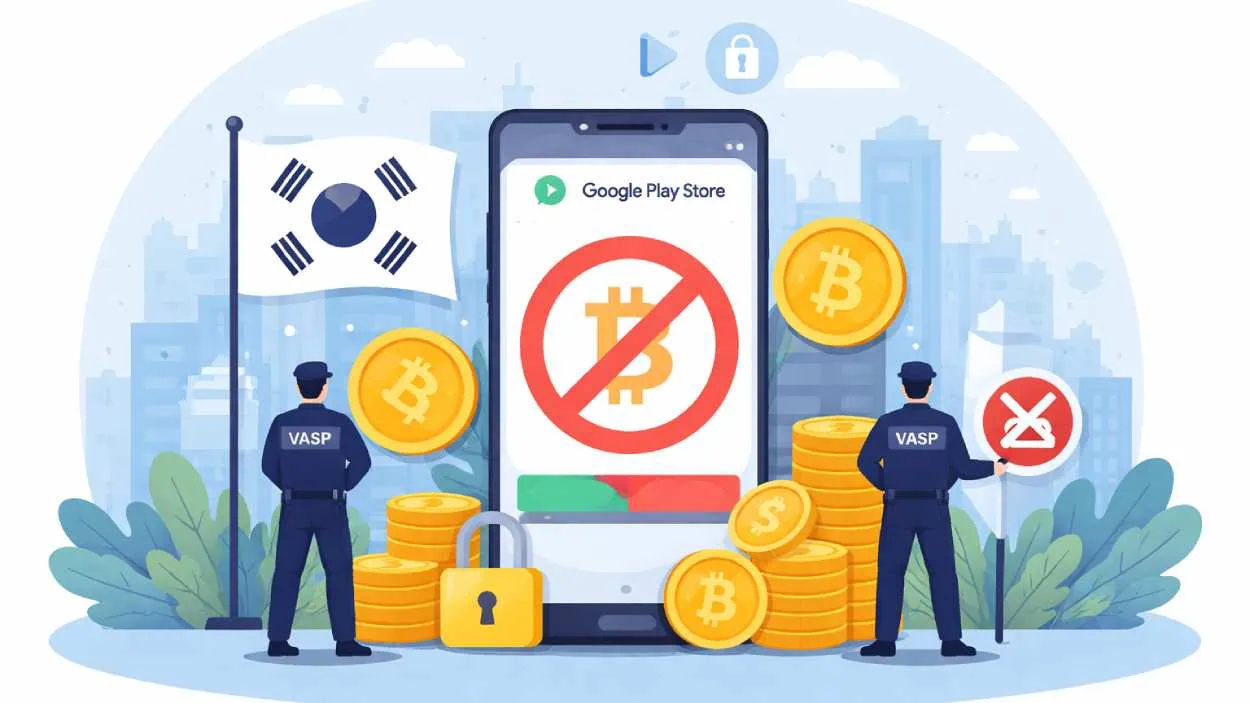







Starting January 28, most foreign cryptocurrency exchange apps will vanish from South Korea’s Google Play Store, marking a major regulatory shift aimed at tightening local compliance standards.
Key Takeaways
- Google will block unregistered foreign crypto apps from the South Korean Play Store, enforcing new rules tied to Virtual Asset Service Provider (VASP) registration.
- Only locally licensed exchanges will remain available for download or updates through Google Play, effectively cutting off many global platforms.
- Users can still access overseas services via browsers or APKs, but this poses higher risks from phishing, malware, and reduced functionality.
- Domestic exchanges like Upbit and Bithumb stand to benefit, gaining greater market share and influence.
What Happened?
Google has updated its Play Store policies in South Korea to enforce the country’s VASP rules for cryptocurrency platforms. As a result, crypto exchanges and wallet apps that are not officially registered with South Korean financial authorities will be blocked from the Play Store starting January 28. This change significantly reduces access to foreign crypto platforms through Android devices in South Korea.
🚨GOOGLE PLAY STORE TO BAN OVERSEAS CRYPTO APPS IN S. KOREA
— Coin Bureau (@coinbureau) January 16, 2026
From Jan. 28, Google Play Store will require crypto apps to register as VASPs with Korean authorities.
This will block Android access to overseas exchanges as compliance is nearly impossible for foreign firms. pic.twitter.com/4PKGl9vo7b
Google Aligns with South Korean Regulators
The new policy requires crypto-related apps to secure Virtual Asset Service Provider (VASP) registration with the South Korean government to remain on the Play Store. This registration demands strict compliance with anti-money laundering (AML) protocols, reporting standards, and data security measures.
By linking app availability directly to regulatory status, Google has positioned itself as a key enforcer of local financial laws. Rather than relying on lengthy legal processes, regulators can now control access through app distribution channels.
Impact on Foreign Exchanges and Users
The immediate effect is that most global centralized exchanges (CEXs) will no longer be downloadable or updatable through the Google Play Store unless they have obtained a Korean VASP license. Currently, only a few overseas platforms meet this requirement.
Users can still reach these services via mobile browsers or APK sideloading. But:
- APK installations bypass Google Play security, increasing exposure to malware and phishing.
- Browser-based trading lacks many features and speed compared to native apps.
- These methods are less secure and user-friendly, especially for active traders.
This creates a major barrier to continued use of foreign exchanges and may shift user behavior over time.

Boost for Domestic Exchanges
The policy shift is expected to benefit South Korean platforms like Upbit and Bithumb, which already hold VASP licenses. These exchanges will remain easily accessible and could see increased trading volume, greater control over token listings, and higher user engagement.
As competition from global players fades, local exchanges may gain more power over the market, although this could lead to reduced innovation and fewer asset choices.
Rise of DeFi and Workarounds
The new rules do not apply to decentralized finance (DeFi) platforms or non-custodial wallets, which don’t require VASP licensing under current laws. Some users may migrate to these alternatives for broader market access, though:
- Regulatory scrutiny around DeFi is increasing.
- South Korea is also expanding its crypto enforcement strategy beyond centralized entities.
Global Exchanges Seek New Strategies
Instead of exiting the market altogether, some foreign firms may explore partnerships with licensed Korean entities to retain user access. Binance, for example, previously acquired a stake in local exchange Gopax to comply with regulations.
However, even with VASP compliance, service offerings would remain limited. South Korean law prohibits certain products like crypto derivatives, which restricts the scope of operations even for approved exchanges.
CoinLaw’s Takeaway
In my experience covering crypto regulations, this is one of the clearest examples of enforcement through infrastructure rather than direct bans. Google’s move, likely under regulatory pressure, turns app stores into tools for financial compliance. That’s a big deal.
I found it particularly telling that South Korea is using tech platforms like Google to speed up enforcement. Instead of chasing violators one by one, they’ve cut off the main access point. That’s not just smart policy. It’s a warning to the rest of the world: compliance isn’t optional anymore. If you’re not licensed, you’re out of sight, out of mind, and maybe out of business.