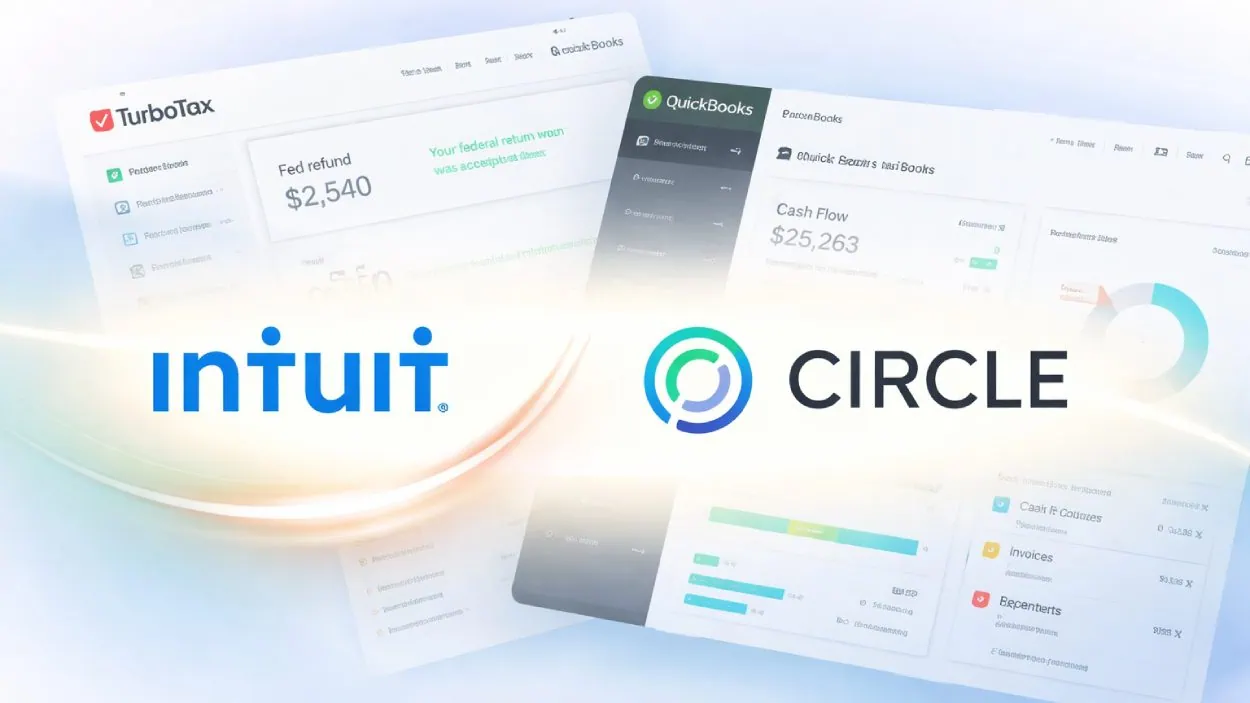







Intuit has announced a strategic multi-year partnership with Circle to integrate USDC stablecoin payments into its financial platforms, aiming to modernize how money moves across TurboTax, QuickBooks, Credit Karma, and Mailchimp.
Key Takeaways
- Intuit will use Circle’s USDC infrastructure to enable faster, cheaper, and programmable payments across its ecosystem.
- The stablecoin will initially be used as a backend payment rail, enhancing refunds, remittances, savings, and business payouts.
- USDC’s integration aligns with rising institutional adoption following the GENIUS Act and Visa’s launch of USDC settlement for U.S. banks.
- Intuit processes over $100 billion annually in tax refunds and serves 100 million global users, offering USDC massive reach into everyday finance.
What Happened?
Financial software leader Intuit and blockchain firm Circle have entered a multi-year partnership to embed USDC, the second-largest stablecoin, into Intuit’s product suite. The move aims to streamline financial services with stablecoin-based infrastructure that operates around the clock, unhindered by traditional banking hours.
We’re leveling up money movement. 💸
— Intuit (@Intuit) December 18, 2025
Our partnership with @circle will unlock faster, smarter, more affordable ways for consumers and growing businesses to move money across the Intuit platform.
Read more: https://t.co/a7c5xDeqzu pic.twitter.com/3Fbig9G0gR
Intuit Bets on USDC to Modernize Money Movement
The collaboration allows Intuit to tap into Circle’s blockchain-based USDC payment rails across its core services, including TurboTax, QuickBooks, Credit Karma, and Mailchimp. The goal is to enable low-friction, real-time financial experiences for both consumers and small businesses.
According to Intuit CEO Sasan Goodarzi, the company is focused on putting money “at the center of everything we do” by building a faster and smarter money platform. Integrating stablecoin technology helps the company move beyond legacy systems and provide programmable money movement that is always on.
Circle Co-Founder and CEO Jeremy Allaire called the partnership a major step forward in the evolution of digital payments. Allaire said:
Strategic Timing and Regulatory Tailwinds
This partnership comes on the heels of a growing wave of institutional adoption of stablecoins. Visa recently rolled out USDC settlement services for U.S. banks on Solana, while Cross River Bank and Lead Bank became early participants.
The timing also aligns with new U.S. regulation: the GENIUS Act, passed in July 2025, provides the first federal framework for dollar-backed stablecoins. It mandates 1:1 reserves backed by U.S. cash and Treasuries, adding a layer of credibility to stablecoin providers like Circle.
Circle itself has been ramping up its reach with partnerships like the one with crypto exchange Bybit to boost USDC liquidity in spot and derivatives markets. Now, with Intuit onboard, USDC is positioned to enter mainstream consumer and small-business financial workflows in a big way.

What It Means for Customers?
While Intuit hasn’t disclosed exactly when or how users will interact with USDC, the company confirmed that the stablecoin will first operate behind the scenes to enhance the speed and efficiency of services like tax refunds and business payouts. Given Intuit’s presence in major financial moments, such as the annual tax season, USDC integration could significantly upgrade customer experience during peak money movement times.
The partnership is not only about speed but also about programmability. By embedding blockchain-based infrastructure into its ecosystem, Intuit could enable more intelligent financial flows, better fraud protection, and eventually, new financial products tailored to individual needs.
CoinLaw’s Takeaway
I think this deal is a massive win for both companies and a major signal that stablecoins are moving from crypto-niche to financial mainstream. Intuit already touches almost every corner of U.S. personal and small business finance. By plugging in USDC behind the scenes, it’s laying the groundwork for faster, smarter, and cheaper money movement that could improve everything from tax refunds to payroll.
In my experience, partnerships like this only happen when there’s both clear regulatory backing and strong demand from users and businesses alike. It’s not about hype. It’s about real-world utility. I found it especially notable that Intuit’s initial focus is on backend infrastructure. That’s how you quietly scale a disruptive technology without scaring users off.