




• Skip to primary navigation
  • Skip to main content
  • Skip to primary sidebar
  • Skip to footer
CoinLaw LogoCoinLaw

Bringing Crypto & Finance Closer to You

  • Latest News
  • Statistics
  • About
  • Contact
Subscribe
CoinLaw Logo
Subscribe To Our Newsletter
Home » Finance

Household Debt Statistics 2026: Risks, Trends & What Comes Next

Updated on: January 29, 2026
Steven Burnett
Written By
Steven Burnett
Steven Burnett
Research Analyst
Steven Burnett has over 15 years of experience across finance, insurance, banking, and compliance-focused industries. Known for his deep res... See full bio
LATEST POSTS:
Personal Loan Industry Statistics 2026: Growth Insights
Personal Finance App Industry Statistics 2026: Smart Money Apps Now
Payday Loan Industry Statistics 2026: Risk, Demand & Growth
Kathleen Kinder
Reviewed By
Kathleen Kinder
Kathleen Kinder
Senior Editor
Kathleen Kinder brings over 11 years of experience in the research industry, with deep expertise in finance, cryptocurrency, and insurance. ... See full bio
LATEST POSTS:
Tesla Secures SpaceX Stake After xAI Merger Before IPO
BlackRock Launches Ethereum Staking ETF ETHB on Nasdaq
Wizz Financial Launches Stablecoin Payments to 80 Countries
Household Debt Statistics
As Featured In
FortuneYahoo! FinanceCoinDeskSeeking AlphaCoin Market Cap
Share on LinkedIn ChatGPT Perplexity Share on X Share on Facebook

U.S. households face mounting debt. This shapes decisions in housing, spending, and financial planning, whether a family balancing a mortgage or an auto loan, or a retiree drawing from home equity. Readers will find concise insight into where debt is rising, who’s most affected, and what might lie ahead. Explore the full article to follow the numbers and their stories.

Editor’s Choice

  • Total household debt stands at $18.2 trillion as of Q2 2025.
  • Mortgage balances grew by $131 billion in Q2 2025.
  • Revolving credit, primarily credit cards, rose at an annual rate of 9.7% in July 2025.
  • Revolving credit card debt reached $1.18 trillion, the highest on record.
  • The average American owes $63,000 in debt as of Q2 2025.
  • Average mortgage debt per household is about $252,505 in 2024, up 3.3% from 2023.
  • Credit card interest rates averaged 22–22.8% in early and mid‑2025.

Recent Developments

  • Household debt rose $185 billion (+1%) in Q2 2025, hitting $18.2 trillion.
  • Q2 2025 saw a $28 billion rise in total household debt, 5.8× more than Q2 2024.
  • Credit card debt matched last year’s record at $1.21 trillion, up 2.3% from the prior quarter.
  • Delinquency rose to 4.4%, marking a modest increase but remaining elevated.
  • Student loan delinquencies jumped after payments resumed, with over‑90‑day delinquencies hitting 8% in Q1 2025.
  • Serious overall delinquencies across all credit climbed from 2% to 2.8%.
  • The average credit card interest rate hit 24.35% in August 2025.

U.S. Household Debt Breakdown

  • Total household debt reached $18.2 trillion in Q1 2025, the highest level on record.
  • Mortgage debt accounts for $12.8 trillion, making it the largest share of household borrowing.
  • Automobile loans stand at $1.64 trillion, reflecting rising car prices and financing costs.
  • Student loans total $1.63 trillion, continuing to be a major burden for younger households.
  • Credit card debt hit $1.18 trillion, showing strong growth in revolving credit usage.
  • Other debt amounts to $0.94 trillion, covering smaller categories such as personal loans.
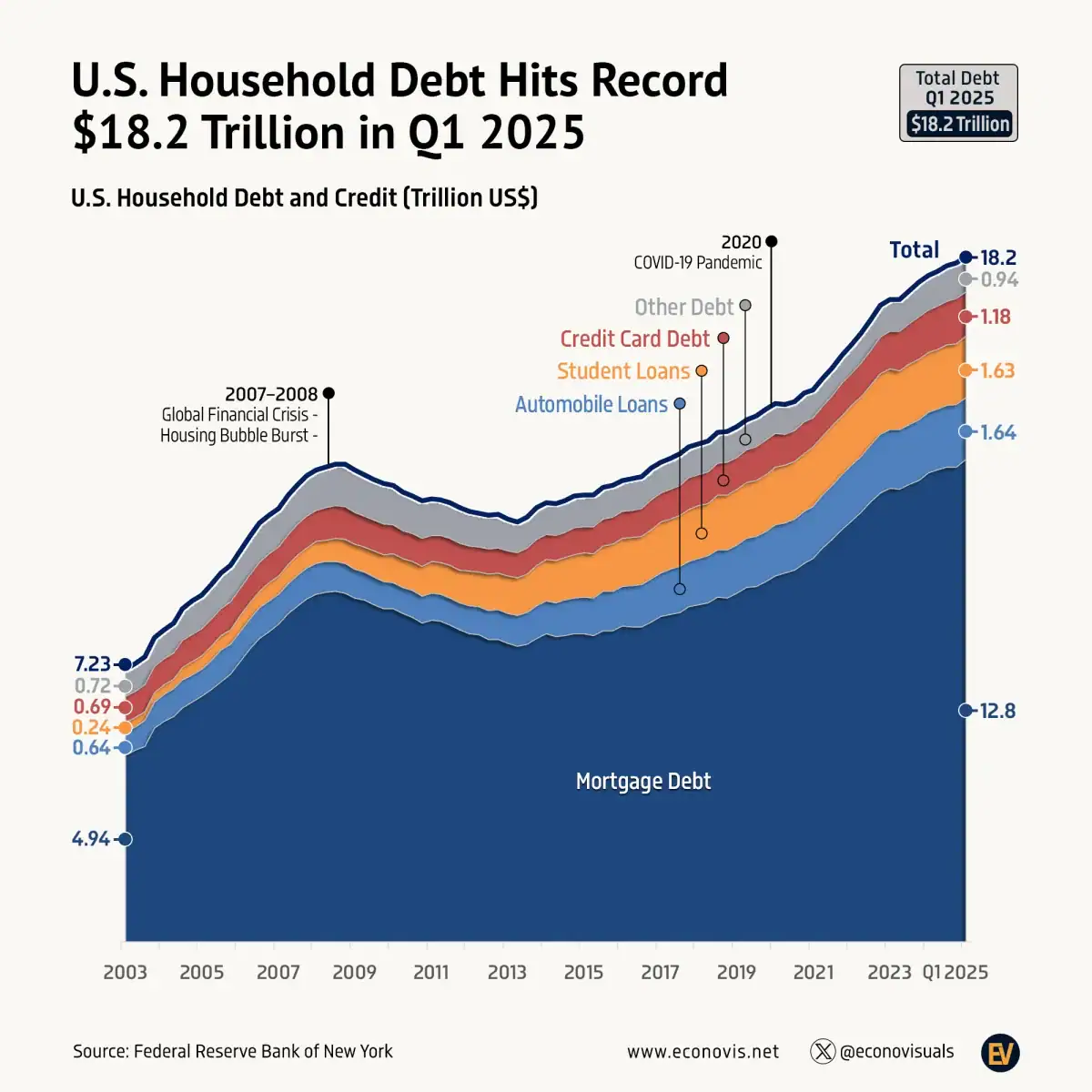
U.S. Household Debt Breakdown
Reference: Voronoi)

Historical Trends in Household Debt

  • Household debt rose by $4.6 trillion since 2019, reaching $18.20 trillion by 2025.
  • Visit Q1 2025, household debt stood at $18.2 trillion, up $167 billion from Q4 2024.
  • Compared with Q2 2024, Q2 2025’s $28 billion increase is nearly six times larger.
  • Student loan debt has declined 17.8% from its peak, though still significant.
Newsletter Img
Don't chase the news. Let us curate it.

You get one weekly briefing with only the stories that matter. If the market is quiet, we skip it.

✅ Join readers from Visa, Vanguard, and the FDIC.

Mortgage Debt Statistics

  • Mortgage balances rose $131 billion in Q2 2025.
  • Total mortgage debt is $12.94 trillion as of mid‑2025.
  • In Q1 2025, Americans originated $430 billion in new mortgage debt, 78.9% went to super‑prime borrowers, 4.7% to subprime.
  • Serious mortgage delinquency was 0.86% in Q1 2025, up from 0.70% in Q4 2024.
  • There were 61,660 new foreclosures in Q1 2025, nearly 50% higher than the prior quarter.
  • In Q1 2025, servicers completed 7,889 mortgage modifications, a 7.6% increase Q‑over‑Q, and 92.1% were combination modifications.
  • Mortgage debt share under 6% interest is declining, expected to approach 75% by year‑end 2025.

Household Debt Categories: What Consumers Owe

  • Mortgages remain the largest debt burden, with a median owed of $263,923 and an average monthly payment of $2,205.
  • HELOC balances average $45,157, with consumers paying around $509 per month.
  • Student loans carry a median balance of $38,375, with an average monthly payment of $500.
  • Auto loans show a median of $24,373, but come with one of the highest payment burdens at $742 per month.
  • Credit card debt has a median of $6,730, with an average monthly payment of $269.
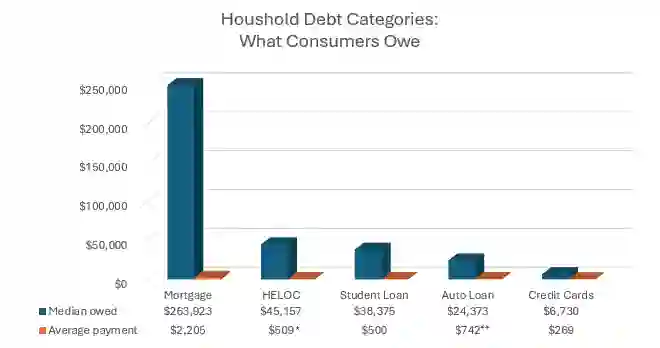
Household Debt Categories: What Consumers Owe
(Reference: Debt.org)

Credit Card Debt Statistics

  • Outstanding credit card debt rose to $1.21 trillion in Q2 2025, up from $1.182 trillion in Q1 2025.
  • That’s an increase of $27 billion over the quarter.
  • Compared with Q2 2024, card debt is 5.9% higher.
  • Credit-card balances are now matching last year’s record high.
  • The average credit card APR climbed to approximately 24.35% in August 2025.
  • About 12.3% of credit card balances are 90+ days delinquent in Q2 2025. This rate has remained relatively stable compared to prior quarters.
  • Newly delinquent credit card balances reached 8.6% of total balances in Q2 2025.

Auto Loan Debt Statistics

  • Auto loan debt rose by $13 billion in Q2 2025, reaching $1.66 trillion.
  • This growth was partly due to purchases ahead of expected tariffs.
  • The delinquency rate on auto loans eased slightly to 8.0%, still elevated.
  • Auto loan liabilities now make up a substantial share of non‑mortgage debt.
  • The increase reflects renewed borrowings, even as credit scores show rising strains.

Average Household Debt per Account vs. per Consumer

  • Mortgages are the largest debt category, averaging $147,000 per account and $43,000 per consumer.
  • Student loans total $38,000 per account, but on an individual level, average $6,100 per consumer.
  • Auto loans average $15,000 per account and $5,600 per consumer, highlighting widespread vehicle financing.
  • Credit card balances stand at $1,900 per account, yet consumers carry an average of $4,000 each.
  • Home equity loans average $29,000 per account, while the per-consumer figure is much lower at $1,300.
Average Household Debt per Account vs. per Consumer
(Reference: Education Data Initiative)

Student Loan Debt Statistics

  • Outstanding student loan debt now stands at $1.64 trillion.
  • Balances increased by $7 billion in Q2 2025.
  • After the repayment moratorium ended, delinquencies surged, and about 10.2% of student loans are now over 90 days past due.
  • Less than half of borrowers (38%) are current on payments.
  • Approximately 30% of borrowers are at least 90 days past due.
  • More than 10.3 million borrowers are in forbearance, up from 2.9 million in 2024.
  • Payment pauses have doubled since 2024, showing growing repayment stress.

Household Debt-to-Income Ratio

  • Debt-service ratios, the share of income spent on principal and interest payments, remain below pre‑pandemic averages, largely due to mortgage holders benefiting from fixed, lower interest rates locked in prior to 2022 rate hikes.
  • Homeowners benefited from solid equity cushions and past refinancing.
  • These factors help explain why U.S. households can carry high overall debt while managing payments.

Household Debt-to-GDP Ratio

  • As of Q1 2025, the debt‑to‑GDP ratio stood at 68.10%, down from 71.40% in Q4 2024.
  • The ratio has been trending downward, nearing 20‑year lows.
  • This suggests national output is growing faster than household borrowing, improving debt sustainability.

International Comparisons of Household Debt

  • U.S. household debt equaled 72.9% of GDP, which is lower than Canada (102.2%) and the U.K. (77.8%) but higher than Germany (51.3%)
Comparing Household Debt Levels Across Major Economies
  • In Q1 2025, U.S. household debt was around 72.9% of GDP, based on IMF reporting. While this is higher than Germany’s and Italy’s, it is lower than Canada’s 102.2% and the UK’s 77.8%.
  • More broadly, U.S. households carry less debt relative to GDP than some peers, though higher than many developed economies.
  • The OECD defines household debt relative to disposable income, offering varied frames for comparison.

Household Debt Distribution by Demographics

  • Households aged 40–49 carry the highest debt, with balances rising by $50 billion to $4.81 trillion in Q2.
  • The 18–29 age group owes the least, roughly $1.1 trillion.
  • Middle-aged cohorts remain the most affected, likely due to mortgage, auto loans, and student loans.

Delinquency Rates and Defaults

  • Aggregate delinquency across all credit types rose to approximately 4.4%, which the Fed labels as elevated.
  • Credit card delinquency (30+ days past due) reached 14.1% among the lowest-income ZIP codes and 8.3% among the highest-income ZIP codes in Q1 2025. National delinquency rates for 30+ days past due are lower on average, but disparities by income level are stark.
  • For 90+ days past due, credit card delinquency hit 12.3% nationally, 20.1% in low‑income areas, and 7.3% in high‑income areas.
  • Mortgage delinquency eased slightly in Q2 2025; the 30-day rate fell to 2.10%, 60-day to 0.72%, and 90-day to 1.11%.
  • Foreclosure starts dipped to 0.17%, a mild decline from the previous quarter.
  • The overall delinquency rate on consumer loans at commercial banks was 2.76% in Q2 2025, nearly flat from Q1 2025 (2.77%).
  • Student loan serious delinquency spiked to 8%, up from under 1% during pandemic relief.

Factors Driving Household Debt

  • Resumption of student loan repayments triggered a surge in delinquencies, especially among borrowers unprepared for the return of payments.
  • High interest rates, including credit card APRs averaging over 24%, push balances upward, as many make only minimum payments.
  • Among the lowest‑income ZIP codes, 30‑day credit card delinquency rose from 12.6% to 22.8% since Q3 2022.
  • Rising living costs like rent and food pressure household budgets, especially for younger and middle‑income borrowers.
  • Persistent emotional spending triggers, such as stress and convenience, have inflated credit card usage. Financial experts advise repairing behavior, not just finances.
  • Depletion of excess savings post-pandemic forced many consumers to rely more on credit to bridge gaps.
  • Lower‑income households are more vulnerable to macro risks, such as inflation and layoffs, limiting their buffer against debt strain.

Economic Impact of Household Debt

  • Elevated household debt, particularly high‑interest types like credit cards and student loans, raises the risk of consumer retrenchment if economic conditions worsen.
  • Rising delinquencies, especially among subprime borrowers, signal growing financial fragility and uneven recovery.
  • However, strong home equity gains, roughly $15 trillion since 2019, offer households a potential liquidity buffer.
  • With 40% of homeowners owning their homes outright, there’s scope for extracting funds via HELOCs to support spending and renovations.
  • At the same time, rising interest burdens and debt levels elevate risks for future economic downturns, echoing concerns about systemic stress.
  • Despite rising debt, consumer spending remains resilient, driven mainly by higher‑income households, though lower‑income groups lag behind.
  • Economists caution that sustained borrowing could become a drag on the economy if broader credit conditions tighten or wages stall.

Policy Responses to Household Debt

  • The U.S. Education Department has expanded the role of the student loan Ombudsman, promoting borrower education and standardizing servicing manuals to lower defaults.
  • Proposed reforms like the “One Big Beautiful Bill Act” aim to cap federal loan limits and eliminate problematic programs, targeting unsustainable borrowing.
  • Financial planners advocate strategies such as the debt snowball and avalanche methods, along with consolidation, balance transfers, and budgeting tools to reduce consumer debt burdens.
  • There’s encouragement for shifting student lending toward private models that better reflect borrowers’ repayment capacity.

Conclusion

Household debt in the U.S. climbs steadily across types, from mortgages to student loans and credit cards. Delinquency levels, particularly among the most vulnerable, are rising, fueled by surging interest rates, repayment pressures, and shrinking financial cushions. Yet, rising spending and home equity suggest some resilience. Policymakers are responding with borrower education, repayment tools, and proposed lending reforms. At the macro level, U.S. household debt remains high compared to many peers, underscoring the need for sustainable solutions.

As patterns shift, households and policymakers alike must navigate a balance, sustaining livelihoods while managing debt responsibly. The full article offers deeper insight into these trajectories and what may lie ahead.

Add CoinLaw as a Preferred Source on Google for instant updates! Follow on Google News
Share ChatGPT Perplexity

References

  • Statista
  • Statista
  • Statista
  • USAFacts
  • Business Insider
  • Mortgage Professional America
  • The House of Commons Library
Steven Burnett

Steven Burnett

Research Analyst


Steven Burnett has over 15 years of experience across finance, insurance, banking, and compliance-focused industries. Known for his deep research and data analysis skills, Steven transforms complex topics into clear, actionable insights. At CoinLaw, he contributes in-depth articles on financial systems, regulatory trends, and lending practices, helping readers make informed decisions with confidence.

Disclaimer: The content published on CoinLaw is intended solely for informational and educational purposes. It does not constitute financial, legal, or investment advice, nor does it reflect the views or recommendations of CoinLaw regarding the buying, selling, or holding of any assets. All investments carry risk, and you should conduct your own research or consult with a qualified advisor before making any financial decisions. You use the information on this website entirely at your own risk.

Related Posts

Loan Default Statistics 2026: What You Must Know
Cryptocurrency

Loan Default Statistics 2026: What You Must Know

Medical Debt Statistics 2026: Shocking New Trends
Finance

Medical Debt Statistics 2026: Shocking New Trends

Global Household Savings Statistics 2026: See How Your Country Ranks
Finance

Global Household Savings Statistics 2026: See How Your Country Ranks

Reader Interactions

Leave a Comment Cancel reply

Primary Sidebar

Connect With Us

facebook x linkedin google-news telegram pinterest whatsapp email
google-preferred-source-badge Add as a preferred source on Google

You Should Also Read

Consumer Debt Statistics 2026: Who Owes What & How It’s Changing Rapidly
Household Financial Stress Statistics 2026: Startling Facts You Can’t Ignore
Bankruptcy Filing Statistics 2026: What’s Surging?

Table of Contents

  • Editor’s Choice
  • Recent Developments
  • U.S. Household Debt Breakdown
  • Historical Trends in Household Debt
  • Mortgage Debt Statistics
  • Household Debt Categories: What Consumers Owe
  • Credit Card Debt Statistics
  • Auto Loan Debt Statistics
  • Average Household Debt per Account vs. per Consumer
  • Student Loan Debt Statistics
  • Household Debt-to-Income Ratio
  • Household Debt-to-GDP Ratio
  • International Comparisons of Household Debt
  • Household Debt Distribution by Demographics
  • Delinquency Rates and Defaults
  • Factors Driving Household Debt
  • Economic Impact of Household Debt
  • Policy Responses to Household Debt
  • Conclusion
Connect on Telegram

Footer

CoinLaw Logo

Bringing Finance Closer to You.

Connect With Us

Follow Us on Google News

Site Links

  • About CoinLaw
  • Newsletter
  • Privacy Policy
  • Terms and Conditions
  • Disclaimer

Worth Checking

  • Debit Card Statistics
  • NFT Market Growth Statistics
  • Retail Investing Statistics
  • Credit Card Fraud Statistics
  • Most Expensive Crypto Scams
Contact Us
13570 Grove Dr #189,
Maple Grove, MN 55311,
United States
10 a.m. – 6 p.m. | Every day

Copyright © 2024–2026 CoinLaw. All Rights Reserved. Powered by the HODL Force ❤️

  • Privacy Policy
Company
  • About Us
  • Our Team
  • Our Mission
  • Core Values
Discover
  • glossary icon
    Glossary
  • Stats
    Stats Research Process
  • Brand Guide Icon
    Brand Assets
Categories
  • Cryptocurrency
  • Payments
  • Finance
  • Banking
  • Insurance
Cryptocurrency
Metaplanet Statistics
Metaplanet Statistics 2026: Explosive BTC Growth
INX Digital Statistics
INX Digital Statistics 2026: Powerful Market Insights
Transak Statistics
Transak Statistics 2026: Key Metrics You Must See Now
WonderFi Statistics
WonderFi Statistics 2026: Growth Exposed
Digital Currency Statistics
Digital Currency Statistics 2026: Global Surge Now
Cryptocurrency Mining Statistics
Cryptocurrency Mining Statistics 2026: Energy, Profits & Risks
Payments
Payment Processing Solutions Statistics
Payment Processing Solutions Statistics 2026: Fintech Growth
Online Payment Statistics
Online Payment Statistics 2026: Explosive Growth
Money Transfer Industry Statistics
Money Transfer Industry Statistics 2026: Global Surge Now
Mobile Wallet Industry Statistics
Mobile Wallet Industry Statistics 2026: User Growth Trends
Merchant Services Industry Statistics
Merchant Services Industry Statistics 2026: Innovations, Payments, and Security
Mastercard Statistics
Mastercard Statistics 2026: Global Spending Trends Now
Finance
Personal Finance App Industry Statistics
Personal Finance App Industry Statistics 2026: Smart Money Apps Now
Inflation Statistics
Inflation Statistics 2026: Latest Trends, Comparisons, and Economic Impacts
Foreign Exchange Industry Statistics
Foreign Exchange Industry Statistics 2026: Who Controls FX Now?
Financial Planning Industry Statistics
Financial Planning Industry Statistics 2026: Powerful Market Insights
Finance Industry Statistics
Finance Industry Statistics 2026: Powerful Insights
Diversity In The Finance Industry Statistics
Diversity In The Finance Industry Statistics 2026: Powerful Trends Uncovered
Banking
JPMorgan Chase Statistics
JPMorgan Chase Statistics 2026: Growth Insights
Online Banking Usage Statistics
Online Banking Usage Statistics 2026: Shocking Growth
Digital Transformation in Banking Statistics
Digital Transformation in Banking Statistics 2026: Growth, Challenges, and Opportunities
Banking Statistics
Banking Statistics 2026: What You Must Know Now
ATM Statistics
ATM Statistics 2026: Insights You Must See Now
Neobank Industry Statistics
Neobank Industry Statistics 2026: Tap Into Explosive Revenue Secrets
Insurance
Pet Insurance Industry Statistics
Pet Insurance Industry Statistics 2026: Growth, Costs, and Coverage
Parametric Insurance Industry Statistics
Parametric Insurance Industry Statistics 2026: Payout Trends Now
Motorcycle Insurance Industry Statistics
Motorcycle Insurance Industry Statistics 2026: Growth Report
Insurtech Statistics
Insurtech Statistics 2026: Explosive Market Growth
Home Insurance Industry Statistics
Home Insurance Industry Statistics 2026: Growth Forecast
Embedded Insurance Industry Statistics
Embedded Insurance Industry Statistics 2026: Hidden Opportunities
Categories
  • Cryptocurrency
  • Investments
  • Compliance
  • Fintech
  • Finance
Cryptocurrency
Blackrock Launches Ethereum Staking Etf Ethb On Nasdaq
BlackRock Launches Ethereum Staking ETF ETHB on Nasdaq
Wizz Financial Launches Stablecoin Payments With Bitgo
Wizz Financial Launches Stablecoin Payments to 80 Countries
South Korea Ai Crypto Tax Reporting
South Korea to Use AI to Track Crypto Taxes by 2027
Binance Wins Anti Terrorism Connections Case
US Courts Dismiss Anti-Terrorism Claims Against Binance
Grayscale Debuts Avax Staking Etf On Nasdaq
Grayscale Debuts AVAX Avalanche Staking ETF on Nasdaq
Metaplanet Announces New Ventures
Metaplanet Expands Bitcoin Push With Ventures and Asset Unit
Investments
Tesla Secures Spacex Stake After Xai Merger
Tesla Secures SpaceX Stake After xAI Merger Before IPO
Tether Invest In Ark Labs For Bitcoin Stablecoin
Tether Joins $5.2M Ark Labs Round to Build Stablecoins on Bitcoin
Nvidia And Nebius Partner On Next Gen Ai Cloud Platform
Nvidia and Nebius Partner on Next Gen AI Cloud Platform
Ripple Plans 750m Buyback Program
Ripple Plans $750M Buyback as Valuation Hits $50B
Strive Buys Strategy Shares With Bitcoin Puchase
Strive Boosts SATA Dividend and Adds $50M of Strategy STRC
Bitgo Backs Ubyx As Settlement Agent
BitGo Backs Ubyx as Settlement Agent for Digital Assets
Compliance
Bithumb Faces Six Month Suspension Over Aml Compliance Issues
Bithumb Faces Six Month Suspension Over AML Violations
Dubai Authorities Send Cease And Desist To Kucoin Exchange
Dubai Regulator Orders KuCoin to Halt Crypto Services
Trump Criticizes Bank For Clarity Act Delays
Trump Pressures Banks as Crypto Clarity Act Stalls in Senate
Crypto Com Wins Financial License In Malta
Crypto.com Boosts EU Compliance With New MFSA Licence
Occ Proposes New Stablecoin Rules Under Genius Act
OCC Proposes New Stablecoin Rules Under GENIUS Act
Pakistan Enables The Regulatory Crypto Sandbox
Pakistan Advances Digital Asset Regulation With Crypto Sandbox
Fintech
Dia Launches New Blockchain Oracle
DIA Targets $100 Billion DeFi Pricing Gap With New Value Oracle
Crypto Com Joins Broadridge Nyfix Network
Crypto.com Joins Broadridge NYFIX Network for Institutional Trading
Starcloud Plans Bitcoin Mining In Space
Nvidia Backed Starcloud Plans Bitcoin Mining in Space
Visa And Bridge Partner For Stablecoin Network
Visa and Bridge Take Stablecoin Cards Global
Nasdaq Plans Binary Options On Platform
Nasdaq Plans Yes or No Options on Nasdaq 100
Numo Launches Bitcoin Tap To Pay App For Merchants
Numo Launches Bitcoin Tap-to-Pay App for Merchants
Finance
21shares Launches Strategy Yield Etp
21Shares Rolls Out Strategy Yield ETP on Euronext Amsterdam
Yahoo Finance Adds Coinbase Trading
Yahoo Finance Adds Coinbase Trading as Stock Rollout Expands
Bitcoin Crash Hits Galaxy Digital Hard With 482m Q4 Loss
Bitcoin Crash Hits Galaxy Digital Hard with $482M Q4 Loss
Ripple Cleared For Eu Expansion With Full Luxembourg Emi License
Ripple Cleared for EU Expansion with Full Luxembourg EMI License
Chainlink Etf By Bitwise Goes Live On Nyse
Chainlink Gets a Wall Street Gateway as Bitwise Spot ETF Hits NYSE
Pharos Foundation Live For Open Finance
Pharos Foundation Debuts to Drive Institutional Adoption of Open Finance
Newsletter Img

Too much noise in crypto?

We respect your time. You get one high-impact briefing a week. If the market is quiet, so are we.

✅ Join readers from Visa, Vanguard, and the FDIC.
Newsletter Img

The Weekly Briefing

We track the market 24/7. You get a 5-minute summary. If it’s quiet, we skip it.

✅ Read by pros at Visa, Vanguard, and the FDIC.