






FICO scores drive critical financial decisions for millions of Americans every year. These three‑digit numbers influence credit card approvals, mortgage rates, auto loans, and even rental applications. National trends show shifts in credit behavior as inflation pressures and student loan policy changes affect consumer credit profiles. Across industries like lending and real estate, lenders and borrowers alike monitor FICO trends to gauge credit risk and opportunity. Explore detailed FICO statistics below to understand how credit scoring is evolving today.
Editor’s Choice
- The national average FICO score in the U.S. is ~715 in 2025, down from ~717 in 2024, reflecting wider financial stress.
- Gen Z (ages 18–29) saw the largest year‑over‑year FICO decline, down ~3 points.
- Older consumers (60+) hold the highest share of exceptional scores (800+).
- FICO scores range from 300 to 850, with higher scores indicating lower credit risk.
- Student loan delinquencies are contributing to credit score pressures.
- FICO scoring models continue evolving with industry adoption and reporting changes.
Recent Developments
- 2025 national average FICO score: ~715, down ~2 points YOY.
- This decline in FICO scores is described as the largest drop since the Great Recession.
- Rising credit card utilization partly explains score downward pressure.
- Resumption of student loan delinquency reporting has a marked negative impact on credit scores.
- Gen Z’s FICO scores dropped by about 3 points on average compared with last year.
- Around 14% of Gen Z experienced a 50‑point or larger score drop, reflecting volatility.
- Older age groups show more resilience in maintaining higher credit scores.
- Mortgage and loan markets are adjusting to these shifts in credit risk profiles.
FICO Score Distribution Across U.S. Consumers
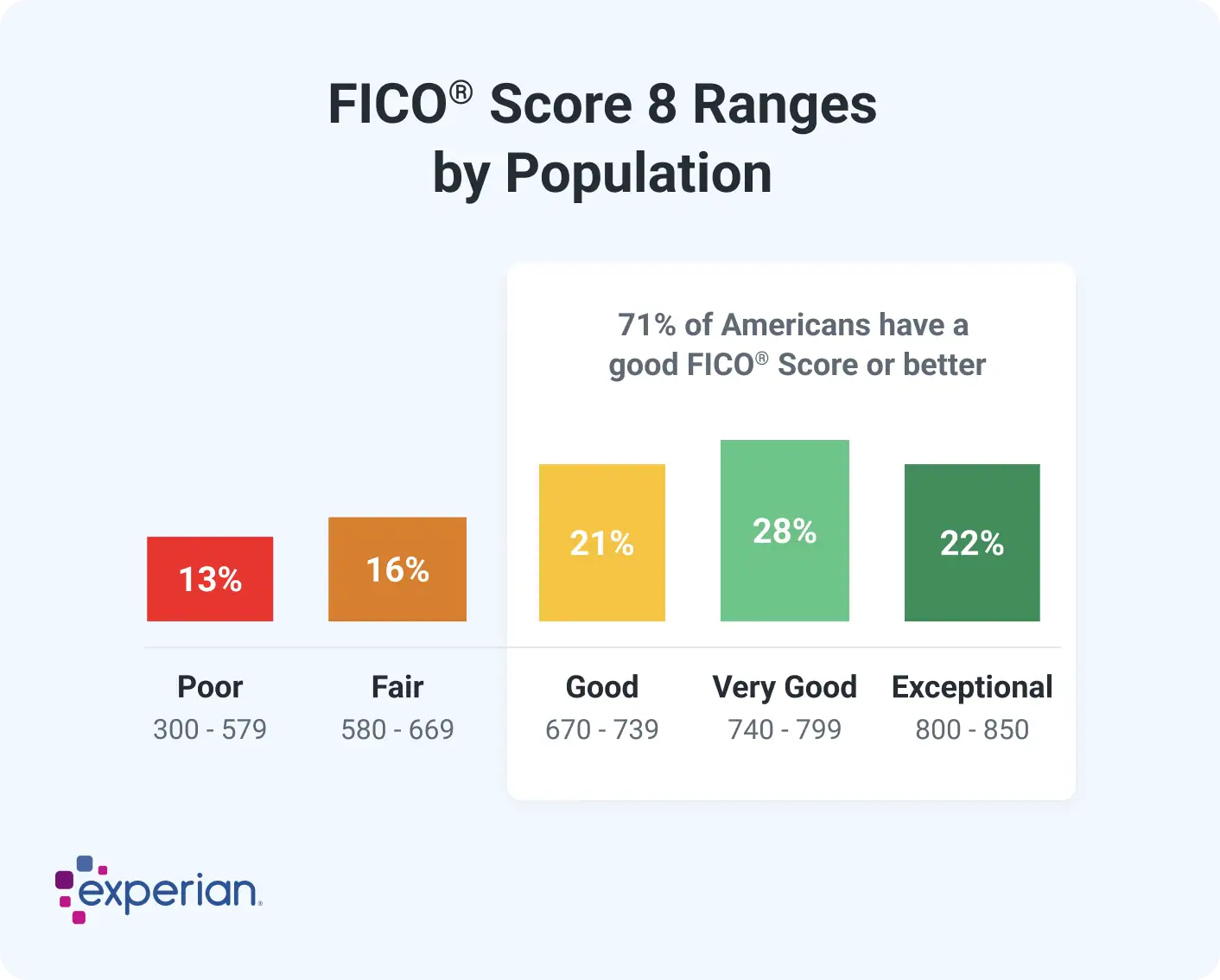
- 71% of Americans have a Good FICO score or higher, indicating strong overall credit health nationwide.
- 28% of the population falls into the Very Good (740–799) range, the largest single credit segment.
- 22% of Americans hold an Exceptional FICO score (800–850), qualifying for the best loan terms and interest rates.
- 21% of consumers have a Good score (670–739), typically meeting approval standards for most mainstream credit products.
- 16% of Americans are in the Fair range (580–669), where borrowing costs rise and approval rates decline.
- 13% of the population remains in the Poor credit category (300–579), often facing limited access to credit and higher risk pricing.
Average FICO Score in the U.S.
- Average FICO Score (2025): ~715, classified as “Good.”
- The national average fell by ~2 points compared with 2024.
- Experian data aligns with this average figure for 2025.
- VantageScore averages (an alternative metric) hover around 702 in 2025.
- The average has remained relatively stable at ~715 over recent years despite fluctuations.
- Average scores have climbed ~28 points since 2010, signaling long‑term improvement before recent dips.
- Nearly 60% of consumers score in the 700+ range, seen as lower credit risk.
- Score data helps lenders assess the overall credit health of U.S. borrowers.

FICO Score Distribution by Credit Category
- FICO scores are segmented into ranges: 300–579 (Poor), 580–669 (Fair), 670–739 (Good), 740–799 (Very Good), 800–850 (Exceptional).
- Consumers scoring 800+ account for ~23% of the population.
- Over half of 800+ scorers are aged 60+, reflecting age‑linked credit experience.
- State distributions vary, with Minnesota having some of the highest average scores.
- Lower range scores (below 640) tend to signal higher credit risk and potential subprime status.
- Distribution skews toward higher scores compared with a decade ago, reflecting long‑term credit improvements.
- Score distribution influences lending decisions from credit cards to large loans.
Key Factors That Influence FICO Score 8
- Payment history accounts for 35% of a FICO Score 8, making on-time payments the single most important credit factor.
- Amounts owed represent 30% of the score, highlighting the impact of credit utilization and outstanding balances.
- Length of credit history contributes 15%, rewarding borrowers with long-established accounts and consistent usage.
- New credit makes up 10%, reflecting the effect of recent account openings and hard inquiries.
- Credit mix accounts for 10%, favoring consumers who maintain a balanced combination of credit cards, loans, and other accounts.

Income‑Level Differences in FICO Scores
- Higher‑income borrowers (>$100K) generally report higher average FICO scores, often above 740, compared with lower brackets.
- Borrowers in the middle‑income range ($50K–$100K) tend to cluster around the 700–720 score range.
- Lower‑income consumers (<$50K) more often fall in the Fair to Good categories (580–739).
- Income growth is often positively correlated with more on‑time payments, boosting scores.
- Higher income often means greater access to low‑interest credit, which supports lower utilization ratios.
- Mid‑ to high‑income segments show greater resilience to economic pressures, including inflation and rate spikes.
- Individuals with steady income streams are less likely to miss payments, supporting higher scores over time.
- External factors such as job loss risk disproportionately affect lower‑income consumers’ credit behavior and scores.
Racial and Ethnic Patterns in Credit Scoring
- Asian Americans average 745 FICO score, the highest among groups.
- White Americans average a 734 FICO score.
- Hispanic Americans average a 701 FICO score.
- Black non-Hispanic Americans average a 677 FICO score.
- Native Americans average 612 FICO score, the lowest among groups.
- Overall US average FICO score stands at 717.
- 50% of White households exceed 700 FICO, vs 21% Black.
- Majority White communities median 727, Black 627.
Credit Score Trends Across Age Groups
- Young adults (18–24) average ~680, lower than the national average.
- 25–34 year olds hover around ~688.
- 35–44 year olds approximate ~705.
- 45–54 year olds roughly average ~720.
- 55–64 year olds commonly have a score of ~740.
- Adults aged 65+ average ~760, among the highest.
- The progression shows that credit scores generally increase with age as credit histories lengthen.
- Gen Z shows the steepest decline in 2025, with broader implications for early‑career financial stability.

How Credit Utilization Impacts FICO Scores
- Credit utilization is a key part of the Amounts Owed category, which is roughly 30% of a FICO score.
- Experts recommend keeping utilization below 30% of your total credit limit to avoid negative score impacts.
- Borrowers with utilization below 10% typically rank among the highest score tiers.
- As utilization rises above 30%, credit risk perception increases, and scores can drop.
- A national trend shows average utilization rising amid higher cost pressures, which contributes to score declines.
- Revolving debt balances (e.g., credit cards) disproportionately drive utilization fluctuations.
- Consumers who pay down credit card debt regularly see measurable improvements in their FICO scores.
- High utilization can signal financial strain to lenders, affecting future credit access.
Effects of New Credit Inquiries on FICO Scores
- New credit accounts for 10% of the FICO score.
- Hard inquiries stay on credit reports for 2 years.
- FICO considers only inquiries from the past 12 months.
- A single hard inquiry typically lowers a score by less than 5 points.
- Inquiry on a new credit file can drop the FICO 8 score by 21 points.
- People with 6+ inquiries are up to 8 times more likely to file bankruptcy.
- Rate shopping inquiries within 45 days count as one.
- 24% of Americans opened a new credit card in the past year.
- 13% opened a new personal loan recently.
Auto Financing Decisions Based on Credit Scores
- Super prime (781+) new car APR 4.88%, used 7.43%.
- Prime (661-780) new car APR 6.51%, used 9.65%.
- Subprime (501-600) new car APR 13.34%, used 19.00%.

- New car loans average FICO 755, used 691.
- Deep subprime (<500) used car APR 21.60%.
- Subprime (<620) auto delinquencies 15.78% 30+ days.
- Subprime 60+ days delinquency hits 6.65% record.
- Prime/super-prime accounts for 69.9% vehicle financing.
- New car average payment $748, used $532.
Delinquencies and Their Influence on Credit Scores
- Credit card delinquency rate at 2.98% Q3 2025.
- Forecast credit card 90+ days delinquencies stable at 2.57% 2026.
- Student loan delinquency rate reaches 31% April 2025.
- 5 million federal student loan borrowers are 90+ days overdue.
- Subprime auto loan 30+ days delinquency at 15.78%.
- Auto delinquency forecast rises to 1.54% end of 2026.
- General-purpose credit card delinquency 3% end of 2024.
- Private-label credit card delinquency is 3.8% end of 2024.
- The average credit score drops 60 points due to student delinquency.
Default Rate Correlations with FICO Scores
- FICO below 620 shows default rates 5x higher than prime.
- FICO 760+ borrowers have the lowest default probabilities.
- 620 FICO mortgage rate 7.89%, vs higher scores lower.
- Subprime FICO under 640 concentrates on auto defaults.
- Credit card charge-off rate 3.92% Q3 2025.
- 50-point FICO drop raises serious delinquency risk.
- Student delinquency drops FICO 760+ by 171 points.
- Credit union severe delinquency 7.6% Jan 2024.
- Charge-offs forecast 3.6-3.9% by 2026.
Use of FICO Scores in Mortgage Underwriting
- Conventional mortgages require a minimum 620 FICO score.
- FHA loans need a 580 FICO for 3.5% down payment.
- FICO 500-579 qualifies for FHA with 10% down.
- FICO 740+ gets an average 7.26% 30-year conventional rate.
- FICO 620 averages a 7.89% 30-year conventional rate.
- 25% consumers have FICO 740-799, better rates.
- Average mortgage borrower FICO exceeds 740.
- FICO 700 gets a 7.42% 30-year conventional rate.
Credit Card Issuing Practices and FICO Scores
- Rewards cards typically require a 700+ FICO for approval.
- Entry-level cards available for Fair credit 580–669.
- 48% credit card applicants were denied past year.
- 74% poor credit (<580) were denied financial products.
- 64% FICO 670-799 applicants face denials.
- 29% exceptional FICO 800+ denied.
- The average FICO score US is 715.
- 25% consumers FICO 740-799 get premium offers.
- 22.5% population has an exceptional 800-850 FICO.
Comparing FICO and VantageScore Usage Patterns
- FICO scores remain the dominant model for mortgage and auto lending.
- VantageScore sees broader use in consumer credit monitoring tools.
- Over 90% of top lenders rely on FICO for major lending decisions.
- FICO and VantageScore ranges both span 300–850, but scoring logic differs.
- Some fintech lenders blend both models for risk evaluation.
- Consumers may see score differences of 20–40 points between models.
- FICO emphasizes longer credit history, while VantageScore is more forgiving for thin files.
- Lender preference continues to favor FICO for regulated credit products.
Inequality in Credit Access Linked to FICO Scores
- FICO scores below 640 face higher fees and denial rates.
- The majority Black areas median FICO 627, White 727.
- The majority of Native American areas median FICO of 612.
- The majority of Hispanic areas median FICO of 667.
- 74% poor FICO scores (<580) were denied financial products.
- 48% loan applicants were denied past year.
- 82% Americans prioritize improving credit score access.
- US average FICO 715, Minnesota 742, Mississippi 680.
- 75% feel in control of credit, but gaps persist.
Frequently Asked Questions (FAQs)
Older Americans (60+) often average about 752+ FICO scores versus ~680 for younger adults (18–29).
The share of adults with scores between 600 and 749 declined from 38.1% in 2021 to 33.8% in 2025.
The national average FICO score dropped about 2 points from 2024 to 2025.
Conclusion
FICO statistics today highlight how deeply credit scores shape access to housing, transportation, and everyday financial tools. While higher scores consistently correlate with lower risk and better pricing, economic cycles and structural inequalities continue to influence outcomes across income and demographic groups. As lenders refine underwriting models and policymakers examine fairness, FICO scores remain central to the U.S. credit system. Understanding these trends helps consumers, lenders, and regulators make informed decisions in a rapidly shifting financial landscape.