






In 2010, a pizza purchase for 10,000 BTC was seen as quirky. Today, that amount represents billions. But with the astronomical rise of cryptocurrencies has come a more grounded reality: regulation. Fast-forward to 2025, and compliance isn’t just a checkbox, it’s a survival tactic for any serious player in the crypto space.
Whether you’re a startup in blockchain or a seasoned exchange, understanding compliance risks is non-negotiable. Regulations are evolving faster than ever, and falling behind could mean steep fines or even losing the license to operate. This guide explores the latest statistics and key compliance risks shaping the cryptocurrency landscape in 2025, helping you navigate a complex but rewarding space.
Editor’s Choice
Here are seven standout statistics that highlight the urgency of cryptocurrency compliance in 2025:
- 74% of cryptocurrency exchanges have enhanced their compliance protocols in response to stricter regulations introduced in 2024.
- $2.8 billion in crypto assets were frozen by regulatory bodies due to non-compliance and illicit activities in 2024 alone.

- Over 62% of decentralized finance (DeFi) platforms are at risk of non-compliance with Know Your Customer (KYC) standards by Q2 2025.
- 45% of crypto firms reported challenges in cross-border regulatory alignment, up from 38% in 2023.
- The average fine for Anti-Money Laundering (AML) non-compliance has risen to $12 million globally.
- 80% of tax authorities in OECD countries now have automated systems in place to track and audit crypto transactions.
- 57% of Initial Coin Offerings (ICOs) launched in 2025 are subjected to multi-jurisdictional legal reviews before token issuance.
Overview of Cryptocurrency Compliance Risks
Cryptocurrency has transitioned from a fringe asset to a global phenomenon, attracting regulators’ attention. Here’s an overview of the main compliance risks facing crypto businesses in 2025:
- 72% of financial regulators worldwide cite AML non-compliance as their top concern when overseeing crypto exchanges.
- 60% of surveyed cryptocurrency businesses in 2025 report difficulties in understanding and implementing region-specific compliance standards.
- The Financial Action Task Force (FATF) has flagged 30% of countries as “high-risk jurisdictions” for crypto operations due to poor compliance frameworks.
- $3.2 billion worth of crypto was lost to fraud in 2024, prompting regulators to push stricter fraud-prevention protocols.
- 48% of crypto exchanges fail to perform adequate KYC checks, increasing their exposure to regulatory penalties.
- Only 41% of blockchain projects have a dedicated compliance officer or team, despite rising legal requirements.
- 55% of digital asset platforms have faced at least one regulatory investigation in the past 18 months.
- Compliance costs for major exchanges have increased by 27% year-over-year, reaching an average of $4 million annually.
- Token classification ambiguity remains a significant hurdle, with 67% of projects unsure whether their assets qualify as securities under local laws.
US Regulators Impose Penalties Related to Crypto Asset Violations
- US regulators have collectively imposed $2.5 billion in penalties for violations connected to crypto assets.
- The Securities and Exchange Commission (SEC) leads with $1.69 billion in penalties, accounting for the largest share.
- The Commodity Futures Trading Commission (CFTC) followed, imposing $624 million in penalties.
- FinCEN (Financial Crimes Enforcement Network) has issued penalties totaling $183 million.
- OFAC (Office of Foreign Assets Control) has levied fines amounting to $0.6 million.

Regulatory Landscape for Cryptocurrency in 2025
By 2025, regulators around the world will have upped their game. The legal frameworks are more comprehensive, and enforcement is more aggressive. Here’s how the regulatory environment is shaping up:
- The European Union’s Markets in Crypto-Assets (MiCA) framework became fully enforceable in January 2025, affecting over 300 crypto service providers.
- The US Securities and Exchange Commission (SEC) reported a 40% increase in enforcement actions related to unregistered token sales between 2024 and 2025.
- Asia-Pacific countries, including Singapore and South Korea, introduced stricter crypto licensing requirements, impacting 58% of existing exchanges.
- In 2025, Brazil passed its first comprehensive crypto legislation, mandating real-time reporting of suspicious transactions to authorities.
- 78% of crypto exchanges in the Middle East and North Africa (MENA) region have applied for new licenses following updated compliance rules.
- The Financial Crimes Enforcement Network (FinCEN) in the US expanded its definition of “money transmitter” to include NFT marketplaces, impacting 25% of blockchain gaming companies.
- 62% of regulatory bodies worldwide now require Proof of Reserves (PoR) audits from crypto custodians to ensure transparency.
- The FATF Travel Rule adoption reached 85 countries by March 2025, requiring crypto firms to share customer data for transactions above $1,000.
- The UK Financial Conduct Authority (FCA) has approved only 12% of crypto firms applying for licenses, underscoring stringent vetting processes.
- In Australia, the Digital Assets (Market Regulation) Bill 2025 now holds stablecoin issuers to the same regulatory standards as traditional payment providers.

Breakdown by Type of Violation
- Unregistered securities offerings represent the highest category of violations, with penalties totaling $1.38 billion.
- Fraud violations account for $928 million in fines.
- Anti-Money Laundering (AML) violations resulted in $183 million in penalties.
- Sanctions violations penalties are relatively low at $0.6 million.
- Other violations make up $8.5 million in penalties.

Anti-Money Laundering (AML) and Know Your Customer (KYC) Challenges
AML and KYC remain central to cryptocurrency compliance frameworks. In 2025, heightened global scrutiny and technology-driven fraud have intensified these challenges for crypto firms.
- 69% of crypto exchanges fail to meet FATF’s Travel Rule compliance, particularly when handling cross-border transactions.
- $4.2 billion was linked to money laundering through cryptocurrency in 2024, marking a 23% increase from 2023.
- Only 43% of DeFi platforms implement mandatory KYC verification despite increasing regulatory pressure.
- 85% of major crypto exchanges now use AI-based transaction monitoring systems to flag suspicious activity in real time.
- 51% of crypto businesses cite identity verification delays as a top barrier to effective KYC onboarding in 2025.
- 29% of crypto users in the US abandoned transactions due to complex KYC requirements, reflecting a growing tension between compliance and user experience.
- 36 countries have introduced crypto-specific AML regulations since 2023, accelerating compliance obligations across jurisdictions.
- 58% of financial crimes investigated in 2024 had a cryptocurrency component, increasing law enforcement’s focus on AML procedures.
- 74% of cryptocurrency exchanges now collaborate with external regtech providers to manage KYC and AML compliance more effectively.
- In Q1 2025, Interpol launched a dedicated crypto task force focused on cross-border AML enforcement, targeting high-risk jurisdictions.
How Organizations Address Cryptocurrency Risks in Financial Crime Compliance Programs
- 31% of organizations state that cryptocurrency risks are already included in their Financial Crime Compliance Programs.
- 22% of organizations plan to include cryptocurrency risks in the future.
- 19% report that they are not exposed to risks associated with cryptocurrencies.
- 15% have assessed their operations and concluded they are not exposed to cryptocurrency risks.
- 7% of respondents don’t know how cryptocurrencies could expose their business to risk.
- 5% of respondents are unsure about the risks posed by cryptocurrencies.

Risks Related to Data Privacy and Security Compliance
As data becomes more valuable and vulnerable, crypto companies must navigate a minefield of privacy regulations and cybersecurity threats in 2025.
- 77% of crypto firms identified data privacy compliance as their biggest regulatory challenge, up from 64% in 2023.
- 39% of cryptocurrency exchanges experienced a data breach in 2024, primarily due to inadequate security protocols.
- The global average cost of a data breach in the crypto sector is now $5.3 million, a 15% rise compared to 2023.
- GDPR fines related to crypto firms increased by 28% in 2024, with penalties totaling $820 million across Europe.
- 63% of decentralized platforms fail to comply with GDPR’s right to erasure (right to be forgotten) due to blockchain’s immutable nature.
- 53% of US-based crypto firms are now required to comply with California Consumer Privacy Act (CCPA) regulations, adding complexity to their data management.
- 47% of crypto wallets will have integrated multi-party computation (MPC) technologies to bolster data security and privacy in 2025.
- South Korea’s Personal Information Protection Act (PIPA) mandates stricter data-handling protocols, impacting 70% of local crypto service providers.
- 42% of crypto organizations have appointed a Data Protection Officer (DPO) to oversee compliance with emerging privacy regulations.
- In 2025, zero-knowledge proof (ZKP) adoption has surged by 60%, with crypto projects leveraging this technology to ensure compliance and privacy.
Perceived Risk of Investing in Cryptocurrency
- 60% of respondents consider investing in cryptocurrency to be a high risk.
- 26% believe it carries a moderate risk.
- Only 5% view cryptocurrency investment as low risk.
- Another 5% think there is no risk involved.
- 4% of respondents gave no answer regarding their perception of risk.

Tax Compliance Issues in Cryptocurrency Transactions
Tax compliance remains one of the most complex and fast-evolving areas of cryptocurrency regulation. In 2025, tax authorities worldwide are ramping up enforcement and utilizing advanced analytics to trace crypto transactions.
- 90% of tax authorities in OECD countries now require crypto platforms to report user transaction data automatically.
- 34% of crypto investors in the US under-reported gains in 2024, triggering audits and penalties from the IRS.
- The IRS issued 12,000 compliance letters to crypto traders in 2024, a 35% increase compared to 2023.
- FinCEN has expanded its scope to classify crypto-to-crypto transactions as taxable events, increasing compliance burdens.
- 61% of crypto traders report confusion over cost basis calculation rules for tax reporting.
- 45 countries have enacted Crypto Tax Reporting Frameworks (CTRF) in line with the OECD Crypto-Asset Reporting Framework (CARF) guidelines by 2025.
- 79% of centralized exchanges in the EU now provide automated tax reporting tools to simplify compliance for users.
- 19% of NFT sales in 2024 triggered unexpected capital gains taxes, creating new challenges for creators and investors.
- Australia’s Taxation Office (ATO) reported a 27% increase in crypto tax compliance audits in 2024, with fines exceeding $18 million.
- Japan’s National Tax Agency introduced real-time withholding tax rules for crypto earnings in 2025, impacting 34% of trading platforms operating in the region.
Top Risks Impacting Financial Services Firms
- 58% of firms report disruptive technology risk has significantly increased in impact, this is the highest ranked risk.
- 55% cite data/privacy breaches as a growing concern.
- 52% highlight operational risk as having a greater impact compared to two years ago.
- 49% point to financial risk as an area of heightened concern.
- 46% are facing increased strategic risks.
- 45% mention greater challenges with regulatory and compliance risk.
- 31% say systemic risk has grown in importance.
- 28% identify macroeconomic/business cycle risk as a growing issue.
- 25% are more concerned about reputational and brand risk.
- 20% report increasing concerns around geopolitical change and rising protectionism.

Cross-Border Regulatory Compliance Risks
Operating across multiple jurisdictions introduces serious compliance risks for crypto businesses in 2025, as regulatory frameworks remain fragmented and inconsistent.
- 68% of cross-border crypto transactions face compliance scrutiny due to inconsistent AML and KYC standards.
- 54% of global exchanges halted operations in at least one jurisdiction in 2024 due to regulatory uncertainty.
- 35% of US-based crypto firms report difficulties complying with European MiCA regulations when offering services to EU customers.
- 61 countries have introduced licensing frameworks for crypto firms targeting foreign markets, increasing barriers to entry.
- 72% of surveyed crypto businesses say navigating sanctions compliance is a major challenge when handling cross-border transfers.
- $1.7 billion worth of crypto assets were frozen in 2024 due to non-compliance with international sanctions.
- 47% of DeFi protocols with cross-border services have yet to comply with FATF’s Travel Rule, risking regulatory action.
- 48% of multinational crypto firms have created regional compliance teams to address country-specific regulations in 2025.
- Singapore’s Monetary Authority (MAS) now mandates real-time transaction monitoring for all cross-border crypto remittances.
- 44% of cross-border payment companies report delays due to inconsistent tax rules between jurisdictions, complicating compliance.
Cybersecurity Protection Levels and Compliance Status Overview
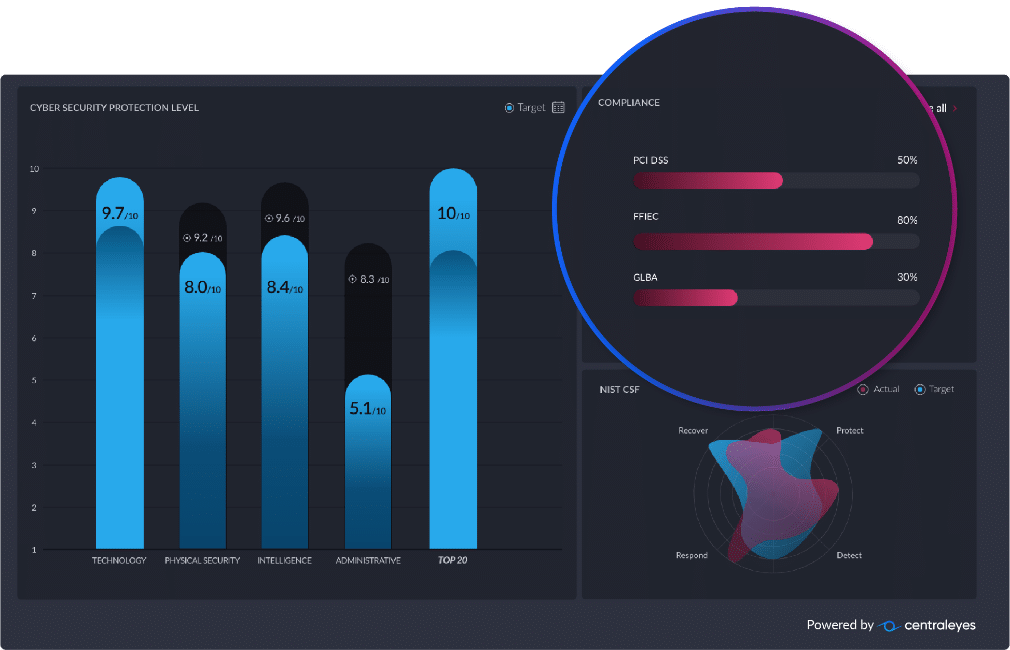
- Technology protection scores an impressive 9.7/10, close to the target score of 10.
- Physical security stands at 8.0/10, below its target of 9.2.
- Intelligence security measures reach 8.4/10, with a target of 9.6.
- Administrative protection is significantly lower at 5.1/10, against a target of 8.3.
- The top 20 cybersecurity protection levels achieve a perfect score of 10/10.
Compliance Readiness
- FFIEC compliance leads at 80% readiness.
- PCI DSS compliance is at 50%.
- GLBA compliance lags behind at 30%.
Risks of Non-Compliance with Sanctions and Blacklists
As geopolitical tensions rise, sanctions enforcement is becoming a critical compliance area for crypto businesses in 2025.
- 52% of crypto exchanges operating globally have updated their sanctions screening systems within the past 12 months.
- $3.5 billion worth of crypto assets were seized in 2024 due to violations of international sanctions.
- 41% of DeFi platforms lack integrated compliance checks for sanctioned wallets, making them vulnerable to enforcement actions.
- The US Department of the Treasury’s Office of Foreign Assets Control (OFAC) added 8 crypto mixers to its sanctions list in 2024.
- 70% of crypto businesses now rely on third-party compliance providers for real-time blacklist monitoring.
- 63% of surveyed crypto compliance officers report difficulty interpreting dual-use sanctions lists across different jurisdictions.
- The UK’s Financial Conduct Authority (FCA) levied £90 million in fines on crypto platforms for failing to block sanctioned individuals in 2024.
- 28 countries have implemented mandatory sanction list screening for all crypto transactions above $5,000.
- Interpol’s Global Sanctions Database now covers 97 countries, offering crypto firms centralized access to real-time data.
- 36% of crypto custodians froze user accounts in 2024 due to flagged transactions linked to sanctioned entities.
Decentralized Finance (DeFi) and Compliance Complexities
The DeFi sector is booming but presents significant regulatory challenges in 2025, primarily due to its non-custodial and permissionless nature.
- 74% of DeFi protocols are non-compliant with AML and KYC regulations, according to the latest FATF report.
- DeFi platforms accounted for $1.3 billion in illicit transactions in 2024, a 40% increase year-over-year.
- 61% of DeFi users transact anonymously, complicating compliance monitoring and identity verification.
- 45 countries have proposed DeFi-specific regulatory frameworks, with Singapore and Switzerland leading the charge.
- 80% of liquidity pools do not undergo smart contract audits, increasing systemic risk and regulatory scrutiny.
- 42% of DeFi platforms now offer permissioned pools to meet jurisdiction-specific compliance requirements.
- $500 million was lost to DeFi protocol hacks in 2024, pushing regulators to enforce stricter cybersecurity standards.
- 59% of institutional investors say the lack of compliance assurances prevents them from entering the DeFi space.
- The EU MiCA regulation introduced DeFi governance rules, holding DAO operators accountable for legal compliance.
- 28% of DeFi platforms in 2025 now integrate compliance oracles to provide automated KYC and AML processes.
Compliance Risks in Initial Coin Offerings (ICOs) and Token Sales
Although ICOs are less common today, token sales continue to pose compliance challenges in 2025, particularly in terms of securities regulation.
- 62% of token sales in 2025 are subject to multi-jurisdictional securities laws, complicating global fundraising efforts.
- 48% of ICOs launched in 2024 failed to meet disclosure requirements, resulting in enforcement actions.
- The SEC initiated 67 enforcement cases against fraudulent ICOs in 2024, totaling over $600 million in fines and penalties.
- 75% of token issuers now conduct legal reviews before launching to avoid classification as unregistered securities.
- 40% of token projects reported delays due to legal uncertainty around utility versus security token classification.
- Japan’s Financial Services Agency (FSA) mandates pre-sale licensing for all token offerings targeting retail investors.
- 53% of ICO investors in 2025 demand third-party audits of smart contracts and white papers before participating.
- $1.1 billion in funds raised through token sales in 2024 was returned to investors due to non-compliance findings.
- 30 countries now require prospectuses for public token sales, increasing transparency and reducing fraud risks.
Emerging Compliance Technologies and Solutions
New technologies are helping crypto businesses tackle compliance challenges more efficiently in 2025.
- AI-driven transaction monitoring solutions are used by 68% of crypto exchanges to flag suspicious behavior in real time.
- Zero-Knowledge Proofs (ZKPs) are integrated into 49% of DeFi applications to enable privacy-preserving KYC.
- Blockchain analytics platforms have increased adoption by 72%, helping firms detect illicit activities across networks.
- Regtech solutions focusing on cross-border compliance have seen 58% growth in the past 12 months.
- Smart contract auditing services are now standard for 84% of token projects, up from 55% in 2023.
- Decentralized Identity (DID) frameworks are deployed in 37% of DeFi platforms to manage KYC compliance without compromising privacy.
- Automated tax reporting tools are available in 80% of centralized exchanges, easing compliance for users and regulators.
- Regulatory sandboxes have been established in 22 countries to test new compliance technologies in controlled environments.
- 61% of crypto firms employ continuous compliance monitoring systems, ensuring they meet evolving regulatory requirements in real time.
Recent Enforcement Actions and Legal Precedents
Recent cases in 2024-2025 highlight the consequences of non-compliance and shape the legal landscape for crypto.
- The US SEC fined Binance $1.2 billion in 2024 for operating as an unregistered securities exchange.
- Kraken settled with the CFTC for $30 million over illegal derivative trading without proper registration.
- FTX executives received a combined 160 years in prison sentences for fraud and mismanagement of user funds.
- The UK FCA banned 20 crypto firms from operating after they failed to meet anti-money laundering obligations.
- Ripple Labs achieved partial legal clarity with a court ruling that XRP is not a security when sold on public exchanges.
- South Korea’s Supreme Court upheld the conviction of Bithumb‘s former CEO for embezzlement and non-compliance.
- Germany’s BaFin revoked licenses from 5 crypto custodians that failed to implement adequate cybersecurity measures.
- Singapore’s MAS imposed $15 million in fines on three exchanges for breaching AML regulations.
- Brazil prosecuted 14 individuals for running a $200 million Ponzi scheme through crypto investment platforms.
Best Practices to Mitigate Cryptocurrency Compliance Risks
To navigate this complex regulatory landscape in 2025, crypto businesses are adopting best practices to ensure compliance and minimize risks.
- Conduct jurisdictional risk assessments before entering new markets to understand local regulatory requirements.
- Implement comprehensive AML and KYC programs, integrating AI tools for continuous monitoring and risk scoring.
- Adopt Proof of Reserves (PoR) audits to increase transparency and build trust with regulators and users.
- Regularly update sanctions screening protocols to align with global watchlists and prevent inadvertent violations.
- Utilize smart contract audits and third-party verifications before launching tokens or DeFi protocols.
- Establish cross-functional compliance teams that work closely with legal, technical, and operational departments.
- Invest in regulatory technology (regtech) to automate compliance reporting, reducing costs and human error.
- Educate users on privacy and security best practices, ensuring informed consent when collecting personal data.
- Develop and publish clear policies and procedures on AML, KYC, data privacy, and tax reporting compliance.
- Participate in regulatory sandboxes or industry working groups to stay informed on evolving compliance trends.
Conclusion
The cryptocurrency landscape in 2025 is as exciting as it is complex. As regulators step up enforcement and technological advancements bring new opportunities, compliance isn’t just about following the rules, it’s about fostering trust and sustainability in a rapidly evolving ecosystem. By staying informed and adopting proactive compliance strategies, crypto businesses can not only mitigate risks but also seize the full potential of the digital asset revolution.