






Credit card debt has climbed steadily, reflecting economic pressures and shifting consumer habits. Rising interest and slower wage gains strain borrowers. This debt surge affects industries like retail, where higher balances drive demand for loyalty financing, and lending, where personal loan consolidation shows growth. Explore the full article to see how these trends impact households and policy.
Editor’s Choice
- As of Q2 2025, aggregate U.S. credit card balances stand at $1.21 trillion, up 5.87% year over year.
- Q1 2025 delinquency rate on credit card loans is 3.05%, slightly down from Q4 2024 at 3.08%.
- Share of credit card debt that’s 30+ days delinquent reached 14.1% nationally in Q1 2025.
- About 30% of Americans anticipate increasing their credit card balances by the end of 2025, citing inflation and interest rates as primary reasons.
- 18% surge in personal loans used for consolidation, reaching $257 billion in early 2025.
- The average interest rate across credit accounts is around 21.37% in Q1 2025.
- Approximately 11.1% of cardholders were making only minimum payments, a behavior often linked to financial distress.
Recent Developments
- According to Visa’s 2025 payment trends, debit card transaction growth outpaced credit for the first time since 2020, reflecting more cautious consumer behavior.
- Consolidation via personal loans rose 18%, reaching $257 billion, a signal of shifting debt strategies.
- Household debt climbed to $18.39 trillion (inflation-adjusted), and credit card debt hit $1.21 trillion, up 2.3% from the prior quarter.
- Texas cities like Laredo and San Antonio are among those with the largest consumer debt increases in early 2025.
- Nearly 1 in 3 Americans anticipate increasing their credit card debt by the end of 2025.
- 24% of BNPL users had used the service to purchase groceries, highlighting its use for essential spending.
- Critics warn BNPL may be a hidden risk, pressuring consumers to accumulate short-term debt for essentials.
Total Credit Card Debt in the U.S.
- Total credit card balances reached $1.21 trillion in Q2 2025, marking a 5.87% gain from a year earlier.
- This mirrors national household debt near $18.39 trillion (adj. for inflation).
- By late 2024, total credit card debt was $1.12 trillion, with delinquency rates at post-GFC highs.
- In 2023, credit card debt hit $1.14 trillion, breaking the trillion-dollar mark.
- General-purpose card debt rose to $935 billion by the end of 2022.
- Consumer credit, including cards, reached record levels in Q2 2025.
- Household credit behavior is shifting toward consolidation and caution.
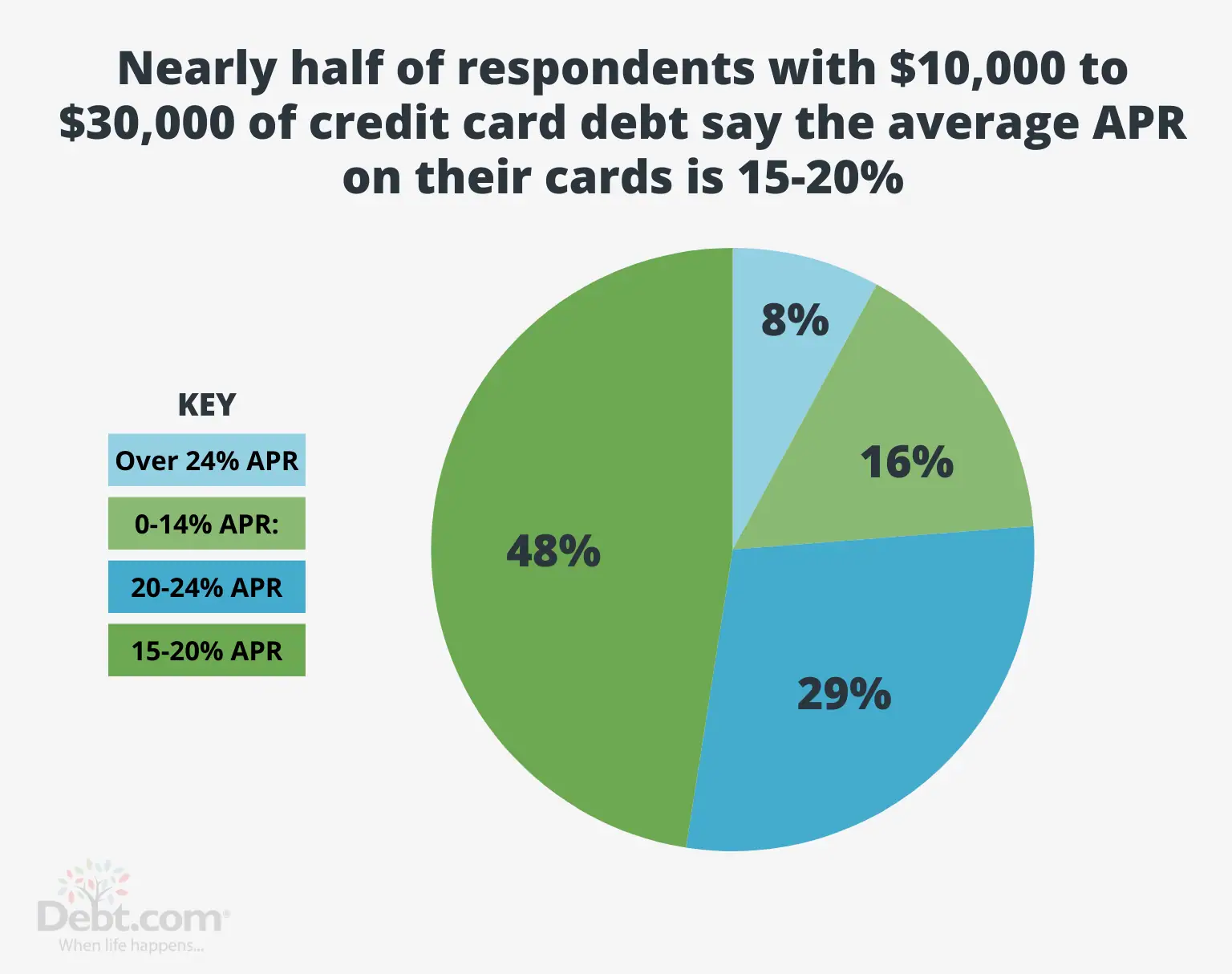
Average APR on Credit Cards for High-Debt Households
- 48% of respondents with $10,000–$30,000 in credit card debt reported an APR between 15–20%.
- 29% said their APR falls in the 20–24% range.
- Only 16% carry an APR of 0–14%, indicating lower interest burdens.
- A smaller 8% face APRs over 24%, reflecting the steepest borrowing costs.

Average Credit Card Debt per Borrower or Household
- Average cardholder debt (with balances) in Q1 2025: $7,321, up 5.8% from $6,921 in Q1 2024.
- Average household credit card debt is $10,668, by age: 18‑35: $4,070, 35‑44: $6,370, 45‑54: $6,660, 55‑64: $7,530, 65‑74: $7,720, 75+: $3,990.
- New Jersey had the highest per-cardholder average in Q1 2025: $9,382, followed by Maryland at $9,252; Mississippi had the lowest at $5,221.
- Georgia saw the fastest growth in average balances: 20.5% increase from $6,592 to $7,943 year over year.
- Double-digit jumps occurred in Oklahoma (14.9%) and Massachusetts and D.C. (both 13.3%).
- Average balances vary widely by region, reflecting economic disparities.
Debt Trends Over Time
- Credit card debt surpassed the trillion-dollar threshold in 2023 at $1.14 trillion.
- Balance growth continues, $1.12 trillion by Q4 2024, rising further to $1.21 trillion in Q2 2025.
- Quarterly growth in delinquency slowed from ~3% to 1.5% or lower in 2024–2025.
- The percentage of credit card debt that is delinquent continues upward, hitting 14.1% in Q1 2025.
- Delinquency rate held at 3.05% in Q1 2025, marginally down from Q4 2024 at 3.08%.
- By mid-2025, 4.4% of total household debt, including cards, is delinquent.
- The share of minimum payment only accounts rose to 11.12% in late 2024.
- Higher defaults and write-offs appear likely; 2025is already seeing default levels not seen in over a decade.
Delinquency Rates
- The delinquency rate on credit card loans stood at 3.05% in Q1 2025, a slight drop from 3.08% in Q4 2024.
- That rate exceeded 3.20% in Q3 2024, indicating gradual improvement.
- As of Q1 2025, 14.1% of credit card debt was 30+ days past due, up from previous lows.
- In the lowest income ZIP codes, 30-day delinquency climbed from 14.9% in mid-2022 to 22.8% in Q1 2025.
- The highest income ZIP codes saw a rise from 4.8% to 8.3% over the same period.
- By the end of Q1 2025, 12.3% of credit card debt was 90+ days delinquent nationally, with the lowest income tier at 20.1% and the highest income at 7.3%.
- Large banks reported year-over-year declines in delinquency in Q1 2025, the first such drop since late 2021, though levels remain elevated.
- Widespread delinquency growth occurred across all income groups, though the pace has slowed in recent quarters.
Average Credit Card Debt by Race or Ethnicity
- White (non-Hispanic) households carry the highest average debt at $6,940.
- Black or African American (non-Hispanic) households have the lowest average at $3,940.
- Hispanic or Latino households report an average balance of $5,510.
- Households identifying as other or multiple ethnicities carry an average of $6,320.

Credit Card Debt by State
- Laredo, TX, had one of the fastest rises in average credit card debt in early 2025, increasing 2.2% to $6,208.
- San Antonio, TX, also ranked among the top 10 U.S. cities for rising consumer debt.
- States such as New Jersey and Maryland have the highest average per cardholder debt nationally, over $9,000.
- Mississippi reports the lowest average cardholder debt, around $5,221.
- Georgia posted the fastest growth in average debt, 20.5% year over year, from $6,592 to $7,943.
- Oklahoma, Massachusetts, and D.C. achieved double-digit increases in average balances (~13–15%).
- Regional disparities continue to shape debt dynamics.
Age Group Demographics
- Average household credit card debt is $10,767 in Q1 2025.
- Gen Z and Millennials are showing the fastest increases in debt amid high living costs and interest rates (~21.16%).
- Older age groups still hold more total debt, but younger borrowers are accumulating at a faster pace.
- Delinquency rates on student loans, largely held by younger adults, are rising faster than credit card delinquency.
- Gen Z experienced a 20% year-over-year increase in personal debt in early 2025, the fastest among all age groups.
- Younger users face tighter access to rewards-heavy products.
Usage Trends
- As of Q2 2025, the U.S. has about 636 million credit card accounts, with balances totaling $1.29 trillion.
- Credit card transactions represent 35% of all payments in 2024, with usage rising 9.38% over the prior year.
- The average person holds about five credit card accounts, paying around $514.65 in annual interest and fees in 2024.
- About one in five consumers has tried BNPL (Buy Now, Pay Later) services.
- In 2024, BNPL purchases totaled around $46 billion, nearly one-third of total credit card debt volume.
- By 2025, nearly 25% of BNPL users used it for grocery shopping, up from 14% a year earlier.
- Spending via credit cards appears to be slowing, now trailing debit for the first time since the pandemic.
Consideration of Professional Debt Relief
- 45.6% of respondents reported they have never explored professional debt relief options.
- 17.6% turned to a credit card balance transfer as a strategy.
- 13.6% chose a DIY debt repayment plan.
- 12.8% used a consolidation loan to manage balances.
- Only 5.6% sought help through credit counseling.
- Just 4.8% relied on a debt management plan.

Economic Factors Influencing Credit Card Debt
- Higher and lower income groups follow different spending trends; the wealthy keep spending, while others grapple with rising debt and flat or falling spending.
- Resumption of student loan payments and high interest rates are causing more cautious borrowing and stricter underwriting by card issuers.
- Legislative action looms with proposals to cap APRs at 10%, roughly half of current averages.
- Macroeconomic uncertainty, including tariffs and budget tightening, threatens to further harm consumer borrowing capacity.
- Despite high balances, strong wage growth may be helping some cardholders maintain payments for now.
Effects of Inflation on Credit Card Debt
- Inflation drove an 18% increase in credit card use for everyday purchases among middle-income households in early 2025.
- 52% of adults say prices are rising faster than their incomes.
- 63% of respondents reported financial anxiety, with 35% saying they couldn’t cover a $2,000 emergency bill.
- Elevated inflation puts upward pressure on credit card APR levels.
- Inflation-adjusted total credit card debt in May 2025 was 8% below the all-time record, though 0.3% higher than a year prior.
- Consumers paid off $44 billion in credit card balances in Q1 2025, 11% less than Q1 2024 after adjusting for inflation.
- More households are paying off their balances monthly, though a growing share are making only minimum payments.
Credit Card Defaults and Write‑Offs
- Lenders wrote off $46 billion in seriously delinquent credit card debt through September 2024, up 50% year over year, the highest level in 14 years.
- Q1 2025 credit card charge-offs declined to 4.29%, down from 4.54% the previous quarter.
- Despite the quarterly dip, write-offs remain elevated compared to the past decade.
- Seriously delinquent accounts (90+ days) almost doubled, from around 1.6% in 2021 to over 3% by early 2025.
- As of June 2025, average delinquency was 2.79%, up from 2.33% in May, net charge-off rate rose to 3.99%.
- These metrics remain higher than pre-COVID levels, with delinquencies at 2.19% in June 2019, charge-offs at 3.9%.
- Defaults are at record levels for 2025, signaling elevated risk.
- Rising delinquencies and charge-offs persist despite tightening credit standards.
Highest and Lowest Average Credit Card Balances (by Region)
- Santa Clarita, CA, tops the list with an average household credit card debt of $21,625 in Q1 2025.
- Chula Vista, CA follows with an average of $20,837 per household.
- New York, NY households average about $19,540 in card debt.
- Rancho Cucamonga, Fontana, and Oxnard all report balances above $18,400.
- On the lower end, Madison, WI, leads with only $8,941 in average household credit card debt.
- Toledo, OH, and Cedar Rapids, IA follow with $9,458 and $9,684, respectively.
- Alaska consumers carry the highest state-level average per user ($9,255), followed by D.C., Maryland, and New York.
- Mississippi shows one of the lowest state-level average per-user debts ($5,221).

Alternative Financing Trends (e.g., Home Equity, BNPL)
- Buy Now, Pay Later (BNPL) purchases hit $46 billion, accounting for nearly one-third of the total credit card debt volume in 2024.
- Over 1 in 5 U.S. consumers have used BNPL, up from 17.8% in 2021.
- Nearly 25% of BNPL users in 2025 rely on it for groceries, up from 14% a year earlier.
- The rising use of BNPL indicates growing financial stress among households.
- Personal loan consolidation rose 18%, reaching $257 billion early in 2025.
- Consumers are turning to balance transfer cards as a lifeline amid high APRs (20–25%).
- With rewards programs likely to tighten, users may shift toward practical options like BNPL or balance transfers.
- Proposed legislation suggests capping APRs at 10%, potentially shifting lending dynamics.
Financial Wellness & Carrying Revolving Balances
- 42% of Americans are worried about credit card debt, yet 21% have taken no action in six months.
- Reducing debt ranks third among financial priorities, behind building savings (40%) and covering daily expenses (42%).
- Over 40% carry credit card balances or make only minimum payments.
- Nearly 39% say debt affects their sleep.
- There were 1.18 trillion dollars in outstanding credit card debt through Q1 2025, with 172 million people carrying balances.
- Among cardholders, about half are “revolvers,” making purchases and carrying balances month to month at ~22% APR, up from 15% in the early 2000s.
- Revolving behaviors are long-standing, not temporary, as financial habits persist.
- More consumers are paying balances monthly, but a growing share still makes only minimum payments, hinting at strain.
Future Trends in Credit Card Debt
- Credit card balances and delinquencies will continue rising in 2025, but at a slower pace than in 2022–2023.
- Credit card balances are expected to increase 4.4% year over year by the end of 2025.
- Among non-prime borrowers, balances are forecasted to grow 8% in 2025, up from 21% in 2023.
- AI will expand credit card use, including faster applications, fraud prevention, and customer service.
- The Federal Reserve plans only two rate cuts in 2025, implying credit card interest rates may stay elevated.
- As economic risks rise, banks prepare for a downturn, tightening lending and focusing on higher-income clients.
- If recessions hit, rewards programs will likely shrink, raising redemption thresholds and reducing perks.
Conclusion
The landscape of credit card debt reflects mounting financial pressure, with soaring balances, elevated delinquency and write-offs, growing tension from inflation, and evolving funding options like BNPL. Regional differences and demographic divides add complexity. Still, signs of resilience appear; some consumers are paying down debts, and balance growth may be slowing. As economic challenges deepen, understanding these trends is vital for households, lenders, and policymakers alike. Stay tuned, your financial choices today will shape tomorrow’s debt story.