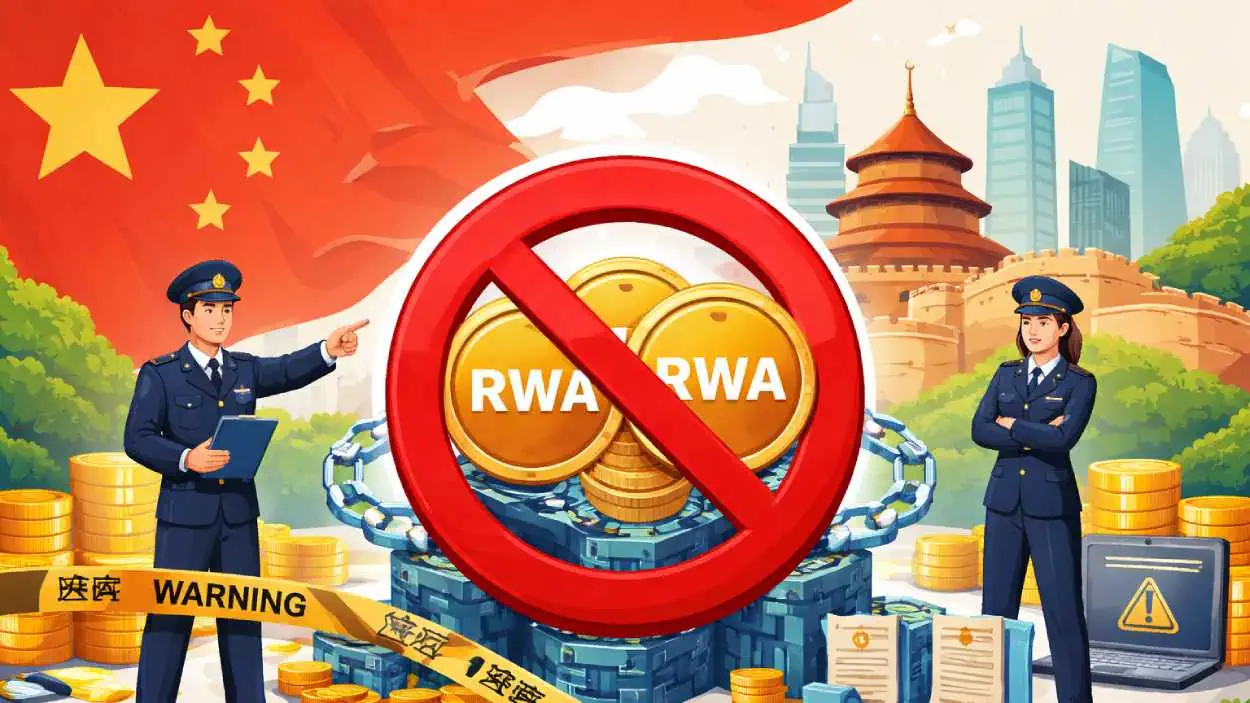







China’s top financial associations have declared real-world asset (RWA) tokenization illegal, sending a clear message to crypto projects operating at home and abroad.
Key Takeaways
- Seven major financial industry associations in China jointly classified RWA tokenization as illegal, likening it to fraudulent fundraising and pyramid schemes.
- Regulators emphasized that no RWA activity has been approved in China, and all such activity is now deemed criminal if operated within or connected to the mainland.
- Domestic staff supporting overseas RWA projects may also face legal consequences, effectively ending the entire Web3 service chain tied to RWAs in China.
- The notice rejects arguments around RWA as a new technology, stating that financial risks far outweigh any innovation or technological benefit.
What Happened?
A unified notice co-signed by seven of China’s leading financial industry associations has classified real-world asset (RWA) tokenization as a prohibited financial activity. The sweeping ban targets both domestic and offshore operators, stating that no RWA initiatives have been approved and that any such activity involving financing, token issuance, or trading is now illegal under Chinese law.
China Classifies RWA as Illegal Finance, Warning Both Domestic and Overseas Operators
— Wu Blockchain (@WuBlockchain) January 5, 2026
By @mankunlaw
China’s financial industry associations issued a joint notice explicitly labeling RWA tokenization as illegal financial activity. The statement says RWA involves unauthorized… pic.twitter.com/WHVGRyvKcw
China’s Financial Sector Closes the Door on RWA
In an unprecedented move, seven major financial bodies, including the National Internet Finance Association of China, the China Banking Association, and the Securities Association of China released a joint document titled Risk Warning on Preventing Illegal Activities Involving Virtual Currencies. The document drew clear legal lines around RWA projects and categorized them alongside stablecoins, “air coins,” and crypto mining as illegal activities.
The statement defines RWA tokenization as “financing and trading activities carried out through the issuance of tokens or other rights or debt certificates with token-like characteristics.” It warns that such structures carry risks of fraudulent assets, operational failure, and speculative hype. As of now, no RWA initiatives are authorized by Chinese regulators.
This new stance means:
- All RWA-based projects in China lack legal grounding.
- Activities such as token issuance, trading, and yield distribution are banned.
- Support staff, consultants, tech vendors, and even marketers tied to RWA projects could face criminal liability.
Web3 and Crypto Services Face Legal Risk
Regulators made it clear that being registered offshore does not shield a company if operations are managed or supported from within China. According to the warning, “domestic institutions or individuals who knowingly or should have known of such virtual-currency-related activities yet still provide services, will be held legally accountable.”
This language impacts a wide range of service providers including:
- Project consultants
- Technical development teams
- Payment processors
- Social media promoters
- Outsourcing partners
Essentially, anyone contributing to an RWA project with a China nexus now operates at legal risk. Even if a single operations staff member is based in China, the entire project may be deemed as offering services domestically, triggering enforcement.

A Total Rejection
Authorities were firm in framing this decision as a full exclusion, not a temporary suspension or regulatory grey area. The document explicitly rejects arguments based on technology, offshore structuring, or supposed compliance workarounds.
It highlights that even “legitimate” RWA projects present too much financial risk, emphasizing that tokenized structures cannot guarantee legal ownership or enforceable claims. The aim is not to regulate or optimize RWA activities but to eliminate them entirely from China’s legal and financial ecosystem.
Regulatory Backdrop and Global Context
The ban comes after rising concerns around scams posing as RWA projects in China. Attorney Honglin, who has spoken about RWA fraud on Shanghai People’s Radio, said the scale of this regulatory response shows just how seriously the risks are being taken.
In the past year, several Chinese firms quietly explored RWA in Hong Kong, including China Merchants Bank’s $3.5 billion tokenized money market fund on BNB Chain. But activity slowed after Chinese authorities advised caution in late 2023.
Globally, RWA tokenization is gaining momentum. In the US, Backed Finance tokenized stocks like Apple and Tesla, with trading volumes for xStocks reaching over $457 million. But China’s new position draws a stark line against such innovation.
CoinLaw’s Takeaway
I’ll be honest. This is a game-changer. In my experience covering crypto regulation, few moves have been as definitive as this one. China just slammed the door shut on RWA, not with vague policy but with clear legal language, criminal liability, and a systemic dismantling of the support ecosystem. This is not a crackdown on a few bad actors. It’s the end of the road for RWA in China. Anyone thinking of operating even remotely in this space needs to rethink fast. If you’ve got ties to China, cut them or get out of the RWA game entirely. The risk is real and the warning couldn’t be clearer.