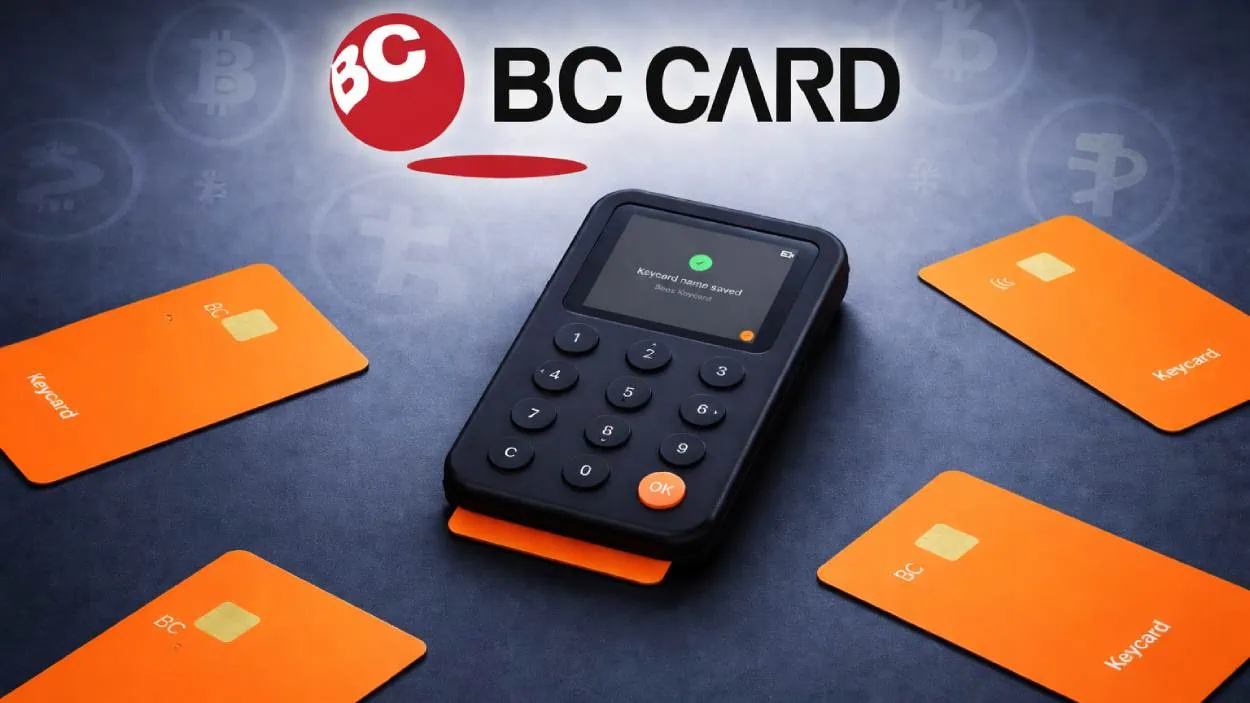







South Korea’s leading card processor BC Card has successfully wrapped up a pilot program that allowed foreign users to pay domestic merchants using stablecoins, marking a bold step toward merging traditional payments with blockchain technology.
Key Takeaways
- BC Card enabled foreign users to convert stablecoins into digital prepaid cards accepted across Korean merchants.
- The pilot partnered with Wavebridge, Aaron Group, and Global Money Express to test cross-border stablecoin usage.
- BC Card processes over 20% of Korea’s card transactions, making this a major development in mainstream payment integration.
- Regulatory uncertainty remains, but firms are moving forward with infrastructure ahead of clear laws.
What Happened?
BC Card tested a system where stablecoins held in foreign wallets could be converted into prepaid digital cards. These cards, issued in cooperation with BC Card’s partners, were then used at local merchants including cafes, supermarkets, and convenience stores. The pilot focused on real-world usability and transaction stability, addressing long-standing challenges with cross-border payments.
BC Card’s Big Bet on Stablecoins
BC Card’s move signals a major push by traditional finance players to adapt to the rising tide of blockchain-based payment systems. Instead of treating stablecoins as competition, the company is exploring ways to embed them into Korea’s card network.
- The pilot launched in October 2025 with blockchain firm Wavebridge, wallet provider Aaron Group, and cross-border remittance firm Global Money Express (GME Remittance).
- Users could scan QR codes at Korean merchants using digital prepaid cards linked to their stablecoin wallets, eliminating the need for currency exchange or physical cards.
- The system ensured that transactions were processed just like conventional card payments, including real-time approvals, cancellations, and corrections.
BC Card emphasized that this pilot was not a short-term experiment. It was designed as foundational infrastructure to prepare for regulatory clarity around digital assets.
A Market Ready for Change
BC Card is one of the biggest names in Korean finance, handling more than 20% of all card transactions in the country and serving 3.4 million domestic merchants. Owned primarily by KT Corp, a major telecom operator, the company is deeply embedded in South Korea’s digital infrastructure.
This pilot comes as regulators and financial institutions in Korea take a more serious look at stablecoins. In July, local card companies formed a joint task force to assess the impact of stablecoins after the government floated the idea of won-denominated tokens.
However, progress has been slower than expected. The Financial Services Commission (FSC) missed a recent deadline to submit a draft proposal on stablecoin regulation. Lawmakers attributed the delay to disagreements between the FSC and the Bank of Korea. The central bank wants banks to own a majority stake in any approved stablecoin issuer, while other regulators support a broader ecosystem that includes fintechs and private companies.
Despite this regulatory gridlock, BC Card and other firms are forging ahead.

Stablecoins as Payment Rails, Not Just Crypto
Industry voices see this shift as more than just technical experimentation. Shehram Khattak, general counsel at Trust Wallet, said:
Recent moves by major players back this trend:
- YouTube allowed U.S. creators to get paid in PayPal’s dollar-backed stablecoin.
- Visa launched USDC settlement services for select financial institutions.
These developments show that stablecoins are increasingly acting behind the scenes, powering the back end of payments while keeping the consumer experience familiar.
BC Card’s CEO Choi Won-seok reinforced this vision, saying:
CoinLaw’s Takeaway
In my experience, when giants like BC Card move first, the rest of the financial world takes notes. What stands out here is not just the tech, it’s the strategic alignment between old and new finance. Stablecoins are no longer just a “crypto thing.” They’re becoming payment rails, quietly powering transactions in the background. I found BC Card’s approach smart: don’t wait for perfect rules, build the system now and adjust as needed. If South Korea gets this right, it could become a global model for integrating blockchain into daily commerce.