






In a coffee shop in downtown San Francisco, a small business owner uses her accounting app to pull data directly from her bank without switching platforms. Across the Atlantic, a fintech developer in Berlin builds a new budgeting tool powered by real-time transaction data from multiple banks. These aren’t isolated stories; they’re part of a sweeping shift known as open banking.
As we enter 2025, open banking is no longer just a buzzword; it’s become a core infrastructure reshaping how data flows in financial services. This article explores the adoption rates, trends, and impact points of open banking globally and regionally, drawing on the most current data available.
Editor’s Choice
- As of early 2025, over 78 countries have implemented some form of open banking regulatory framework, compared to 60+ just two years ago.
- The global open banking user base surpassed 470 million in 2025, with projections aiming for 600 million by 2027.
- In the US, nearly 52% of adults now use at least one open banking-enabled service.
- The UK’s active open banking users reached 11.6 million in Q1 2025, growing 26% YoY.
- In Europe, more than 94% of licensed banks are compliant with PSD2 and participating in open banking ecosystems.
- APAC leads in growth rate, with India and Singapore showing over 80% YoY increase in API calls.
- Over 95% of fintech startups launched in 2024 were built with at least one open banking API integration.
Top Reasons Why People Would Leave Their Bank
- 55% of customers said they would leave their bank if fraud incidents weren’t properly handled. Security and trust remain the most critical factors in banking loyalty.
- 42% of respondents would switch banks for better financial incentives from another provider, highlighting the importance of competitive offers and promotions.
- 40% noted they would leave if their bank had no local branches, showing that physical presence still matters to a significant portion of consumers.
- 35% mentioned they would consider switching if the bank’s product offerings didn’t align with their needs, suggesting the need for personalized banking services.
- 31% would leave if digital services were not good enough, emphasizing the growing importance of seamless online and mobile banking experiences.
- 22% said a lack of sufficient local branches would push them to switch, reinforcing that branch availability still influences customer retention.

Global Open Banking Adoption Rates
- The global market value of open banking is projected to hit $87 billion in 2025.
- Open banking transactions crossed 120 billion annually.
- Over 65% of global financial institutions now support API access to customer data.
- Mobile banking apps integrated with open banking APIs have seen a 37% increase in session frequency.
- North America remains a high-growth region with a CAGR of 21.4% projected through 2027.
- Asia-Pacific recorded the highest user growth, with open banking accounts expanding by 44% YoY.
- Africa’s fintech boom is increasingly driven by open banking infrastructure, especially in Nigeria and South Africa.
- The Middle East has started national-level adoption campaigns, with Saudi Arabia’s SAMA initiative rolling out nationwide APIs.
- Global API call volumes are estimated at over 6.7 billion/month.
- Open banking investment funding topped $7.4 billion globally, with VC activity heavily focused on data security startups.
Regional Breakdown of Adoption (US, UK, EU, APAC, LATAM)
- In the United States, open banking is driven primarily by market-led frameworks, with 52% of banks offering data-sharing APIs in 2025.
- The UK remains a global leader, with 95% of banks participating in the Open Banking Implementation Entity (OBIE).
- EU adoption under PSD2 is near universal, with more than 94% of regulated institutions actively exposing APIs.
- India’s Account Aggregator Framework now supports over 1.2 billion API calls per quarter, showing one of the fastest scaling models.
- In Australia, open banking participation now includes 90+ accredited data recipients.
- Brazil leads LATAM with over 9.8 million open banking users, with mandatory phases completed.
- Mexico’s open banking model, governed by its Fintech Law, now involves over 80 financial institutions.
- Singapore requires data-sharing consent to be digitally traceable under the MAS guidelines, reinforcing both transparency and adoption.
- Japan has registered over 150 third-party providers under its FSA-regulated open banking structure.
- In Canada, while regulation remains in draft, voluntary adoption has grown to over 8 million users with high bank-FinTech collaboration.

Open Banking Market Size Projections
- The global open banking market is expected to grow from $30.89 billion in 2024 to $38.86 billion in 2025, showing strong year-over-year expansion.
- The market is forecasted to maintain a CAGR of 24.8%, highlighting rapid digital transformation and increased API-driven financial services.
- By 2026, the market size is projected to surpass $48 billion, continuing its steep upward trajectory.
- In 2028, the open banking market is expected to reach approximately $75 billion, reinforcing its mainstream adoption globally.
- By 2029, the market is set to hit $94.14 billion, more than tripling its 2024 value, driven by consumer demand and fintech innovation.

Open Banking Usage by Financial Institutions
- 87% of Tier-1 banks globally have now implemented open banking capabilities, either directly or via partners.
- In the US, nearly 60% of regional banks have at least one data API enabled, often partnering with fintechs like Plaid or MX.
- Community banks and credit unions in the US increased participation by 31% YoY through consortium-led API initiatives.
- European neobanks, like N26 and Revolut, offer full open banking integration by default.
- Major Asian banks, such as DBS and ICICI, now provide over 20 open APIs each for third-party use.
- In Brazil, over 80% of participating banks allow PISP (Payment Initiation Service Provider) functionality.
- Open finance is gaining traction in LATAM, with insurers and pension funds now adopting similar standards.
- More than 70% of financial institutions in open banking-active regions report improved customer retention due to personalized services.
- Banks investing in API infrastructure reported a 29% reduction in third-party onboarding time.
- Interbank payment systems, particularly in Europe and India, have integrated with open banking rails to enhance real-time transfers.
Consumer Adoption and Awareness Levels
- As of Q2 2025, 64% of U.S. consumers are aware of open banking.
- In the UK, awareness levels are even higher, 78% of adults recognize the term and its purpose.
- Millennials and Gen Z are the most active demographic groups, representing 71% of all open banking users in North America.
- 45% of U.S. consumers use open banking-powered tools, such as budgeting apps or financial aggregators, at least once a week.
- Among consumers in Europe, 52% say open banking has improved their financial decision-making through better visibility and control.
- In India, 68% of digitally active adults have interacted with Account Aggregator systems.
- 60% of respondents globally express trust in open banking services, an increase attributed to more transparent consent flows.
- 22% of U.S. users mistakenly equate open banking with online banking, indicating a need for continued education.
- Among SMB owners, 35% use open banking for real-time cash flow monitoring, an increase from 27% last year.
- Voice-activated banking apps, powered by open APIs, are now used by 1 in 10 U.S. consumers, showing demand for smart UX integrations.
Open Banking Adoption in the UK
- In 2024, the number of open banking users in the UK is projected to reach 22.1 million, accounting for 41.0% of the adult population.
- By 2025, adoption is expected to rise to 27.5 million users, representing 50.7% of UK adults, crossing the halfway mark in national usage.
- In 2026, open banking users will likely hit 33.1 million, covering a remarkable 60.5% of the adult population, showing strong mainstream acceptance.

Key Drivers Behind Open Banking Growth
- Regulatory mandates (like PSD2, CDR, and Open Finance in Brazil) continue to be the primary accelerant of adoption globally.
- The rise in digital-native consumers is pushing banks to offer open API experiences to remain competitive.
- Embedded finance, now used by over 60% of e-commerce platforms, relies heavily on open banking for account verification and payments.
- Faster onboarding through data-sharing APIs reduced average KYC completion times by 30%, streamlining fintech operations.
- Increased demand for personalized financial experiences has led 72% of U.S. fintechs to adopt open banking tech in their product stack.
- Cloud-native banking platforms, like Thought Machine and Mambu, have enabled the rapid rollout of open banking products.
- Global consumers list “control over data sharing” as the top reason they adopted open banking tools in 2025.
- Real-time loan decisions, enabled through income and transaction data APIs, reduced approval times by 43% in Europe.
- The explosion of financial super apps, used by over 100 million users globally, is largely driven by open banking integrations.
- Fintech competition forces traditional banks to open up APIs: 81% of banks in developed markets say open banking is now “critical to survival.”
Industry Segments Benefiting from Open Banking
- Lending platforms that leverage open banking data report 22% lower default rates due to improved risk profiling.
- Wealth management firms use aggregated account data to deliver tailored investment advice to over 15 million users.
- Insurance providers now use income and spending data APIs to price premiums more accurately, which has been adopted by 35% of insurtechs.
- Real estate and mortgage platforms are seeing faster pre-approval cycles by integrating banking data directly.
- B2B payment processors, such as Stripe and Adyen, use open banking to support instant bank payments, reducing fees by up to 50%.
- Gig economy platforms, like Uber and DoorDash, rely on real-time income APIs for dynamic lending and benefits calculations.
- Student finance services in the U.S. are beginning to utilize open banking to assess loan eligibility without credit history.
- In healthcare finance, some U.S. startups are now using spending insights to offer installment payment options at the point of care.
- Travel and ticketing platforms are integrating payment initiation services (PIS) to skip card networks altogether.
- SMBs using ERP-integrated open banking saw a 31% improvement in reconciliation accuracy for accounts receivable/payable.
Mobile Banking App Preferences Among Users
- 50.4% of respondents prefer using a private bank’s mobile app, making it the top choice for mobile banking users.
- 25.7% use both public and private banking apps, reflecting a need for flexibility across services.
- 21.1% rely solely on public bank apps, showing continued trust in government-backed institutions.
- Only 2.8% of people do not use mobile banking at all, highlighting the widespread adoption of digital banking services.

Open Banking API Usage
- Over 72 billion API calls were made globally in Q1 2025, compared to 44 billion in the same quarter last year.
- The average financial institution offers 16 APIs for third-party developer access.
- Account information services (AIS) account for 63% of all API traffic globally, followed by payment initiation services (PIS) at 28%.
- API uptime performance now exceeds 99.98% among top-tier banks, reflecting increasing reliability and SLA focus.
- Token-based access is used in 91% of open banking frameworks to ensure secure, revocable consent.
- API failures due to throttling or schema inconsistencies have declined by 41% over the past year.
- Banking-as-a-Service (BaaS) platforms now dominate the API gateway market, enabling small banks to scale adoption quickly.
- In India, the AA (Account Aggregator) system processed over 150 million data-sharing consents in Q1 2025 alone.
- PSD2-compliant APIs in the EU saw an 18% YoY rise in call volumes, with the Netherlands and Germany leading.
- API analytics platforms, like Tink and TrueLayer, report that usage insights are helping banks optimize endpoint performance.
Fintech Participation in Open Banking Ecosystems
- As of 2025, over 3,200 licensed third-party providers (TPPs) operate under open banking frameworks globally.
- 85% of fintech apps launched in the past 12 months integrated with at least one open banking API.
- Plaid, one of the leading aggregators, now facilitates over 10 billion transactions/month, serving over 12,000 financial apps.
- In the UK, more than 600 registered TPPs actively use data and payment APIs.
- Stripe’s open banking push enabled bank-linked checkouts in 9 European markets by early 2025.
- Fintech adoption in Latin America rose 42%, largely due to simplified onboarding via open APIs.
- AI-powered fintech tools, such as robo-advisors and budget assistants, depend on real-time account feeds, with usage growing 51% YoY.
- BNPL (Buy Now, Pay Later) providers are increasingly using banking data to manage consumer affordability assessments in real-time.
- Open banking has fueled the rise of neobanks, which now serve over 450 million users globally, mostly via API-first architecture.
- Cross-border TPP licenses are becoming common, with 23% of open banking fintechs now operating in 3 or more markets.
Open Banking Market Share by Component
- Services dominate the open banking market in 2024 with a 55% share, reflecting growing demand for API management, data sharing platforms, and banking-as-a-service.
- Solutions account for 45% of the market, highlighting strong interest in software tools that enable compliance, analytics, and integration with financial ecosystems.

Regulatory Impact on Open Banking Adoption
- As of 2025, over 78 countries have formal regulations in place for open banking.
- The European Union’s PSD2 directive, now in its mature phase, has resulted in 94% API compliance among licensed banks.
- In the United States, regulatory momentum is accelerating: the CFPB’s Section 1033 Rule, expected to finalize in mid-2025, aims to standardize consumer data access rights.
- Brazil’s Central Bank mandates full adherence to its Open Finance initiative, now encompassing credit, insurance, and investment products.
- The UK’s OBIE (Open Banking Implementation Entity) is transitioning into a permanent authority, widening its scope under the Smart Data initiative.
- Australia’s Consumer Data Right (CDR) now extends beyond banking to energy and telecommunications, setting a model for cross-sector adoption.
- In Singapore, the Monetary Authority’s Financial Data Exchange (SGFinDex) expanded access to CPF, IRAS, and insurer data, integrating into 12+ financial apps.
- India’s Account Aggregator Framework, backed by the RBI, sees participation from over 200 financial entities and is expected to become mandatory by 2026.
- Canada’s Department of Finance released its final open banking roadmap in Q1 2025, outlining accreditation, liability, and data standards.
- Nigeria became the first African country to implement full-spectrum open banking regulations in early 2024, supporting both read and write access APIs.
Security and Privacy Concerns Among Users
- In 2025, 46% of global users say they are “concerned” or “very concerned” about how their financial data is shared.
- Tokenized authentication is used in over 93% of API sessions, reducing exposure to credential-based attacks.
- Biometric verification, especially facial recognition and fingerprint scanning, now accompanies nearly 40% of open banking logins globally.
- Phishing-related fraud involving open banking APIs declined by 32% YoY, as ecosystem participants improved end-user education.
- End-to-end encryption is standard across 98% of AIS and PIS APIs, with zero-trust protocols gaining adoption.
- In the UK, the OBIE Fraud Reporting Group noted that open banking-related fraud accounted for less than 0.2% of total financial crime cases.
- User control dashboards, now adopted by 71% of regulated banks, allow individuals to revoke third-party access in real-time.
- Regulatory fines related to API misuse or data leaks were issued in 9 jurisdictions, totaling over $31 million.
- Sandbox environments, required by regulators in regions like Hong Kong and Saudi Arabia, are helping TPPs test integrations securely.
- Consumer advocacy groups continue to push for standardized consent UX to ensure users fully understand permissions before sharing data.
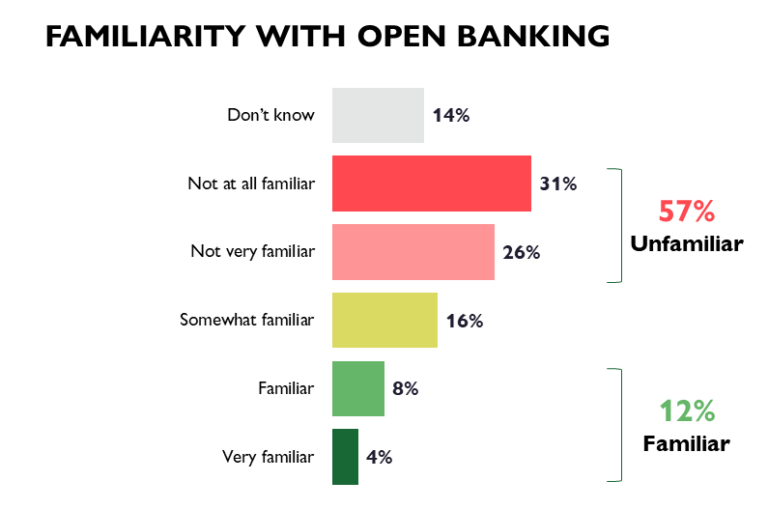
Public Familiarity with Open Banking
- 57% of respondents are unfamiliar with open banking, including 31% who are not at all familiar and 26% who are not very familiar.
- Only 12% consider themselves familiar, with 8% familiar and just 4% very familiar, indicating limited public understanding.
- 14% of people answered “don’t know”, highlighting a notable gap in awareness or exposure to open banking concepts.
Challenges Slowing Down Adoption
- Despite momentum, 32% of mid-sized banks globally still lack the infrastructure to expose or manage open APIs securely.
- Fragmentation in standards, especially in the U.S. and LATAM, leads to interoperability issues, stalling fintech rollouts.
- Lack of consumer education remains a bottleneck: 41% of surveyed users in North America said they “don’t fully understand how open banking works.”
- Integration costs for smaller banks average $320K–$500K, limiting participation without external funding or partnerships.
- Data latency issues in real-time use cases, especially in wealthtech and credit scoring, have been flagged by over 28% of fintech developers.
- APIs with inconsistent schemas or outdated documentation still account for 12% of support tickets filed by TPPs.
- Cybersecurity risks continue to worry smaller financial institutions lacking in-house expertise.
- Regulatory ambiguity in countries like the U.S., South Africa, and Mexico causes hesitation in TPP expansion.
- Over-reliance on aggregators, like Plaid or Yodlee, introduces single points of failure when APIs are down.
- Customer support teams are struggling to handle cross-platform issues involving open banking, affecting trust in early-stage rollouts.
Recent Developments
- In Q1 2025, the U.S. CFPB unveiled a model consent framework to standardize user experience across data-sharing apps.
- The Open Wallet Foundation, backed by the Linux Foundation, launched an open-source platform for universal digital wallets integrated with open banking rails.
- Mastercard’s acquisition of a consent management startup in early 2025 highlights the growing demand for real-time permission governance.
- Tink (owned by Visa) added AI-based anomaly detection to its open banking toolkit, helping detect fraud in under 2 seconds.
- Brazil’s Phase 4 of Open Finance went live, enabling investment and pension data access, opening new wealthtech avenues.
- Apple Wallet now integrates open banking-based payments in the EU, allowing direct-from-bank checkouts for iOS users.
- Stripe’s Financial Connections API, launched in late 2024, expanded to 6 new regions, facilitating income verification for credit providers.
- Finastra and Microsoft partnered to offer cloud-hosted open banking infrastructure for small banks in emerging markets.
- In Japan, 3 megabanks formed a unified open banking alliance to offer standardized developer portals and sandbox environments.
- Google Pay’s API-first rebuild, focused on India and Singapore, now supports UPI and AA ecosystem integrations in one SDK.
Conclusion
Open banking in 2025 is no longer just a regulatory checkbox; it’s a dynamic, adaptive infrastructure at the core of modern financial ecosystems. From neobanks in Nigeria to mortgage platforms in Minnesota, the trend is universal: empower users, unbundle data, and deliver real-time value through APIs.
Yet, challenges persist. Fragmented standards, privacy concerns, and institutional inertia still pose roadblocks. But the arc of transformation is clear: open banking is the backbone of tomorrow’s finance, merging access, trust, and innovation into a new global standard.
As consumer expectations shift toward transparency and personalization, financial institutions that ignore open banking risk are becoming obsolete. For those embracing it, the payoff is already here, and growing.