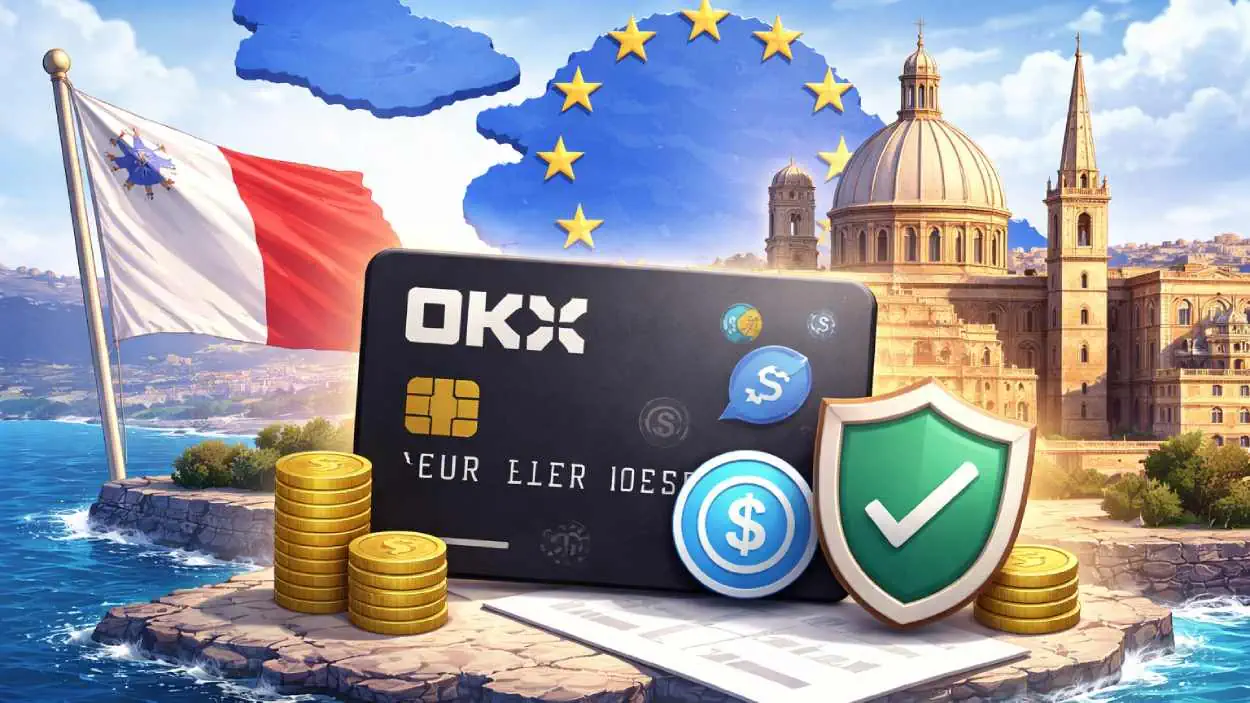







OKX has secured a Payment Institution license in Malta, strengthening its ability to offer stablecoin payment services across the European Union under upcoming regulatory rules.
Key Takeaways
- OKX obtained a Payment Institution license in Malta, aligning with EU rules taking effect in March 2026.
- The license allows OKX to legally operate stablecoin payment products such as OKX Pay and OKX Card under MiCA and PSD2.
- The approval follows OKX’s earlier MiCA license and MiFID II entity acquisition, expanding its regulated European footprint.
- The move comes after a €1.1 million AML fine in Malta, highlighting continued regulatory scrutiny.
What Happened?
Cryptocurrency exchange OKX has secured a Payment Institution license in Malta, enabling it to continue offering stablecoin related payment services across the European Union in compliance with the Markets in Crypto Assets regulation and the Second Payment Services Directive.
The approval ensures that OKX’s payment products can legally operate under updated EU rules that will require crypto firms handling stablecoins, now classified as electronic money tokens, to hold additional authorization beyond a MiCA license.
JUST IN: @okx secures a Payment Institution (PI) license in Malta ahead of the EU’s March regulatory deadline.
— Satoshi Club (@esatoshiclub) February 16, 2026
The approval allows OKX to offer stablecoin-related payment services across the EU in compliance with MiCA and PSD2. pic.twitter.com/HWBxX9xzJr
OKX Aligns With New EU Payment Rules
Under the revised PSD2 framework, crypto asset service providers involved in payment activities tied to stablecoins must hold either a Payment Institution or Electronic Money Institution license. Without this authorization, stablecoin payment services cannot legally function in the region.
This new license complements OKX’s MiCA approval granted by Malta’s financial regulator in January last year. Through passporting rights, the MiCA license allows OKX to offer localized crypto services across 28 European Economic Area countries.
With the Payment Institution license now in place, OKX can operate stablecoin payment services under both regulatory regimes, ensuring full compliance ahead of the March 2026 implementation deadline.
Erald Ghoos, CEO of OKX Europe, said:
He added that “Europe has chosen clarity over ambiguity when it comes to digital asset regulation” and that stablecoins can improve cross-border efficiency and reduce friction in payments, “but only if built within strong regulatory guardrails.”
OKX Card and Pay Now Covered
The new authorization directly covers two key products: OKX Pay and the OKX Card.
Launched in late January, the OKX Card allows European users to spend crypto assets and stablecoins at more than 150 million merchant locations worldwide through a partnership with Mastercard. The card supports stablecoins including Circle’s USDC and Paxos issued Global Dollar.
OKX Pay, the exchange’s broader payments tool, also falls under the Payment Institution framework, enabling users to move and spend stablecoins within a regulated environment.
The company has also shown growing interest in stablecoin infrastructure. Its investment arm, OKX Ventures, recently backed stablecoin issuance platform STBL, signaling long term confidence in the sector’s expansion into mainstream finance.

Broader Regulatory Footprint and Past AML Fine
With the addition of the Payment Institution license, OKX now holds three major regulatory approvals in Europe:
- A MiCA license
- A MiFID II licensed entity for derivatives services
- A Payment Institution license for stablecoin payments
All are based out of Malta, positioning the country as OKX’s central European regulatory hub.
However, the company has also faced regulatory scrutiny. Last year, Malta’s Financial Intelligence Analysis Unit fined OKX €1.1 million for anti money laundering failures related to its 2023 compliance framework. Authorities said that although the company had improved its AML policies, its business risk assessment did not fully address risks tied to cryptocurrency mixers, privacy coins, stablecoins, and decentralized exchanges.
The penalty underscores that regulatory approvals do not shield firms from enforcement tied to past compliance gaps.
CoinLaw’s Takeaway
In my experience, Europe is becoming one of the most structured and serious crypto markets in the world. I see OKX’s move as a smart and necessary step rather than just expansion. If you want to operate stablecoin payments at scale in the EU, you cannot cut corners on compliance.
What stands out to me is that OKX is building a full regulatory stack instead of relying on a single approval. At the same time, the AML fine is a reminder that regulators are watching closely. I found this development significant because it shows that major exchanges are willing to adapt to stricter rules instead of avoiding them. That is ultimately good for long term trust in crypto payments.