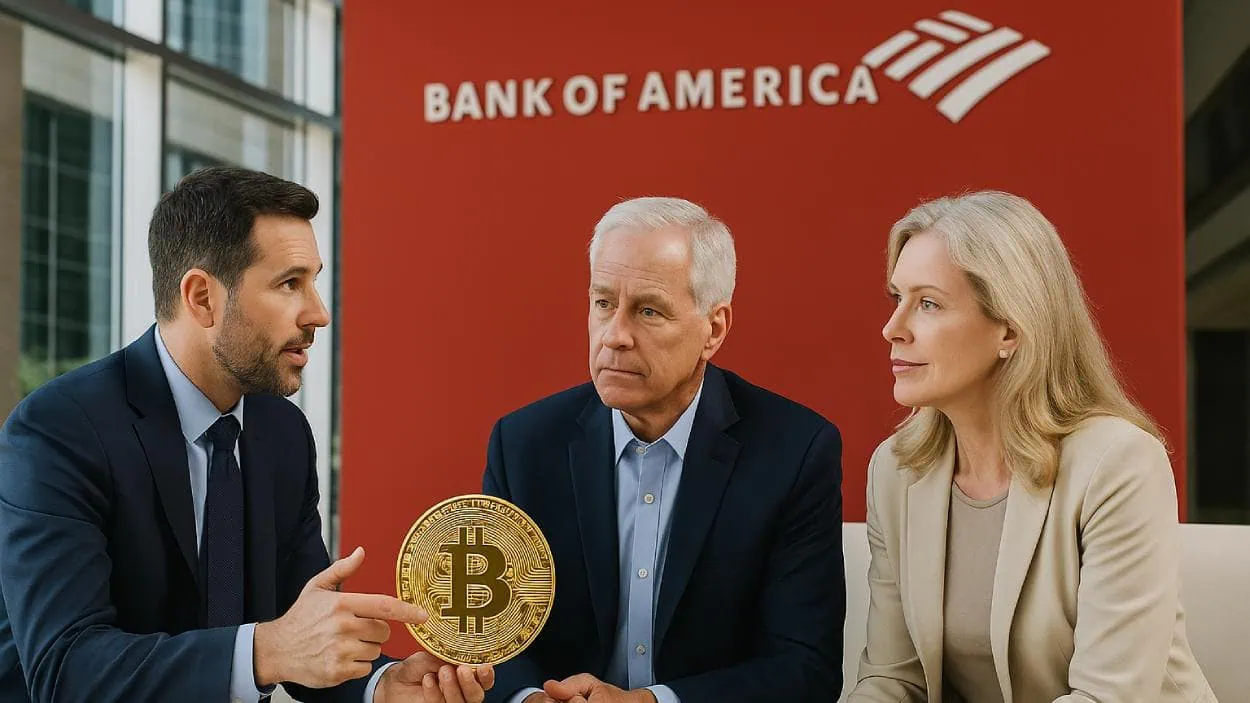







Bank of America is officially encouraging its wealth management clients to consider adding cryptocurrency to their portfolios.
Key Takeaways
- Bank of America recommends a 1% to 4% allocation to crypto for clients using Merrill, Merrill Edge, and the Private Bank platforms.
- Starting January 5, 2026, advisers will offer access to four regulated Bitcoin ETFs from Bitwise, Fidelity, Grayscale, and BlackRock.
- The move aligns with similar guidance from major financial players including Morgan Stanley, BlackRock, and Fidelity.
- The update reflects rising client demand and changing regulations, allowing easier and more secure access to digital assets.
What Happened?
Bank of America is opening the door for wealth management clients to allocate a small portion of their portfolios to cryptocurrency. Beginning in January 2026, advisers across Merrill, Merrill Edge, and Bank of America Private Bank will begin offering direct access to four spot Bitcoin ETFs, marking a significant shift in the bank’s crypto policy.
Bank of America is now recommending a 1%–4% crypto allocation for clients of Merrill, the Private Bank, and Merrill Edge, and will begin CIO coverage of four bitcoin ETFs — BITB, FBTC, Grayscale’s Mini Trust, and IBIT — starting Jan. 5, 2026. This marks a shift from its previous…
— Wu Blockchain (@WuBlockchain) December 2, 2025
BofA Opens Up to Bitcoin: From Restriction to Recommendation
For years, Bank of America’s wealth advisers could only discuss crypto if a client brought it up. That is about to change. Chris Hyzy, Chief Investment Officer at Bank of America Private Bank, confirmed that a 1% to 4% crypto allocation is now part of the firm’s official investment strategy for suitable clients.
Hyzy said:
He emphasized the importance of regulated products and a thoughtful approach to risk when entering this space.
Nancy Fahmy, head of the bank’s Investment Solutions Group, said the decision was driven by growing demand from clients who want digital asset exposure through regulated and compliant methods.
Four Spot Bitcoin ETFs Now in Scope
Starting January 5, 2026, Bank of America advisers will be able to recommend and provide research on four specific spot Bitcoin ETFs:
- Bitwise Bitcoin ETF (BITB).
- Fidelity Wise Origin Bitcoin Fund (FBTC).
- Grayscale Bitcoin Mini Trust (BTC).
- BlackRock iShares Bitcoin Trust (IBIT).
These ETFs provide a way to invest in Bitcoin without owning the underlying asset directly, offering a more traditional route for crypto exposure within a regulated structure.
Hyzy added that investors with a more conservative risk profile might lean toward a 1% allocation, while those with higher risk tolerance can explore up to 4%.

A Broader Trend Across Wall Street
Bank of America’s new guidance comes as other major institutions follow similar paths:
- Morgan Stanley suggests a 2% to 4% allocation, viewing Bitcoin as “digital gold” and emphasizing ETF-based exposure.
- BlackRock recommends 1% to 2%, while Fidelity goes further with 2% to 5%, and even up to 7.5% for clients under 30.
- Vanguard, JPMorgan, and Charles Schwab are also exploring or offering crypto ETFs, albeit with more cautious advisory stances.
The trend reflects a broader shift where digital assets are now being treated as thematic investments within mainstream finance, especially for clients seeking long-term diversification and growth.
Regulatory Shifts Making Crypto More Accessible
Bank of America’s move follows regulatory rollbacks in 2025 that loosened previous restrictions on banks offering crypto-related services. This has enabled institutions to consider Bitcoin and other digital assets as part of their official offerings.
While volatility remains a concern, Bitcoin fell nearly 33% from its October 2025 high of $126,000 to around $85,000, and is down 10% year-to-date. This is seen as further justification for keeping crypto allocations modest and within tightly controlled boundaries.
CoinLaw’s Takeaway
I think this is a big moment for crypto adoption. When a giant like Bank of America gives the green light for Bitcoin ETFs, it signals a clear message: crypto is no longer on the fringe, it’s becoming a normal part of portfolio strategy. In my experience, institutions move slowly and carefully, so this shift shows both client demand and confidence in the regulatory environment. If you’ve been unsure about crypto, this might be the sign to explore it, even if just a small piece of your investment puzzle.