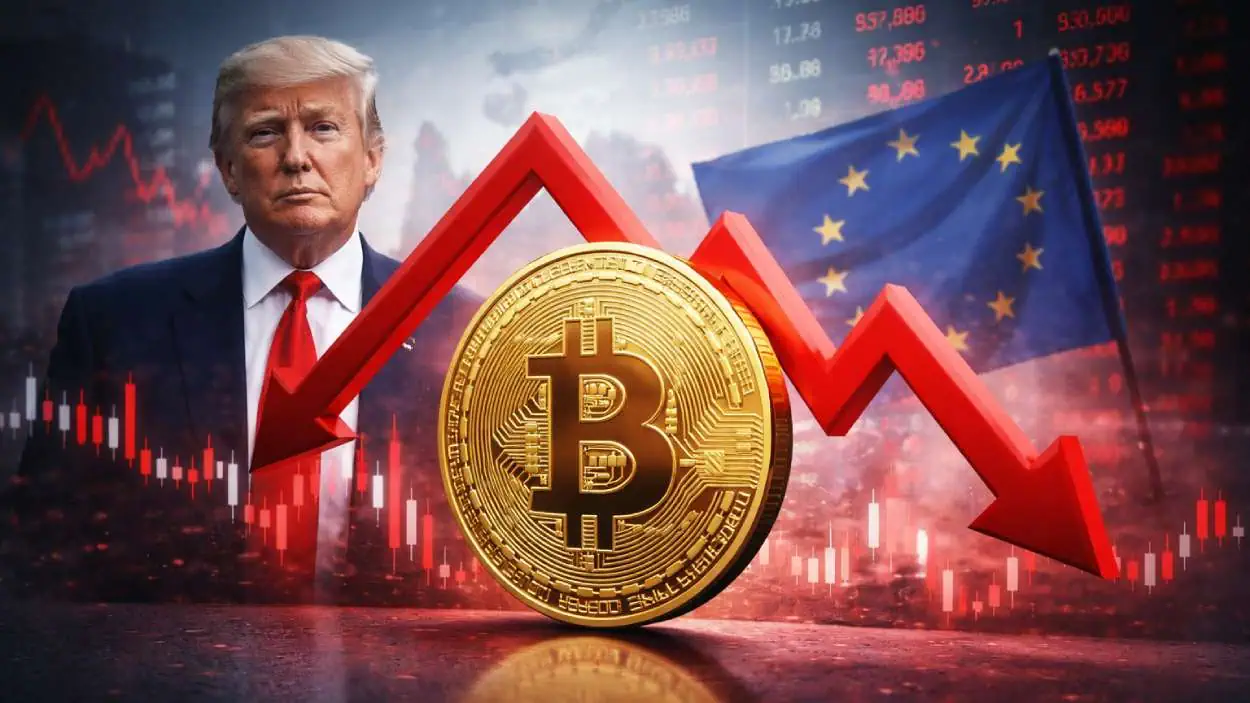







Bitcoin dropped sharply to below $93,000 early Monday after former President Donald Trump unexpectedly threatened new tariffs on eight key European allies, linking the move to his long-standing push to acquire Greenland.
Key Takeaways
- Bitcoin fell over 3% to around $92,000 as Trump proposed a 10% import tariff on eight European countries, starting February 1.
- Trump tied the tariff threat to a stalled U.S. deal to buy Greenland, warning tariffs would rise to 25% if no agreement is reached by June.
- Crypto markets saw a $4 billion Bitcoin selloff within one hour, with major exchanges and market makers driving the bulk of liquidation.
- Despite the downturn, technical indicators suggest a correction, not a trend reversal, with Bitcoin dominance still near 60%.
What Happened?
Global markets opened the week on edge after Trump’s surprise tariff threat over the weekend reignited fears of a trade war. Bitcoin and other digital assets bore the brunt of the initial shock, with the largest cryptocurrency losing key support levels during early Asian hours. The news came just as market participants had begun to embrace 2026 with cautious optimism.
Bitcoin’s Drop Fueled by Tariff Threat and Leverage Unwind
The crypto market stumbled after Trump announced that the U.S. would impose a 10% tariff starting February 1 on goods from Denmark, Norway, Sweden, France, Germany, the Netherlands, Finland and the United Kingdom. If no agreement is reached to allow the U.S. to purchase Greenland by June 1, the tariff would rise to 25%.
On his Truth Social platform, Trump claimed the U.S. had long subsidized European nations. He stated, “We have subsidized Denmark, and all of the Countries of the European Union, and others, for many years by not charging them Tariffs.” He added, “Now, after Centuries, it is time for Denmark to give back – World Peace is at stake!”
cThe markets responded swiftly. Bitcoin fell more than 3% to about $92,500, with over $4 billion in BTC sold in a single hour, largely by major exchanges and insiders.

According to data:
- 22,918 BTC were sold by insider desks.
- Market maker Wintermute offloaded 4,191 BTC.
- Bybit sold 3,339 BTC.
- Coinbase moved 2,417 BTC.
- Binance shed 2,301 BTC.
The crypto market’s total capitalization dropped to $3.14 trillion, down 2.5%, while Ethereum fell 3.23% to $3,209 and Ripple dropped 3.95% to $1.97. Solana led major altcoin losses, plunging 6.08% to $133.78.
Broader Market Impact: Risk-Off Moves Spread Globally
With U.S. cash markets closed for a holiday, futures bore the initial brunt, pulling other assets with them:
- S&P 500 futures dropped 0.7%
- Nasdaq futures slid 1.0%
- Japan’s Nikkei declined 1%
- Euro Stoxx 50 and DAX futures both fell 1.1%
Traditional safe havens rallied. Gold surged 1.5% to a record, while silver hit new highs. Oil prices fell as investors reassessed global growth prospects amid potential trade tensions.
Currency markets also reflected stress, with the dollar weakening against the Japanese yen and Swiss franc. The euro steadied after an initial dip.

Technical Signals Still Show Bullish Structure
Despite the steep decline, technical indicators on Bitcoin remain surprisingly strong. Both the MACD and RSI remain above neutral, suggesting this drop is more of a sharp correction than a full reversal.
The average RSI across the crypto market fell to 38.04, indicating that assets are now technically oversold, which could set the stage for a short-term relief rally once market participants digest the headline risk.
Bitcoin dominance stands at 59.74%, reflecting that capital is rotating into BTC rather than exiting the crypto ecosystem entirely.
EU and Global Response Adds Fuel to Volatility
European officials condemned Trump’s tariff plan, calling it “coercive”. EU diplomats in Brussels confirmed efforts to dissuade Trump from enacting the tariffs, while simultaneously preparing a retaliation package for 93 billion euros worth of U.S. imports. They are also considering using the Anti-Coercion Instrument, a never-before-invoked mechanism to restrict access to EU tenders and services.
Further complicating the story, a letter from Trump to Norway’s Prime Minister linked Greenland to the Nobel Peace Prize, with reports confirming its authenticity. This bizarre twist added unpredictability, reinforcing concerns that there may be no clear diplomatic off-ramp.
CoinLaw’s Takeaway
Honestly, I think this is one of those moments that shows how fragile the crypto market still is when it collides with geopolitics. In my experience, Bitcoin can absorb a lot of internal shocks, but when the broader macro world flips to risk-off, even strong trends get shaken. This Greenland-linked tariff story might sound odd, but traders are not laughing. They remember October’s China-related tariff liquidations, and the pattern feels familiar. I found it particularly striking that insiders sold off so aggressively and so fast. That’s never a good sign, but it’s also not the end of the road. Technicals still favor the bulls, but traders should buckle up for more headline risk.