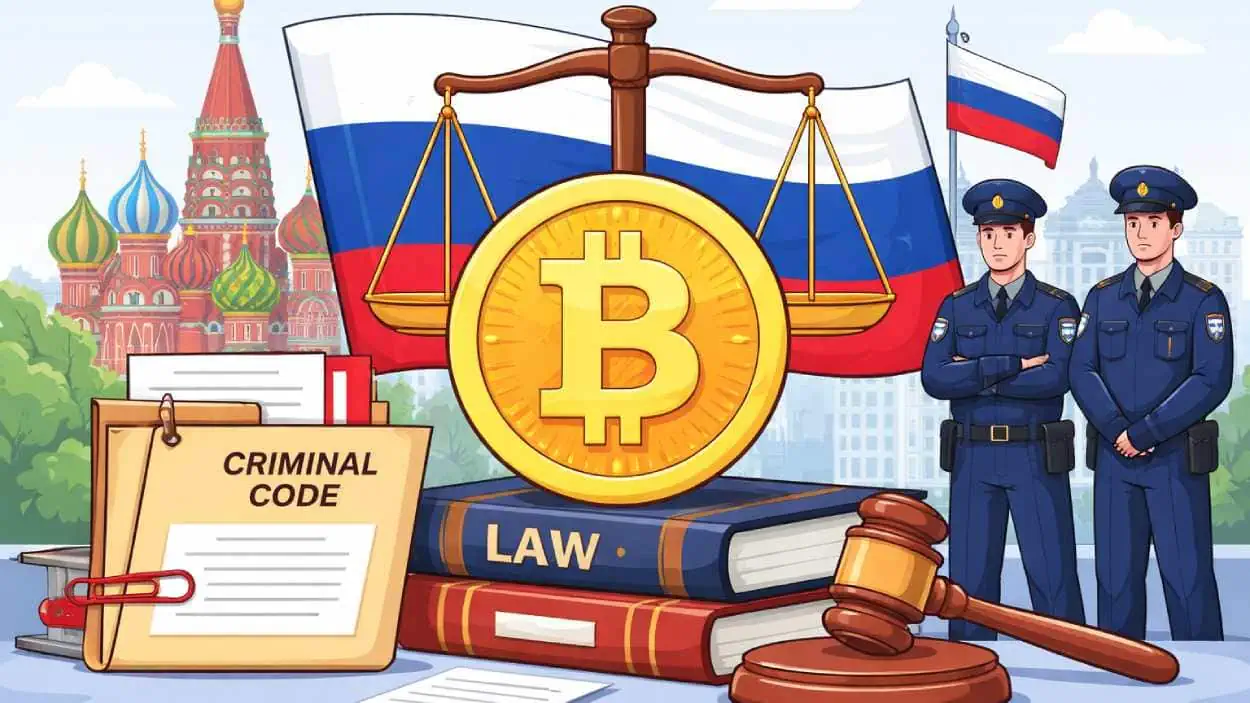







Russia has officially recognized cryptocurrency as intangible property, giving courts clear authority to freeze and confiscate Bitcoin in criminal investigations.
Key Takeaways
- Russia now classifies crypto assets as intangible property under its Criminal Code.
- Courts can legally freeze and confiscate Bitcoin and other tokens during criminal cases.
- Authorities can transfer seized crypto to government controlled wallets.
- The move signals tighter oversight of exchanges and potential restrictions on foreign platforms.
What Happened?
President Vladimir Putin signed amendments to Russia’s Criminal Code and Criminal Procedure Code that formally recognize cryptocurrencies as intangible property. The law gives courts explicit authority to seize digital assets in criminal investigations.
Officials say the legislation codifies existing practices, but now places them directly into statutory law, removing previous legal ambiguity around Bitcoin and other crypto assets.
🇷🇺RUSSIA CAN NOW SEIZE BITCOIN
— Coin Bureau (@coinbureau) February 25, 2026
President Putin signed a law classifying crypto as “intangible property,” allowing courts to freeze and confiscate crypto in criminal cases.
Retail limits tighten, exchanges need domestic licenses, and crypto remains banned for domestic payments. pic.twitter.com/4OAVN1B86f
Crypto Officially Recognized as Property
Under the new framework, cryptocurrencies such as Bitcoin, Ethereum, and other altcoins are legally defined as intangible property. This classification allows judges to treat digital assets similarly to other non physical assets in criminal proceedings.
Previously, Russian authorities relied on court precedent to justify crypto seizures. Now, those procedures are clearly written into law. Deputy Justice Minister Elena Ardabyeva said the amendments formalize current enforcement mechanisms and create a stronger legal basis for action.
By moving crypto into defined legal territory, the government has eliminated uncertainty about whether digital assets can be frozen or confiscated. Courts now have direct authority to intervene.
How Seizures Will Work?
The law outlines a structured process for confiscation. Police or prosecutors requesting seizure must specify:
- The type of cryptocurrency involved
- The exact quantity of tokens
- The wallet addresses holding the assets
In certain cases, bailiffs are authorized to transfer seized crypto to government controlled wallets. The state will define storage and transfer procedures, creating what officials describe as a clear pipeline that includes wallet identification, court approval, and final transfer to a state managed address.
The legislation also opens legal avenues for cooperation with foreign crypto exchanges, potentially expanding enforcement reach beyond domestic platforms.

Pressure on Exchanges and Foreign Platforms
The move comes as Russia attempts to bring order to what officials describe as a largely unregulated crypto sector. Lawmakers are considering additional measures that could force traders to use domestic exchanges or platforms with a physical presence in Russia.
Reports suggest authorities may even block access to overseas crypto exchanges this year. Government estimates claim Russian citizens spend around $650 million per day on crypto trades, a figure that has heightened regulatory concern.
The State Duma is currently working on a broader package of crypto legislation. Moscow also plans to update how it taxes and regulates Bitcoin miners.
Legal System Faces Growing Challenge
Legal experts warn that crypto related crime is becoming increasingly complex for Russia’s judicial system. Olga Tisen, rector of the V.M. Lebedev Russian State University of Justice, told Russian newspaper Vedomosti that crypto crime is “becoming one of the key challenges now facing the judiciary.”
Tisen explained:
In response, the university has launched the country’s first master’s program focused on cryptocurrency law.
The crackdown also comes amid broader geopolitical scrutiny. Blockchain analytics firm Chainalysis claimed in January that Russia, North Korea, and Iran are collectively responsible for conducting $100 billion worth of sanctions evading trade transactions.
CoinLaw’s Takeaway
In my experience, when a government moves crypto directly under criminal law, it is not just about fighting crime. It is about control. I see this as Russia drawing a firm regulatory boundary. By defining crypto as property and formalizing seizure powers, the Kremlin is signaling that digital assets will operate under strict state supervision.
I found it particularly notable that the law allows structured cooperation with foreign exchanges. That tells me enforcement could become more coordinated and more aggressive. For investors, the message is clear. Crypto in Russia is no longer operating in a gray zone. It is firmly inside the legal system, with all the oversight that implies.