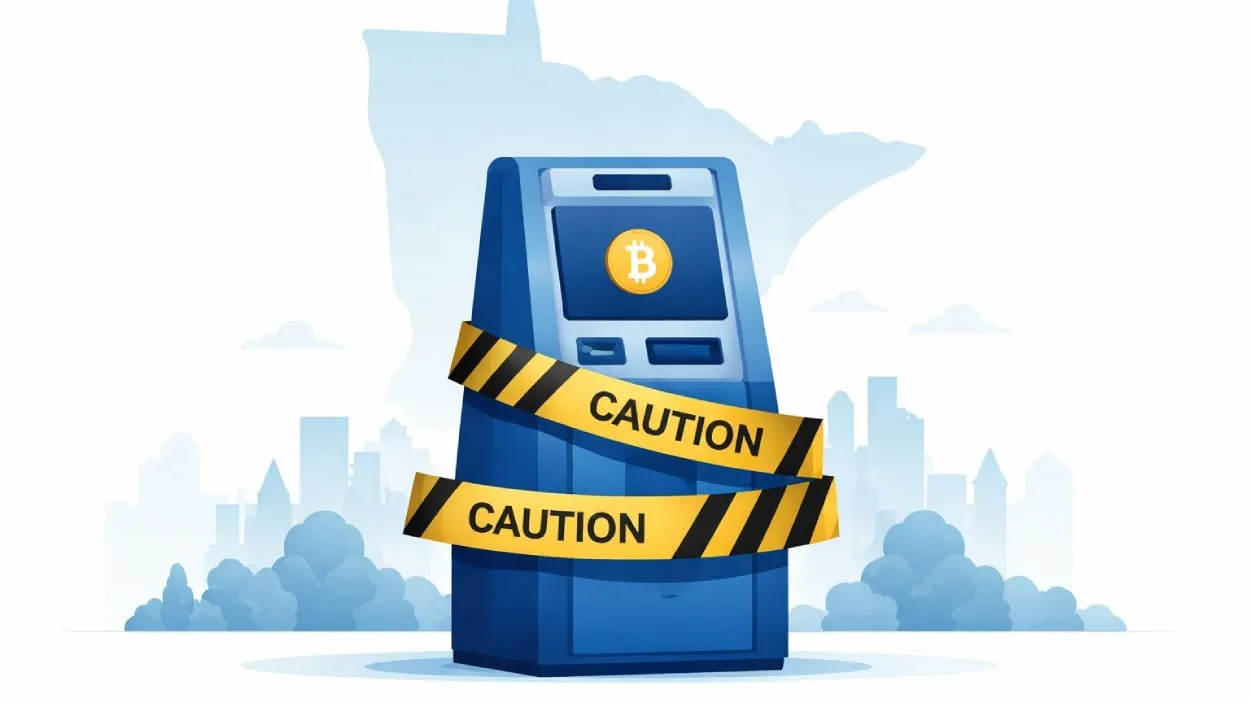







Minnesota lawmakers are advancing legislation that would prohibit cryptocurrency kiosks statewide following a surge in fraud cases, particularly involving older residents.
Key Takeaways
- House File 3642 would ban crypto kiosks across Minnesota if passed.
- Lawmakers say a 2024 consumer protection law failed to stop scammers.
- Police report that elderly residents are the primary victims, often losing essential savings.
- About 350 licensed crypto kiosks operate statewide, including machines run by Bitcoin Depot and Coinflip.
What Happened?
Minnesota DFL Rep. Erin Koegel introduced House File 3642 during a Commerce Finance and Policy Committee session, calling for a full ban on crypto kiosks across the state. The proposal follows growing reports from law enforcement linking the machines to scam activity, especially cases targeting older residents.
State officials say that previous safeguards adopted in 2024, including deposit caps and refund requirements, have not been enough to stop fraud losses.
🚨MINNESOTA WEIGHS ON CRYPTO ATM BAN
— Coin Bureau (@coinbureau) February 27, 2026
Lawmakers introduced a bill to ban crypto ATMs after a surge in scams targeting the elderly.
The state only regulated them in 2024, now a full ban is on the table. pic.twitter.com/wEN5etXfFO
Lawmakers Shift Toward a Full Ban
The proposed legislation directs state agencies to dismantle the existing regulatory framework governing crypto kiosks and remove the machines entirely. Supporters argue that prevention is more effective than trying to recover stolen funds after irreversible transactions occur.
Under a 2024 law, Minnesota capped new user deposits at $2,000 and required kiosk operators to provide refunds in certain fraud cases. However, authorities report that scammers quickly adapted by instructing victims to make multiple smaller deposits or prolonging contact until refund eligibility expired.
Law enforcement officials told lawmakers that scammers often coach victims step by step, convincing them they are communicating with trusted authorities. In many cases, victims are instructed to convert cash into cryptocurrency at retail kiosks and transfer the funds to digital wallets controlled by criminals. Because crypto transfers are difficult to trace and typically irreversible, recovery rates remain low.
Cross State Tactics Raise Alarm
Police also reported cases in which scammers directed victims to travel outside Minnesota, including to neighboring Wisconsin, to bypass transaction limits imposed under state law. These cross state tactics, officials say, highlight the limits of incremental regulation.
Commerce Department officials told lawmakers that only a small portion of losses are ever recovered. Several reported cases involved elderly residents on fixed incomes who faced immediate financial distress after repeated transactions.
Committee leaders emphasized that protecting vulnerable residents is the central objective of the proposed ban. By removing kiosks entirely, they argue, the state could reduce one of the primary scam entry points.

Industry Pushback and Economic Concerns
Kiosk operators have pushed back against the proposed ban. Industry representatives argue that the machines serve legitimate users who rely on cash to access digital assets. They contend that fraud is a national issue and not uniquely caused by kiosk access.
Minnesota currently has roughly 350 licensed crypto kiosks operated by companies such as Bitcoin Depot and Coinflip, according to state findings. Operators have suggested expanding refund rules, extending transaction hold periods, and strengthening identity verification rather than imposing a full prohibition.
Opponents of the bill warn that eliminating kiosks could push activity into less regulated or underground channels. They argue that targeted enforcement against non compliant operators would be more effective than a blanket ban.
Policy Mechanics and What Comes Next
If enacted, House File 3642 would take a direct approach by eliminating kiosk access instead of layering additional disclosures or transaction limits. Supporters believe this simplifies enforcement and consumer messaging by making the rule clear and absolute.
However, implementation questions remain. Lawmakers will need to clarify definitions of what qualifies as a kiosk, set deadlines for removal, and outline verification procedures for compliance. Retailers hosting machines and operators with existing contracts would face de installation and operational adjustments.
The proposal is gaining momentum in committee discussions, but it is unclear whether lawmakers will treat a full ban as the final outcome or a starting point for negotiated guardrails.
CoinLaw’s Takeaway
In my experience, when lawmakers move from regulation to prohibition, it signals that incremental fixes have not worked. I found it notable that Minnesota already tried deposit caps and refund mandates in 2024, yet scam losses continued. That tells me policymakers see this as a consumer protection emergency, not just a compliance tweak.
At the same time, banning kiosks does not eliminate crypto or scams entirely. It shifts how and where people access digital assets. The real test will be whether removing physical machines meaningfully reduces fraud or simply redirects it elsewhere.