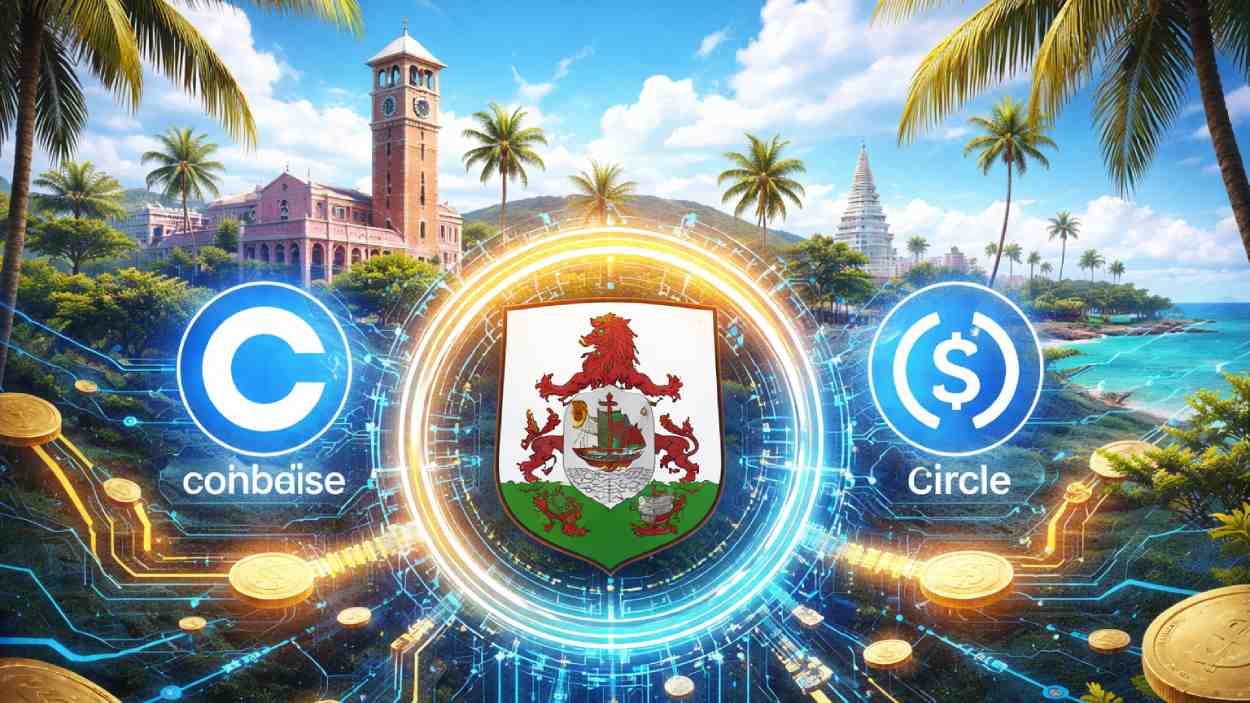







Bermuda has partnered with Circle and Coinbase to launch the world’s first fully onchain economy, integrating blockchain into national finance and public services.
Key Takeaways
- Bermuda unveiled plans to digitize its entire economy using blockchain, stablecoins, and tokenization tools.
- The government will use Circle’s USDC and Coinbase’s Base network to modernize payments, banking, and public services.
- Pilot programs and education efforts aim to onboard residents, businesses, and institutions into the new digital ecosystem.
- This move positions Bermuda as a global testbed for national-level crypto adoption under a robust regulatory framework.
What Happened?
At the World Economic Forum in Davos, Bermuda announced a sweeping national initiative to become the first country with a fully onchain economy. In partnership with Circle and Coinbase, the government will digitize payments, financial services, and public operations using blockchain and stablecoin technology.
The plan builds on Bermuda’s long-standing push toward digital innovation, backed by the 2018 Digital Asset Business Act and a growing number of licensed crypto firms on the island.
We’re working with @coinbase to support @BdaGovernment in their plans to build the world’s first fully onchain national economy.
— Circle (@circle) January 19, 2026
We’re expanding access to @USDC, onchain infrastructure, and digital finance education at a national scale.https://t.co/PYFmy9fVYh pic.twitter.com/v3ccIzfn3f
Bermuda’s Ambitious Onchain Strategy
Bermuda’s strategy marks a bold departure from traditional financial systems. By leveraging Circle’s USDC stablecoin and Coinbase’s Base infrastructure, the government aims to solve long-standing inefficiencies such as high fees, slow settlements, and limited access to global banking.
Premier David Burt emphasized that the goal is to democratize access to capital, boost competitiveness for local businesses, and ensure that residents benefit from global financial innovation.
The initiative includes:
- Stablecoin payments across government agencies and private businesses.
- Tokenization tools for banks and insurers to streamline operations.
- Education programs to teach residents how to safely use digital wallets and assets.
More than 40 digital asset companies have already been licensed under Bermuda’s regulatory sandbox, including early participants like Circle and Coinbase. The island’s regulatory clarity continues to attract major industry players, strengthening its position as a crypto-forward jurisdiction.
Circle Expands USDC Use Nationwide
Circle is playing a central role in enabling Bermuda’s digital payment ecosystem. Its USDC stablecoin is already accepted by some Bermudian merchants and will now be integrated more broadly.
The company is also providing:
- Payment infrastructure tailored for local compliance.
- Enterprise services for insurance and finance firms.
- Support for national financial literacy and wallet security programs.
Circle’s expanded presence enhances its reach into regulated markets, offering Bermuda a way to retain more economic value locally and reduce transaction costs for small and medium-sized enterprises.

Coinbase Builds the Digital Rails
Coinbase, meanwhile, is focused on deploying the technical infrastructure needed to bring this vision to life. The company will work with:
- Government agencies on blockchain integration.
- Banks and financial institutions on stablecoin settlement.
- Merchants on reducing settlement times and setup complexity.
Following its participation in the 2025 Digital Finance Forum, where it helped execute a national USDC airdrop, Coinbase deepened its investment in Bermuda’s digital transition. The company also operates a derivatives exchange in Bermuda for non-US users, adding operational depth to its partnership.
A Model for Other Nations?
Bermuda’s efforts are being closely watched by global regulators and crypto advocates alike. With the presence of Coinbase CEO Brian Armstrong and Circle CEO Jeremy Allaire at Davos, the project is gaining international attention.
If successful, it could serve as a model for other countries exploring how blockchain and stablecoins might modernize national finance, especially in regions underserved by traditional banking infrastructure.
CoinLaw’s Takeaway
In my experience, few countries have dared to make such a sweeping bet on blockchain like Bermuda just did. What stands out to me is that this isn’t just a flashy tech experiment. Bermuda is tackling real-world pain points like high fees and banking access. I found the emphasis on education and regulatory clarity especially promising. If they can make this work at scale, it could be the blueprint for other nations ready to leap into digital finance. I’ll be keeping a close eye on this one.