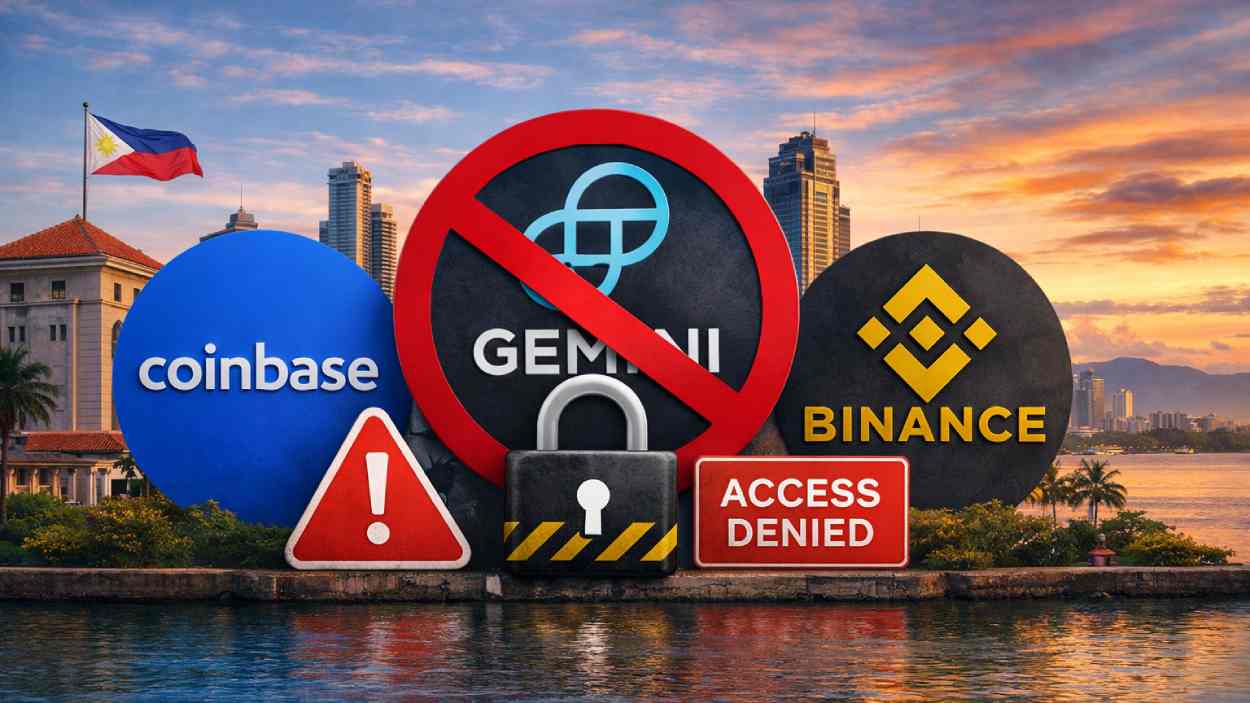







Access to Coinbase and Gemini has been cut off across the Philippines, as regulators escalate enforcement against unlicensed crypto platforms through direct action against internet access.
Key Takeaways
- The Philippines has blocked access to Coinbase and Gemini, joining Binance and other major exchanges previously restricted for operating without local authorization.
- The National Telecommunications Commission (NTC) ordered internet service providers to block 50 unregistered Virtual Asset Service Providers (VASPs), based on a directive from the Bangko Sentral ng Pilipinas (BSP).
- This marks a policy shift from mere advisories to strict enforcement, with regulators using telecom infrastructure to limit unlicensed digital asset access.
- Registered firms like PDAX and GoTyme are expanding, indicating the government supports crypto innovation under proper regulatory supervision.
What Happened?
Starting December 24, 2025, Filipino users began reporting they could no longer access Coinbase and Gemini. This was soon independently confirmed across multiple internet service providers nationwide. The access issues stem from a coordinated enforcement action by the National Telecommunications Commission, which issued a directive to block 50 crypto platforms identified by the Bangko Sentral ng Pilipinas as operating without the necessary licenses.
📢Philippines has blocked Coinbase and Gemini as part of the government crackdown on unlicensed crypto platforms. pic.twitter.com/Xf0GJFDDxi
— CryptoDaku (@CryptoDaku_) December 24, 2025
Regulators Clamp Down on Unlicensed Crypto Platforms
The BSP-backed crackdown represents a significant turn in how the Philippines governs the crypto market. The NTC issued a memorandum instructing ISPs to block access to all 50 identified platforms, including some of the world’s largest exchanges. While the full list has not been officially published, Coinbase and Gemini have both been confirmed as targets.
Authorities cited BSP Circular No. 1206 (Series of 2024) and Section 902-N of the Manual of Regulations for Non-Bank Financial Institutions as the legal foundation for the action. The BSP framed the enforcement as a step for consumer protection and market integrity, not a ban on crypto itself.
The move signals that licensing is now the barrier to entry for crypto firms in the Philippines, whether they deal in cryptocurrencies, online trading, or other investment products.

Binance Set the Precedent
The crackdown follows a similar path taken against Binance in early 2024. After a 90-day grace period given in late 2023, the Philippines Securities and Exchange Commission (SEC) directed users to withdraw their funds from Binance. When the exchange failed to comply with local licensing rules, regulators moved to block it on March 25, 2024. App stores were also ordered to delist the Binance app in April 2024.
Later, the SEC identified OKX, Bybit, and KuCoin among 10 unlicensed platforms. The handling of Binance set a clear precedent: unregistered platforms risk full service disruption in the country.
New Rules from SEC Add Pressure
The enforcement environment tightened further in 2025 when the SEC introduced Memorandum Circular No. 04, outlining its own regulatory framework for Crypto-Asset Service Providers (CASPs). This included a ₱100 million minimum paid-up capital requirement, making it harder for smaller or foreign platforms to enter the market without local partnerships or full compliance.
This broader regulatory shift across agencies means that even “gray area” operations are now vulnerable to strict ISP-level enforcement, not just public warnings or app takedowns.
Regulated Crypto Firms Gain Ground
While enforcement focuses on non-compliant platforms, regulated firms are expanding their footprint. On November 19, 2024, PDAX partnered with payroll service Toku to allow Filipino freelancers and remote workers to receive their salaries in stablecoins. The service enables instant conversion to pesos with no wire transfer fees.
On December 8, 2024, digital bank GoTyme launched crypto features within its app via a partnership with U.S.-based Alpaca. Users can now buy and store 11 digital assets directly from the banking platform, reinforcing the point that regulators are not anti-crypto but want proper oversight.
The Official List Becomes Essential for Users
To guide users, the BSP maintains a directory of registered VASPs, listing compliant entities such as Coins.ph and PDAX. As more blocks roll out, this directory is quickly becoming the go-to resource for Filipino crypto users to verify if a platform is operating legally in the country.
CoinLaw’s Takeaway
I see this as a real turning point for crypto access in Southeast Asia. In my experience covering the regulatory space, governments often start with warnings, but when platforms keep ignoring local rules, they eventually act hard. That’s exactly what’s happening in the Philippines. The message is clear: if you’re not licensed here, you’re not welcome.
I found it particularly telling that the BSP isn’t doing this to kill crypto but to protect consumers and clean up the space. There’s still room for innovation, but the era of wild-west crypto in the Philippines is clearly over. If you’re a user, stick to platforms on the BSP’s list. If you’re a business, now’s the time to get serious about licensing.