
• Skip to primary navigation
  • Skip to main content
  • Skip to primary sidebar
  • Skip to footer
CoinLaw LogoCoinLaw

Bringing Crypto & Finance Closer to You

  • Latest News
  • Statistics
  • About
  • Contact
  • Subscribe
Subscribe
CoinLaw Logo
  • The Crypto Desk
  • Exchanges
  • Ethereum & L1s
  • Mining
  • Regulation
  • Adoption
  • Bitcoin & ETFs
  • Stablecoins
  • DeFi & Web3
  • Security
Subscribe
Home » Cryptocurrency

OFAC Sanctions and Crypto Transactions Statistics 2026: What You Must Know Now

Published on: December 2025 • Last Updated: March 15, 2026
Barry Elad
Founder & Senior Journalist • 592 Articles
Barry Elad is a finance and tech journalist who loves breaking down complex ideas into simple, practical insights. Whether he's exploring fi... See full bio
LATEST POSTS:
Crypto ETF Statistics 2026: Net Assets, Fees and Flows by Issuer
Crypto Regulation by Country Statistics 2026: Legal Status, Tax and Licensing
Biggest Crypto Hacks Statistics 2026: Ranked by Value Stolen
Kathleen Kinder
Senior Editor • 1,973 Articles
Kathleen Kinder brings over 11 years of experience in the research industry, with deep expertise in finance, cryptocurrency, and insurance. ... See full bio
LATEST POSTS:
BingX EU Secures MiCA License From Austria’s FMA
Bitmine Holds 6.03 Million ETH, 4.9% of Total Supply
Moscow Exchange Targets Crypto Trading Launch in December
OFAC Sanctions and Crypto Transactions Statistics
As Featured In
Deloitte logoForbes LogoFortune LogoCoinDesk LogoInvestopedia logo
Share on LinkedIn ChatGPT Perplexity Share on X Share on Facebook

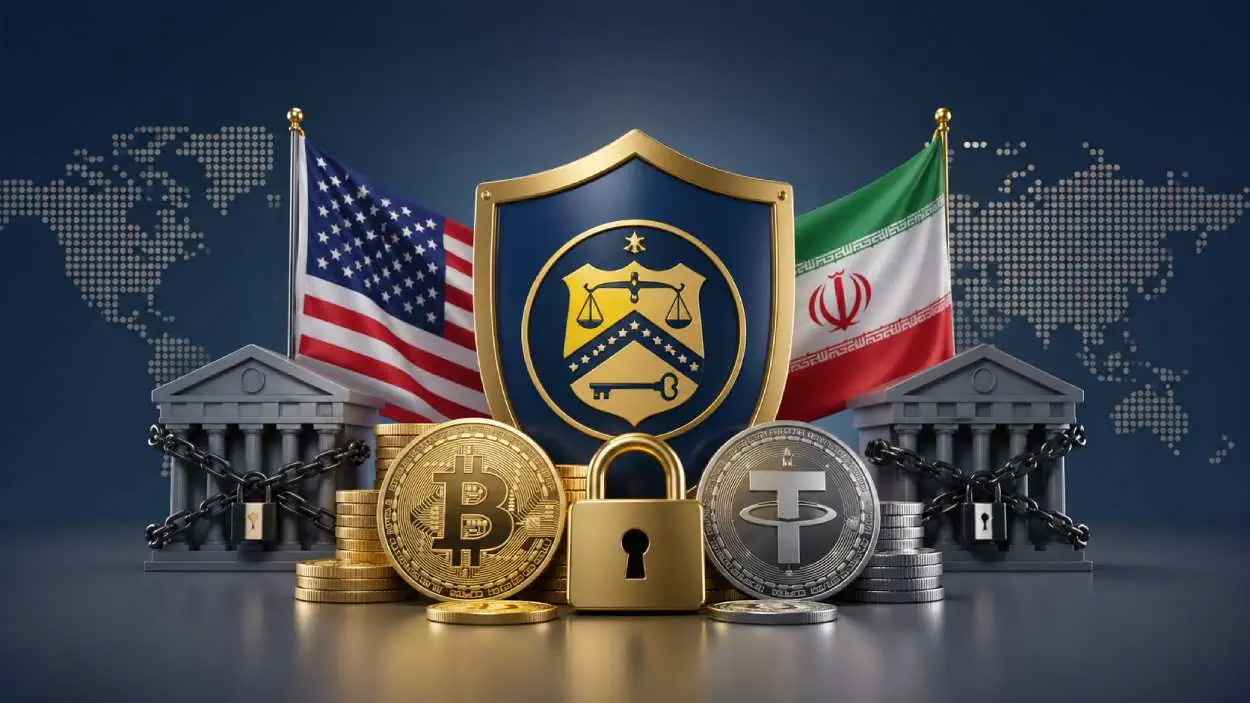
In early 2021, a small blockchain analytics startup uncovered something alarming: a crypto wallet linked to a sanctioned Iranian exchange had just moved millions in Bitcoin. It wasn’t the first time, and it wouldn’t be the last. The stakes were high, and the U.S. Office of Foreign Assets Control (OFAC) knew it. Today, the landscape of crypto transactions under OFAC sanctions has shifted dramatically.

The intersection between decentralized finance and international regulations has become a battleground. As regulators clamp down on illicit transactions, crypto users and institutions are navigating a complex web of compliance and enforcement. This article explores the latest statistics and trends shaping OFAC sanctions and crypto transactions, helping readers understand the key developments that are reshaping this critical space.

Editor’s Choice

  • $1.8 billion in crypto assets have been frozen or seized due to OFAC sanctions as of Q1 2025.​
  • The number of OFAC-designated crypto wallets rose by 32% year-over-year, totaling 1,245 wallets by early 2025.​
  • 76% of crypto exchanges operating in the U.S. reported full OFAC compliance as of March 2025.​
  • OFAC enforcement actions targeting crypto firms increased by 28% from 2023 to 2024.​
  • Approximately 45% of global ransomware payments in 2024 were linked to wallets flagged by OFAC.​
  • North Korean hackers stole $2.02 billion worth of digital assets through early December 2025, up 51% from a year earlier.​

Overview of OFAC Sanctions on Crypto Transactions

  • As of 2025, OFAC has sanctioned 57 individuals and entities specifically for illicit activities involving cryptocurrencies.​
  • OFAC’s first crypto-related designation occurred in 2018, and since then, there has been an annual growth rate of 18% in crypto sanctions.​
  • In 2024, 23% of all new sanctions designations were crypto-related, up from 17% in 2023.​
  • $6.9 billion in illicit crypto transactions were linked to sanctioned entities over the past 24 months.​
  • OFAC’s Specially Designated Nationals (SDN) List now includes over 1,200 crypto wallet addresses.​
  • Sanctioned entities use a variety of crypto assets, with Bitcoin (BTC) accounting for 65%, Ethereum (ETH) 18%, and stablecoins 12% of identified transactions.​
  • OFAC collaborates with INTERPOL and Europol to enforce cross-border compliance on crypto-related sanctions.​
  • In January 2025, OFAC issued its first-ever sanction against a DeFi protocol, freezing $150 million in assets.​

OFAC-Listed Crypto Wallets

  • Bitcoin addresses dominate the OFAC-listed wallets, representing 63% of all sanctioned addresses.​
  • North Korean Lazarus Group wallets account for 14% of all wallets designated by OFAC as of 2025.
  • ​56% of OFAC-sanctioned wallets showed signs of using mixing services prior to being blocklisted.​
  • Only 9% of blocklisted wallets have been completely frozen; the rest remain active but under heavy monitoring.
Distribution of OFAC-Listed Crypto Wallets by Key Metrics
  • By February 2025, the SDN List contains 1,245 unique crypto wallet addresses.​
  • In 2024, OFAC flagged 120 wallets associated with Iranian ransomware groups.​
  • The average transaction volume per OFAC-listed wallet in 2024 was $1.2 million.​​

Most Sanctioned Countries in Crypto-Related OFAC Actions

  • North Korea accounts for 40% of OFAC’s crypto-related sanctions through Lazarus Group activities.​
  • Russia represents 28% of crypto sanctions linked to ransomware and evasion networks.​
  • Iran comprises 20% of enforcement actions involving terrorism financing via USDT.​
  • OFAC designated 65 new entities in Russia and Belarus for crypto evasion.​
  • Venezuela holds 9% of crypto-related designations tied to state actors.​
  • China entities account for 5% of sanctions focused on laundering schemes.​
  • North Korea stole $2.02 billion in crypto, prompting expanded OFAC blocks.​
  • Iran shadow networks facilitated $100 million in crypto oil sales frozen by OFAC.​
  • Russia-based Garantex processed over $100 million in sanctioned illicit transactions.​
  • OFAC crypto wallets rose 32% to 1,245, with North Korea at 14%.
Newsletter Img
Don't chase the news. Let us curate it.

You get one weekly briefing with only the stories that matter. If the market is quiet, we skip it.

Read by pros at Visa, Mastercard, Vanguard, and the FDIC.

Impact of OFAC Sanctions on Global Crypto Transactions

  • OFAC sanctions froze or seized $1.8 billion in crypto assets as of Q1.​
  • Crypto transaction volume linked to sanctioned entities decreased by 18%.​
  • The number of OFAC-designated crypto wallets rose 32% to 1,245.​
  • 76% of U.S. crypto exchanges reported full OFAC compliance.​
  • OFAC issued its first DeFi protocol sanction, freezing $150 million in January.​
  • OFAC penalties on crypto businesses totaled $430 million.​
  • 56% of sanctioned wallets used mixing services prior to blocklisting.​
  • 33% of illicit crypto funds are funneled through DeFi platforms.​
  • Interoperable blocklists across DeFi protocols froze $600 million.​
  • Tether froze $450 million in assets linked to sanctioned Iranian entities.

Trends in Crypto Wallet Freezing and Blocklisting

  • North Korean Lazarus Group wallets comprise 14% of all OFAC designations.
  • ​72% of flagged wallets are frozen within 24 hours of designation.​
  • 45% of ransomware payment wallets are frozen within 48 hours.​
  • Elliptic identified 420 newly sanctioned wallets, 38% DeFi-linked.
Crypto Wallet Freezing And Blocklisting Trends
  • The number of OFAC-designated crypto wallets reached 1,245, up 32% year-over-year.​
  • OFAC added 280 wallets linked to Russian darknet markets.​
  • Tether froze $450 million in assets linked to sanctioned Iranian entities.​​
  • SDN list covers crypto addresses across 17 blockchains.​
  • OFAC sanctioned the first AI trading bot that laundered $60 million.

Compliance Rates Among Crypto Exchanges and Platforms

  • 83% of top-tier centralized crypto exchanges claim full compliance with OFAC regulations.​
  • 76% of US-based exchanges implemented automated OFAC wallet screening by late 2024.​
  • 45% of non-US exchanges had formal compliance programs for OFAC sanctions by Q1.​
  • Coinbase, Kraken, and Gemini scored 98% on OFAC compliance audits.​
  • Binance introduced mandatory OFAC compliance training for all 5,000 employees.​
  • 28% of smaller crypto exchanges in Southeast Asia remained noncompliant as of Q4.​
  • 61% of DeFi protocols reviewed by OFAC lacked sufficient sanctions screening.​
  • Only 30% of DeFi platforms implemented sanctions compliance controls by January.​
  • Bitfinex reported a 99% sanctions compliance success rate with OFAC analytics.

Evasion Tactics Used to Circumvent OFAC Sanctions

  • Chain-hopping accounts for 37% of sanctioned funds moving across multiple blockchains.​
  • Privacy coins like Monero usage rose 21% among sanctioned entities evading detection.​
  • Layer 2 solutions on Ethereum are exploited in 18% of sanctions evasion attempts.​
  • Flash loans are utilized in 11% of laundering cases tied to sanctioned addresses.​
  • Cross-chain bridges comprised 25% of total evasion methods employed.​
  • Decentralized mixers like Sinbad processed $350 million in illicit transactions.​
  • NFT marketplaces laundered $45 million, up 33% from the previous year.​
  • P2P platforms facilitated $620 million involving OFAC-sanctioned wallets.​
  • Social engineering via OTC brokers moved $200 million of sanctioned funds.

US Crypto Enforcement Penalties Overview

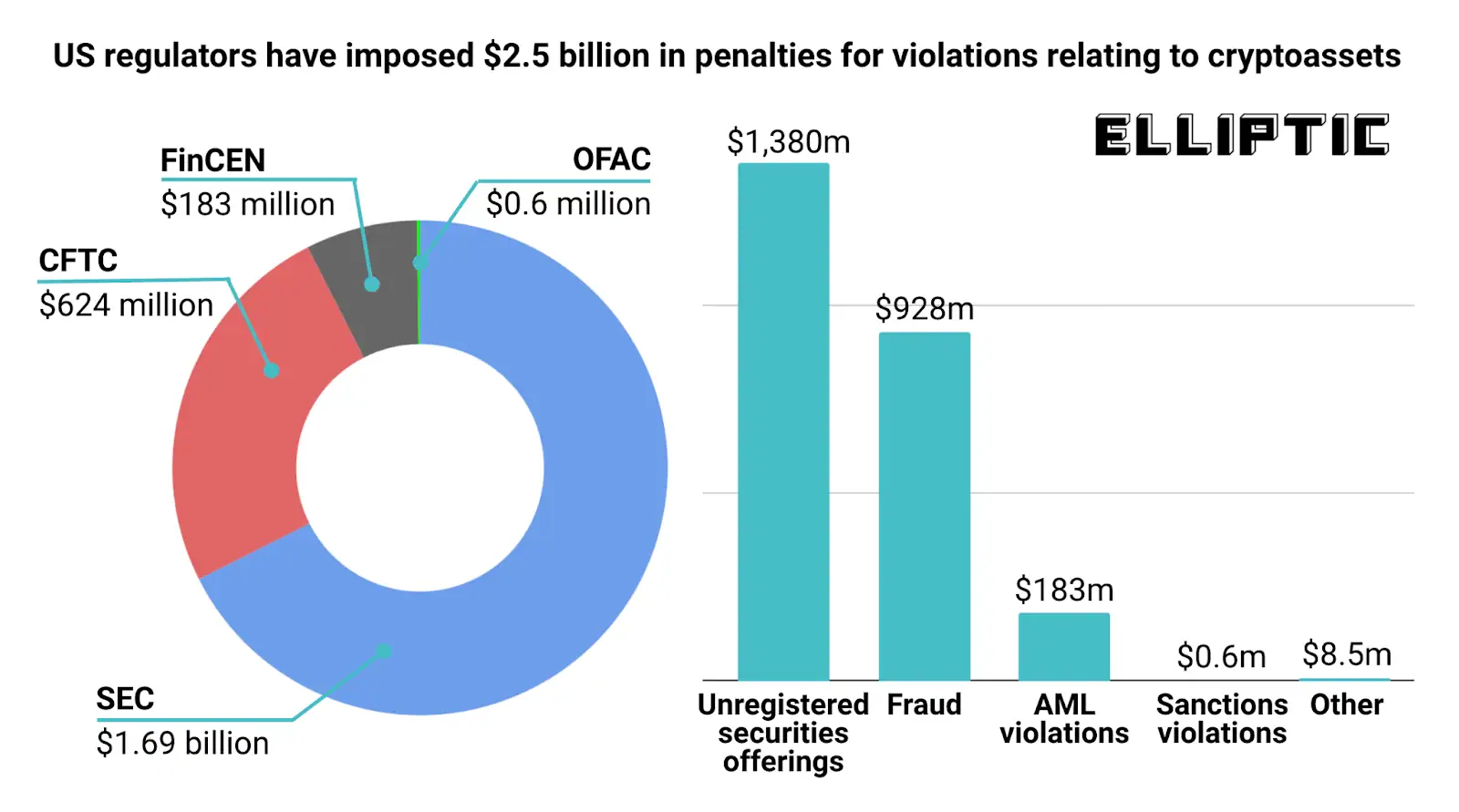
  • $2.5 billion in total penalties have been imposed by US regulators for cryptoasset-related violations.
  • The SEC accounts for the largest share, issuing $1.69 billion in fines, driven largely by unregistered securities offerings.
  • The CFTC follows with $624 million in penalties, reflecting heightened oversight of crypto derivatives and market misconduct.
  • FinCEN imposed $183 million in penalties, primarily tied to AML compliance failures.
  • OFAC sanctions violations resulted in just $0.6 million, highlighting enforcement focus on broader compliance gaps rather than sanctions breaches alone.
  • By violation type, unregistered securities offerings dominate with $1.38 billion in penalties, underscoring regulatory pressure on token issuances.
  • Fraud-related cases contributed $928 million, reinforcing ongoing concerns around investor protection.
  • AML violations accounted for $183 million, showing persistent weaknesses in transaction monitoring and reporting.
  • Other violations made up a relatively small $8.5 million, indicating concentrated enforcement priorities.
US Crypto Enforcement Penalties Overview
(Reference: Elliptic)

Emerging Technologies Aiding OFAC Sanctions Enforcement

  • AI blockchain analytics identified $2.1 billion in illicit transactions tied to sanctioned addresses.​
  • Zero-knowledge proof monitoring detected 16% of transactions masking sanctioned origins.​
  • Smart contract protocols froze $280 million in assets linked to sanctioned users.​
  • Predictive AI models reduced illicit flows by 22% through evasion forecasting.​
  • On-chain KYC wallets boosted sanctioned entity detection by 38%.​
  • Interoperable blocklists across 18 DeFi protocols froze $750 million.​
  • Real-time compliance APIs enabled instant blocking by 58% of exchanges.​
  • DAO voting sanctions lists cut illicit exposure by 25%.​
  • Machine learning caught 45% of complex evasion strategies missed by humans.

Challenges in Tracking and Regulating Sanctioned Crypto Transactions

  • 71% of decentralized protocols without KYC fail to screen for OFAC sanctions.​
  • Privacy coins limit traceability in 30% of sanctioned fund tracking attempts.​
  • Cross-chain bridges enabled $550 million in untraceable transfers, complicating enforcement.​
  • 43% of non-US jurisdictions refuse to enforce OFAC sanctions.​
  • 20% of smaller exchanges lack resources for OFAC compliance monitoring.​
  • Regulatory gaps allow 27% of DAO proposals to bypass sanction policies.​
  • False positives affected 15% of wallet screenings requiring manual reviews.​
  • Lightning Network routed $100 million in illicit payments undetected by OFAC.

Crypto ATM Market Share by Manufacturer

  • General Bytes leads the global crypto ATM market with a 28.6% share, making it the dominant hardware provider worldwide.
  • BitAccess ranks second, controlling 20.2% of installed crypto ATMs and maintaining a strong presence in North America.
  • Genesis Coin holds 17.0% market share, reinforcing its position as a major legacy manufacturer.
  • CoinCloud accounts for 12.6% of crypto ATMs, reflecting its expansion through retail-focused deployments.
  • Bitstop represents 6.1% of the market, specializing in compliance-driven ATM networks.
  • Smaller manufacturers remain fragmented, with Bytefederal at 2.9%, Cambio at 2.4%, and Lamassu at 2.0%.
  • The “Other” category makes up 8.2%, indicating a long tail of niche and regional ATM providers.
  • Combined, the top three manufacturers control 65.8% of the crypto ATM market, highlighting strong industry concentration.
Crypto ATM Market Share by Manufacturer
(Reference: ForkLog)

Recent Developments in OFAC Crypto Sanctions

  • In January 2025, OFAC expanded sanction criteria to include DAOs and decentralized protocols without formal governance.​
  • OFAC launched Crypto Compliance Guidance 2025, mandating real-time monitoring for US-based exchanges.​
  • Three new wallet screening technologies were endorsed by OFAC in March 2025, focusing on DeFi platforms.​
  • OFAC sanctioned the first AI-powered autonomous trading bot, laundering $60 million in February 2025.​
  • Lazarus Group linked to $200 million stolen via sanctioned DeFi protocols in Q1.​
  • OFAC’s collaboration with Interpol and Europol led to six international raids on crypto infrastructure hubs.​
  • OFAC and FATF released a joint directive in April 2025, enhancing global crypto sanctions coordination.​
  • Tether required to freeze $450 million in assets linked to sanctioned Iranian entities in March.

Frequently Asked Questions (FAQs)

How much crypto has been frozen or seized due to OFAC sanctions as of 2025?

OFAC-linked actions have frozen or seized about $1.8 billion in crypto assets as of Q1 2025.

How many crypto wallets are on OFAC sanctions lists in 2025?

The OFAC SDN list contains around 1,245 unique crypto wallet addresses in early 2025.

What share of OFAC-listed crypto wallets use Bitcoin?

Bitcoin addresses account for roughly 63–65% of all OFAC‑sanctioned crypto wallets.

How many individuals and entities has OFAC sanctioned specifically for crypto activities?

By 2025, OFAC has sanctioned approximately 57 individuals and entities specifically for illicit activities involving cryptocurrencies.

Conclusion

As we progress, OFAC sanctions have reshaped the global crypto landscape. The growing sophistication of blockchain analytics, AI-driven enforcement, and inter-agency cooperation has strengthened efforts to combat illicit crypto activity. Yet, the rise of decentralized systems and anonymity tools poses enduring challenges. Crypto exchanges, DeFi protocols, and regulators are engaged in a high-stakes race, one balancing innovation, privacy, and global security. Understanding these evolving statistics and trends is essential for anyone involved in the future of digital finance.


Definition of Blockchain. Link to full glossary entry follows the description.Blockchain

A distributed digital ledger that records transactions across a network, with each block cryptographically linked to the previous one for security.

Read more about Blockchain

Definition of Smart Contract. Link to full glossary entry follows the description.Smart Contract

A smart contract is a self-executing program stored on a blockchain that automatically enforces agreement terms when predefined conditions are met, without intermediaries.

Read more about Smart Contract

Definition of DeFi. Link to full glossary entry follows the description.DeFi

Decentralized finance leverages blockchain protocols and smart contracts to enable lending, trading, and borrowing without banks or traditional intermediaries.

Read more about DeFi

Definition of Lightning Network. Link to full glossary entry follows the description.Lightning Network

Bitcoin's layer-2 protocol routing off-chain payments through bidirectional channels secured by HTLCs, settling in milliseconds at fractions of a cent.

Read more about Lightning Network

Definition of Cross-Chain. Link to full glossary entry follows the description.Cross-Chain

Cross-chain is the ability to move data or assets between separate blockchains via bridges, messaging protocols, or interoperability networks.

Read more about Cross-Chain

This article has been reviewed and fact-checked by Kathleen Kinder. CoinLaw follows strict Publishing Principles and a documented Fact-Check Policy to ensure accuracy, transparency, and editorial independence across all content. Our statistics are verified using a documented Research Process.

Add CoinLaw as a Preferred Source on Google for instant updates! Follow on Google News
Share ChatGPT Perplexity

References

  • Statista
  • Chainalysis
  • Elliptic
  • CoinDesk
  • The Hacker News
Barry Elad

Barry Elad

Founder & Senior Journalist


Barry Elad is a finance and tech journalist who loves breaking down complex ideas into simple, practical insights. Whether he's exploring fintech trends or reviewing the latest apps, his goal is to make innovation easy to understand. Outside the digital world, you'll find Barry cooking up healthy recipes, practicing yoga, meditating, or enjoying the outdoors with his child.

Related Posts

Us Seizes Iranian Digital Assets Crypto
Cryptocurrency

US Cracks Down on Iran’s Crypto Network With Crypto Seizures

Cryptocurrency Trading Regulations Statistics
Cryptocurrency

Cryptocurrency Trading Regulations Statistics 2026: 85+ Global Compliance Data Points

Blockchain Forensics and Illicit Transactions Statistics
Cryptocurrency

Blockchain Forensics and Illicit Transactions Statistics 2026: Hidden Threats Now

Disclaimer: The content published on CoinLaw is intended solely for informational and educational purposes. It does not constitute financial, legal, or investment advice, nor does it reflect the views or recommendations of CoinLaw regarding the buying, selling, or holding of any assets. All investments carry risk, and you should conduct your own research or consult with a qualified advisor before making any financial decisions. You use the information on this website entirely at your own risk.

Reader Interactions

Leave a Comment Cancel reply

Primary Sidebar

Connect With Us

facebook x linkedin google-news telegram pinterest whatsapp email
google-preferred-source-badge Add as a preferred source on Google

You Should Also Read

Cryptocurrency Anti-Money Laundering Statistics 2026: Illicit Flows, Sanctions and Enforcement Data
Financial Sanctions Statistics 2026: Hidden Numbers Exposed
Crypto Sanctions Compliance Guide: Avoid Risks Now

Table of Contents

  • Editor’s Choice
  • Overview of OFAC Sanctions on Crypto Transactions
  • OFAC-Listed Crypto Wallets
  • Most Sanctioned Countries in Crypto-Related OFAC Actions
  • Impact of OFAC Sanctions on Global Crypto Transactions
  • Trends in Crypto Wallet Freezing and Blocklisting
  • Compliance Rates Among Crypto Exchanges and Platforms
  • Evasion Tactics Used to Circumvent OFAC Sanctions
  • US Crypto Enforcement Penalties Overview
  • Emerging Technologies Aiding OFAC Sanctions Enforcement
  • Challenges in Tracking and Regulating Sanctioned Crypto Transactions
  • Crypto ATM Market Share by Manufacturer
  • Recent Developments in OFAC Crypto Sanctions
  • Frequently Asked Questions (FAQs)
  • Conclusion
Connect on Telegram

Weekly stats quiz Week 42

How much of a crypto geek are you?

5 fast questions from this week's verified market data. About a minute.

Play the quiz New every Monday

Footer

CoinLaw Logo

Bringing Finance Closer to You.

Connect With Us

Follow Us on Google News

Editorial & Trust

  • About
  • Publishing Principles
  • Fact-Check Policy
  • Corrections Policy
  • Ethics Policy
  • Disclaimer
  • Cookie Policy

Worth Checking

  • The Crypto Desk
  • Exchange Listings Tracker
  • Crypto Regulation Tracker
  • Retail Options Trading Stats
  • Banking Customer Retention Stats
  • NFT Market Growth Stats
  • DeFi Market Stats
Contact Us
13570 Grove Dr #189,
Maple Grove, MN 55311,
United States
10 a.m. – 6 p.m. | Every day

Copyright © 2024–2026 CoinLaw. All Rights Reserved. Powered by the HODL Force ❤️

  • Privacy Policy
  • Terms
  • Accessibility Statement
Manage your privacy
We use technologies like cookies to store and/or access device information. We do this to improve browsing experience and to show (non-) personalized ads. Consenting to these technologies will allow us to process data such as browsing behavior or unique IDs on this site. Not consenting or withdrawing consent, may adversely affect certain features and functions.
Functional Always active
The technical storage or access is strictly necessary for the legitimate purpose of enabling the use of a specific service explicitly requested by the subscriber or user, or for the sole purpose of carrying out the transmission of a communication over an electronic communications network.
Preferences
The technical storage or access is necessary for the legitimate purpose of storing preferences that are not requested by the subscriber or user.
Statistics
The technical storage or access that is used exclusively for statistical purposes. The technical storage or access that is used exclusively for anonymous statistical purposes. Without a subpoena, voluntary compliance on the part of your Internet Service Provider, or additional records from a third party, information stored or retrieved for this purpose alone cannot usually be used to identify you.
Marketing
The technical storage or access is required to create user profiles to send advertising, or to track the user on a website or across several websites for similar marketing purposes.
  • Manage options
  • Manage services
  • Manage {vendor_count} vendors
  • Read more about these purposes
Manage options
  • {title}
  • {title}
  • {title}
Manage your privacy
To provide the best experiences, we use technologies like cookies to store and/or access device information. Consenting to these technologies will allow us to process data such as browsing behavior or unique IDs on this site. Not consenting or withdrawing consent, may adversely affect certain features and functions.
Functional Always active
The technical storage or access is strictly necessary for the legitimate purpose of enabling the use of a specific service explicitly requested by the subscriber or user, or for the sole purpose of carrying out the transmission of a communication over an electronic communications network.
Preferences
The technical storage or access is necessary for the legitimate purpose of storing preferences that are not requested by the subscriber or user.
Statistics
The technical storage or access that is used exclusively for statistical purposes. The technical storage or access that is used exclusively for anonymous statistical purposes. Without a subpoena, voluntary compliance on the part of your Internet Service Provider, or additional records from a third party, information stored or retrieved for this purpose alone cannot usually be used to identify you.
Marketing
The technical storage or access is required to create user profiles to send advertising, or to track the user on a website or across several websites for similar marketing purposes.
  • Manage options
  • Manage services
  • Manage {vendor_count} vendors
  • Read more about these purposes
Manage options
  • {title}
  • {title}
  • {title}
Company
  • About Us
  • Our Team
  • Our Mission
  • Core Values
Discover
  • glossary icon
    Glossary
  • Stats
    Stats Research Process
  • Brand Guide Icon
    Brand Assets
Categories
  • Cryptocurrency
  • Payments
  • Investments
  • Banking
  • Finance
Cryptocurrency
Crypto Regulation by Country 2026: Legal Status, Tax and Licensing
Crypto Regulation by Country Statistics 2026: Legal Status, Tax and Licensing
Biggest Crypto Hacks Statistics Ranked by Value Stolen
Biggest Crypto Hacks Statistics 2026: Ranked by Value Stolen
Perpetual Futures Statistics Volume Funding and Leverage
Perpetual Futures Statistics 2026: Volume, Funding and Leverage
Bitcoin Treasury Companies Statistics Holdings and Cost Basis
Bitcoin Treasury Companies Statistics 2026: Holdings and Cost Basis
Prediction Market Statistics Kalshi vs Polymarket Volume
Prediction Market Statistics 2026: Kalshi vs Polymarket Volume
AI Trading Bot Statistics
AI Trading Bot Statistics 2026: Market, Platforms and MEV Data
Payments
Remittances By Country Statistics
Remittances by Country Statistics 2026: Inflows and Cost
Cash App vs Zelle Statistics
Cash App vs Zelle Statistics 2026: Speed, Limits and User Data
Venmo vs. PayPal Statistics
Venmo vs PayPal Statistics 2026: Users, Fees and Volume
Toast Statistics 2026: ARR, GPV, Take Rate and Revenue
Rapyd Statistics 2026: Valuation, Revenue and PayU Deal
Marqeta Statistics
Marqeta Statistics 2026: TPV, Revenue and Customer Mix
Investments
Crypto ETF Statistics Net Assets Fees and Flows by Issuer
Crypto ETF Statistics 2026: Net Assets, Fees and Flows by Issuer
Largest Investment Banks Statistics
Largest Investment Banks Statistics 2026: Revenue, League Tables and Headcount
Public vs Robinhood Statistics
Public vs Robinhood Statistics 2026: Users, Assets, and Fees Compared
Robinhood vs Acorns Statistics
Robinhood vs Acorns Statistics 2026: Users, AUM and Fees
Robinhood vs Fidelity Statistics
Robinhood vs Fidelity Statistics 2026: Accounts, AUM, and Fees Compared
Robinhood vs Schwab Statistics
Robinhood vs Schwab Statistics 2026: Users, Assets, Pricing
Banking
Global Systemically Important Banks Statistics
Global Systemically Important Banks Statistics 2026: Bucket Allocation and Capital Surcharges
Bank Failures Statistics
Bank Failures Statistics 2026: FDIC Data, DIF Costs, and Recent Trends
The 15 Largest Banks in the US
The 15 Largest Banks in the US in 2026: By Assets, Deposits, and Branches
N26 Statistics
N26 Statistics 2026: Customers, Deposits, Revenue and the BaFin Growth Cap
Revolut vs Monzo Statistics
Revolut vs Monzo Statistics 2026: Customers & Profit
Islamic Banking Statistics Assets Growth and Top Markets
Islamic Banking Statistics 2026: Assets, Growth, and Top Markets
Finance
Federal Tax Revenue By State Statistics
Federal Tax Revenue by State Statistics 2026: IRS Gross Collections, Top 10 States, Donor vs Recipient
Tariff Revenue Statistics
Tariff Revenue Statistics 2026: Customs Duties and IEEPA Refunds
Emergency Fund Statistics
Emergency Fund Statistics 2026: How Much Americans Have Saved (and How Much They Should)
Financial Advisor Statistics
Financial Advisor Statistics 2026: Headcount, AUM, and Demographics
Wealth Inequality Statistics
Wealth Inequality Statistics 2026: Hidden Wealth Divide
Blockchain In Supply Chain Finance Statistics
Blockchain in Supply Chain Finance Statistics 2026: Trade Breakthrough
Categories
  • Cryptocurrency
  • Fintech
  • Payments
  • Compliance
  • Investments
Cryptocurrency
Pump Fun Prepares Hyperliquid Crypto Perps
Pump.fun Wires Hyperliquid BTC and ETH Perps Into Its API
Cobo Wallet Wind Down
Cobo Wallet Shutdown: Final Withdrawal Deadline Nov. 30
Capital B Bitcoin Loss Write Off
Capital B Reports $78M Loss on Bitcoin Write-Down
Bitmine 17362 Eth Purchase
Bitmine Holds 6.03 Million ETH, 4.9% of Total Supply
Strive 3311 Bitcoin Purchase
Strive Buys 3,311 BTC, Holdings Reach 32,773 BTC
Moex Retail Crypto Spot Dec 1 Featured 3
Moscow Exchange Targets Crypto Trading Launch in December
Fintech
Ledger Atom Hardware Wallet Launch
Ledger Unveils Atom Android Wallet Amid Implant Probe
Payward And Saldo Bank Acquisition
Kraken Owner Payward Plans Saldo Bank Purchase: Report
Og Com Cryptostruct Event Contracts
CryptoStruct Opens OG.com Event Contracts to Algo Traders
Bybit Ceo Ben Zhou Keynote October 13
Bybit CEO Ben Zhou Sets Global Livestream Keynote
Pharos Network Realfi Ai Agent Native Upgrade
Pharos Expands RealFi With Powerful AI Agent Upgrade
Soneium Dayonedream Unveil K Pop Ip Tokenization Deal
Soneium, DayOneDream Unveil K-Pop IP Tokenization Deal
Payments
Coinbase Marqeta Stablecoin Cards
Marqeta Taps Coinbase to Power Stablecoin-Backed Cards
Sbi Startale Join Open Standard
SBI, Startale Join Open Standard for JPYSC-OUSD Pilot
Mastercard and BVNK Launch Global Money Platform for Stablecoins
Polygon Coinme Us 48 State License
Polygon’s Coinme Deal Brings Payment Coverage to 48 States
Privy Wallets Xrp Ledger Rlusd
Stripe’s Privy Brings Embedded Wallets to the XRP Ledger
Polygon Tron Usdt Support
Polygon Open Money Stack Adds TRON USDT Support
Compliance
Bingx Eu Mica License
BingX EU Secures MiCA License From Austria’s FMA
Celsius Alex Mashinsky Crypto Ban New York
Alex Mashinsky Hit With Lifetime Ban in New York Celsius Deal
Uk Sanctions Crypto Payments To Russia
UK Blacklists 5 Crypto Platforms in Bold Russia Sanctions
New York Sues Polymarket Calls Prediction Markets Illegal Gambling
New York Sues Polymarket, Calls Prediction Markets Illegal Gambling
Ecb Central Banks Drop Stablecoin Deposits Rule Featured 1
ECB Pushes to Drop Mandatory Stablecoin Deposit Rule
Avalanche L1 Uaepass Blockchain Id
Avalanche Powers UAE Identity Vault for 12.5M People
Investments
Okx Investment Ripple Circle Standard Chartered
OKX Raises Strategic Capital at $25 Billion Valuation
Payward And Bny Partnership Crypto Custody
Payward and BNY Explore Strategic Crypto Tie-Up
Strategy Locks Strc Dividend Rate At 12 For October
Strategy Locks STRC Dividend Rate at 12% for October
Cboe S P 500 Options Spx
Cboe and S&P DJI Extend SPX Options Exclusivity to 2051
Ondo Finance Blackrock Tokenized Stock
Ondo Brings BlackRock Portfolios On-Chain in Major Move
Kalshi Eyes 60 Stock Perps
Kalshi Eyes 60 Stock Perps as Leverage Debate Heats Up
Newsletter Img

Too much noise in crypto?

We respect your time. You get one high-impact briefing a week. If the market is quiet, so are we.

Read by pros at Visa, Mastercard, Vanguard, and the FDIC.
Newsletter Img

The Weekly Briefing

We track the market 24/7. You get a 5-minute summary. If it’s quiet, we skip it.

Read by pros at Visa, Mastercard, Vanguard, and the FDIC.